

On this page
Why does the integral of 1 by e power x plus e power minus x seem tricky?
When you encounter the integral of 1 by e power x plus e power minus x, standard substitution rules seem unusable. The denominator contains exponential terms with opposite powers, but the numerator contains only the differential dx. There is no isolated eˣ factor to provide the derivative needed for a direct substitution.
In CBSE Class 12 mathematics, algebraic preparation before integration carries high stakes. Under the CBSE Class 12 Mathematics curriculum, Unit III (Calculus) accounts for 35 out of 80 marks in the theory paper—more than 43% of the total theory score.
When students attempt ∫ dx / (eˣ + e⁻ˣ), they often hit two stumbling blocks:
Splitting the fraction: writing 1/(eˣ + e⁻ˣ) as 1/eˣ + 1/e⁻ˣ, an algebraic error that assumes denominators distribute across addition.
Forcing a substitution: setting u = eˣ + e⁻ˣ, which gives du = (eˣ − e⁻ˣ) dx. Because the factor (eˣ − e⁻ˣ) is absent from the numerator, the integral stalls.
A 1983 study by A. Orton involving 110 students aged 16 to 22 in *Educational Studies in Mathematics* (DOI: 10.1007/BF00704699) showed that students often grasp general calculus formulas but struggle when intermediate algebraic restructuring is needed. The solution here is a single algebraic adjustment: multiplying numerator and denominator by eˣ.
How do you solve the integral of 1/(eˣ + e⁻ˣ) step by step?
Multiplying by eˣ produces a quadratic form in the denominator and places the necessary derivative in the numerator:
Multiply numerator and denominator by eˣ:
1 / (eˣ + e⁻ˣ) = eˣ / ((eˣ + e⁻ˣ)eˣ) = eˣ / (e²ˣ + 1)
Identify the quadratic form:
Rewrite the denominator as (eˣ)² + 1, so the integrand is eˣ / ((eˣ)² + 1).
Apply substitution:
Let u = eˣ. Differentiating gives du = eˣ dx.
Integrate with inverse tangent:
∫ dx / (eˣ + e⁻ˣ) = ∫ du / (u² + 1) = tan⁻¹(u) + C
Back-substitute for u:
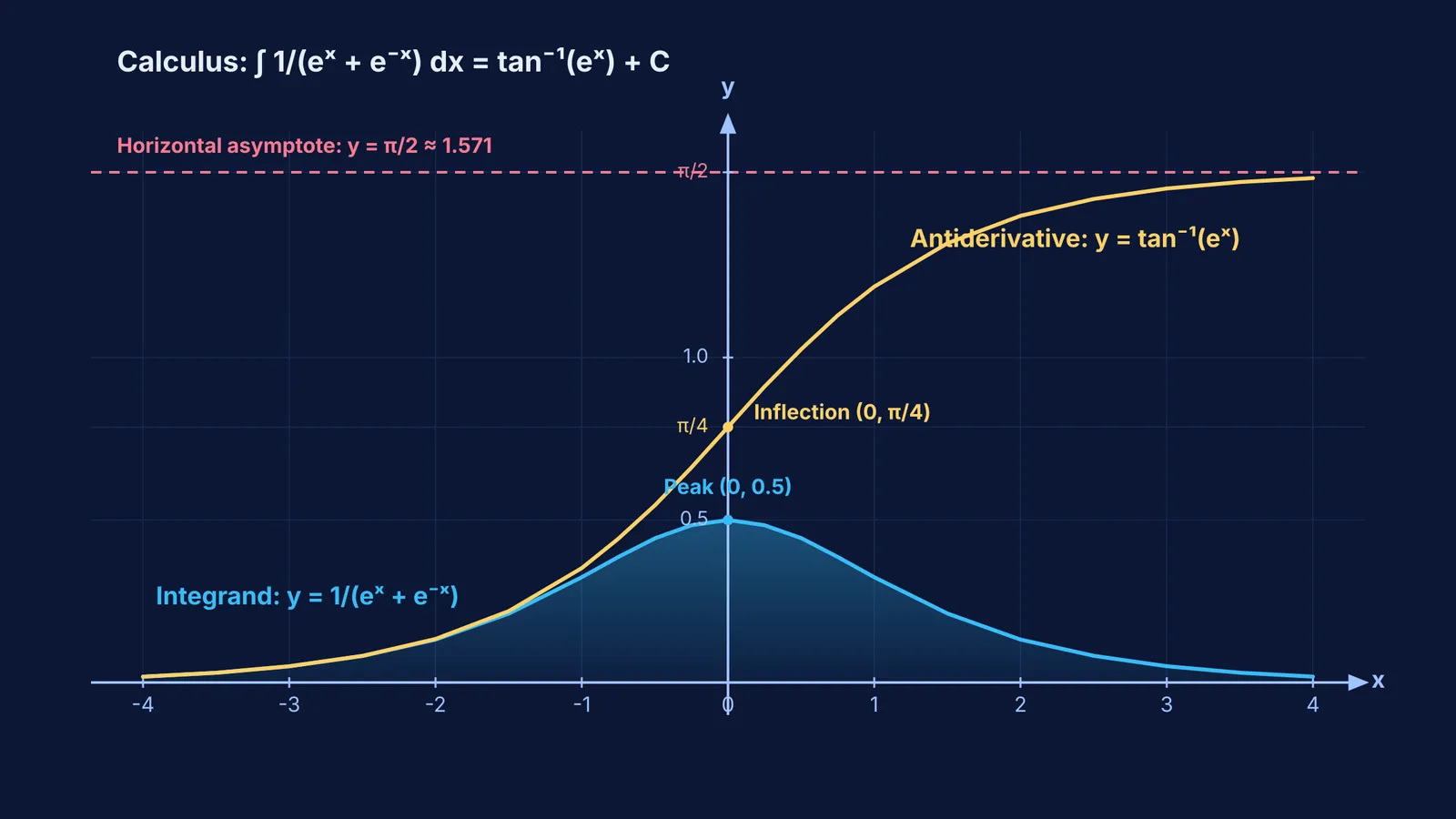
Replacing u with eˣ gives the final result: ∫ 1 / (eˣ + e⁻ˣ) dx = tan⁻¹(eˣ) + C
Multiplying by e⁻ˣ instead yields e⁻ˣ / (1 + e⁻²ˣ). Setting v = e⁻ˣ gives −tan⁻¹(e⁻ˣ) + C₁. Because tan⁻¹(eˣ) + tan⁻¹(e⁻ˣ) = π/2 for all positive real values, both answers are mathematically equivalent up to a constant.
For a definite integral, evaluating from x = 0 to x = ln(√3) changes the bounds to u = 1 and u = √3: [tan⁻¹(u)] from 1 to √3 = tan⁻¹(√3) − tan⁻¹(1) = π/3 − π/4 = π/12.
How do you integrate 1/(1 + eˣ) using the same algebraic logic?
The same multiplying strategy resolves another classic integral: ∫ dx / (1 + eˣ).
Two concise methods solve this expression:
Method 1 (Multiply by e⁻ˣ):
Multiply numerator and denominator by e⁻ˣ to obtain e⁻ˣ / (e⁻ˣ + 1). Setting u = 1 + e⁻ˣ gives du = −e⁻ˣ dx. The integral becomes ∫ −du / u = −ln|u| + C = −ln(1 + e⁻ˣ) + C.
Method 2 (Add and subtract eˣ):
Write 1 / (1 + eˣ) = (1 + eˣ − eˣ) / (1 + eˣ) = 1 − eˣ / (1 + eˣ). Integrating directly yields x − ln(1 + eˣ) + C.
Both answers match because −ln(1 + e⁻ˣ) = −ln((eˣ + 1)/eˣ) = x − ln(1 + eˣ).
In the official NCERT Mathematics Part II textbook, Chapter 7 pairs these algebraic transformations with problems like Exercise 7.2 Question 19 and Miscellaneous Exercise Question 41. Mastering these setups connects directly to integration by substitution, integrals with quadratic denominators, and integration by partial fractions.
What common algebraic mistakes do students make with exponential integrals?
In a 2009 study on undergraduate calculus students in the *International Journal of Mathematical Education in Science and Technology* (DOI: 10.1080/00207390802213591), Nevin Mahir found that learners who rely on rote formula matching without understanding underlying algebraic structure experience frequent errors when problem setups vary.
To evaluate exponential integrals reliably:
Eliminate negative exponents: when denominators contain mixed powers like eˣ and e⁻ˣ, multiply by eˣ to build a solvable quadratic in eˣ.
Look for logarithmic forms: for 1/(1 + eˣ), multiplying by e⁻ˣ immediately sets up f′(x)/f(x).
Differentiate to verify: check that d/dx [tan⁻¹(eˣ)] = eˣ / (1 + e²ˣ) = 1 / (eˣ + e⁻ˣ).
When tricky algebraic setups obscure the right path, the Fermi Problem Library has worked problems with a step-by-step solver that explains the reasoning rather than printing an answer. If you want to review foundational concepts, the Fermi Concept Library covers every concept in mathematics, each with its own lesson and its place in the map. When you are unsure how to begin an algebraic restructuring, Fermi's AI tutor notices where a student is stuck and decides whether to explain, ask, or show the next step.


