On this page
Two prefixes do most of the work here. Eury- means wide and steno- means narrow; *-thermal* is temperature and *-haline* is salt. Get the prefixes right and the four terms sort themselves.
One thing to know first: the current NCERT Class 12 chapter Organisms and Populations (2026-27 reprint) opens directly with populations and no longer has the older section where these terms appeared. You will still meet them in older papers and reference books, so check your exam's current syllabus before deciding how much time to give them.
What is the difference between eurythermal and stenothermal organisms?
A eurythermal organism can tolerate a wide range of temperatures, while a stenothermal organism can tolerate only a narrow range, as the older NCERT text is summarised in these Class 12 ecology notes.
The old NCERT section made the point with three familiar examples: mango trees cannot grow in temperate countries such as Canada and Germany, snow leopards are not found in Kerala forests, and tuna are rare beyond tropical latitudes in the ocean (same notes). The lesson is that a species' temperature tolerance largely decides where on the map it can live.
Real numbers make the contrast sharper:
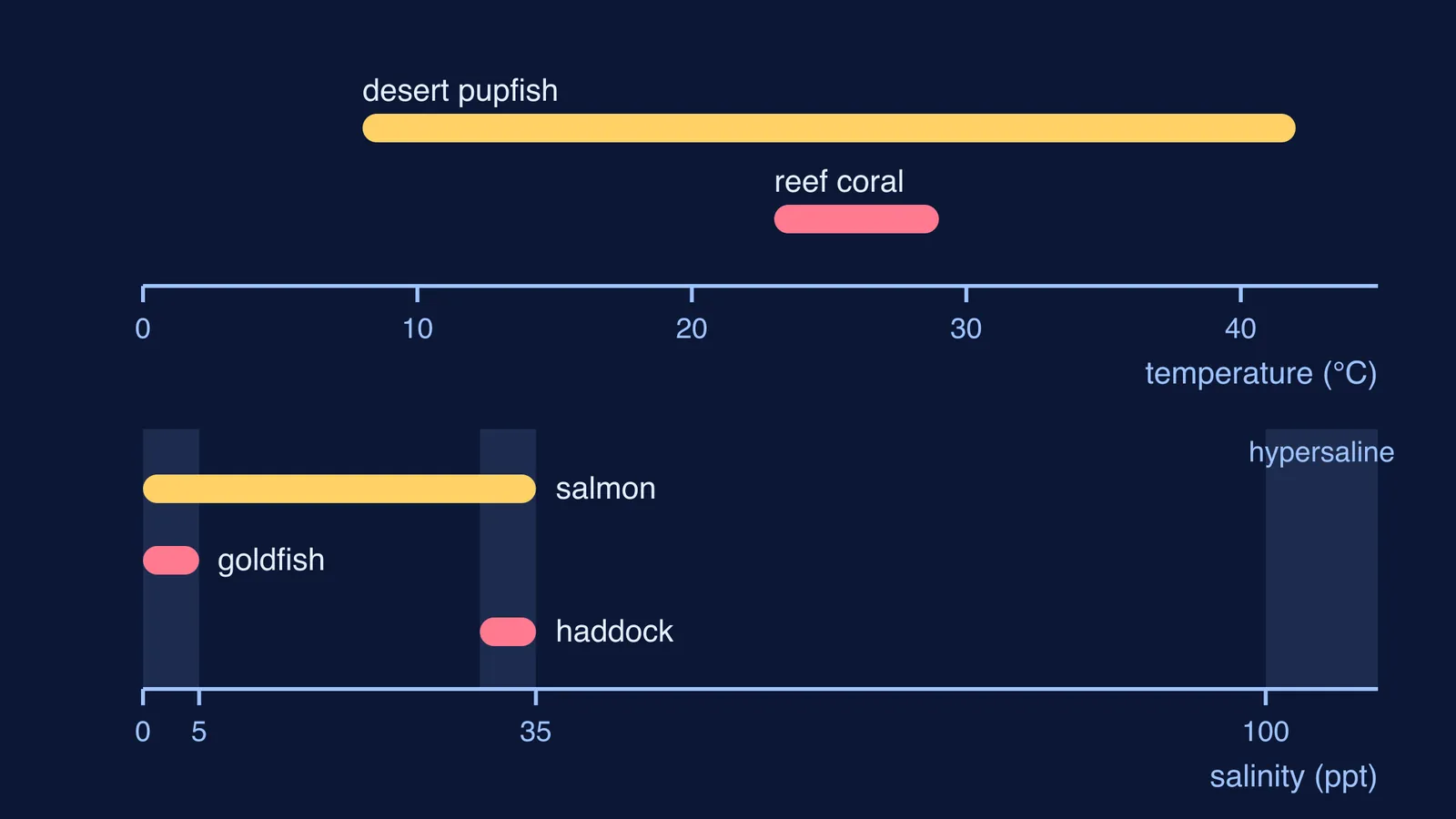
The desert pupfish can function in water from 8 °C to 42 °C, according to the encyclopaedia entry on eurytherms, so it is eurythermal.
Many reef-building corals grow best in water between 23 °C and 29 °C, though some can tolerate up to 40 °C for short periods, says NOAA's coral tutorial. Most coral species are considered stenothermal (same encyclopaedia entry). When water gets too warm, corals expel their algae and turn white (NOAA Ocean Service).
What do euryhaline and stenohaline mean?
Swap temperature for salt and the logic is identical. Euryhaline organisms tolerate a wide range of salinities; stenohaline organisms tolerate only a narrow range (older NCERT text, as summarised).
Salinity is measured in parts per thousand (ppt). The older NCERT text gives it as below 5 ppt in inland waters, 30 to 35 ppt in the sea and above 100 ppt in some hypersaline lagoons (same notes). Seawater averages about 35 ppt, or roughly 35 grams of salt in each kilogram of water, according to the Woods Hole Oceanographic Institution.
Many freshwater animals cannot live long in seawater, and vice versa, because of osmotic problems; our explainer on osmoregulation in freshwater and marine fish shows why.
Chinook salmon hatch in freshwater streams, migrate to the ocean to feed and grow, then return to their home rivers to spawn (NOAA Fisheries). Living in both makes them euryhaline.
Goldfish are freshwater stenohaline fish and haddock are marine stenohaline fish, according to the encyclopaedia entry on stenohaline organisms.
Euryhaline fish are the exception: fewer than 10% of fish species are euryhaline in the habitats they occupy, according to a review by Eric Schultz and Stephen McCormick (USGS summary).
If that second pair feels shaky, read conformers vs regulators vs partial regulators before the quiz.
How do you write the difference in an exam answer?
Use the same four points for both pairs, in this order:
Meaning of the prefix: eury- means wide, steno- means narrow.
The factor: temperature for -thermal, salinity for -haline.
What it means for distribution: eury- species can live across more habitats; steno- species are confined to fewer.
One example each, with a reason: a named organism plus its range earns more than a bare name.
Our guide to difference questions in CBSE biology shows how to turn these points into a two-column answer.
Quick quiz: can you sort these organisms?
Label each one eurythermal, stenothermal, euryhaline or stenohaline. Cover the answers before you start.
Chinook salmon
Reef-building coral
Goldfish
Desert pupfish
Haddock
Mango tree
Answers, with the one-line reason you would write in an exam:
Chinook salmon: euryhaline. It moves between rivers and the sea (NOAA Fisheries).
Reef-building coral: stenothermal. Many grow best between 23 °C and 29 °C and bleach when water is too warm (NOAA).
Goldfish: stenohaline. A freshwater fish that cannot cope with seawater.
Desert pupfish: eurythermal. It functions from 8 °C to 42 °C (source).
Haddock: stenohaline. A sea fish that cannot cope with low salinity.
Mango tree: stenothermal. The older NCERT example of a plant whose temperature tolerance keeps it out of temperate countries.
The usual trap is answering about the wrong factor. Salmon and haddock are sorted by salt, coral and pupfish by temperature, so read which ending the question uses before you pick a prefix.
If you got two or more wrong, the gap is usually the prefixes, not the organisms. The Fermi Concept Library has every concept in biology, each with its own lesson and its place in the map, so you can fill that gap before your next test.