

On this page
Ethanol has two carbons. Acetone, whose IUPAC name is propanone, has three. You get from one to the other in three steps: oxidise ethanol to ethanoic acid, turn the acid into calcium acetate, then heat the dry salt so it breaks down into acetone and calcium carbonate. It is a neat conversion to learn because the extra carbon comes from a second acetate ion, not from a new reagent you have to memorise.
How do you convert ethanol to acetone, step by step?
Oxidise ethanol to ethanoic acid. Heat ethanol with alkaline KMnO₄ or acidified K₂Cr₂O₇: CH₃CH₂OH → CH₃COOH. The NCERT Class 10 Science textbook, Chapter 4 gives exactly these two reagents and calls them oxidising agents because they add oxygen to the starting material.
Make calcium acetate. Neutralise the acid with calcium carbonate or slaked lime: 2CH₃COOH + CaCO₃ → (CH₃COO)₂Ca + H₂O + CO₂, as listed on the calcium acetate reference page. Evaporate the water to get the dry salt.
Dry-distil the salt. Heat solid calcium acetate strongly: (CH₃COO)₂Ca → CH₃COCH₃ + CaCO₃. Acetone boils at about 56 °C (acetone), so it leaves as vapour and condenses in the receiver while calcium carbonate stays behind.
In an answer sheet, write it as one chain: ethanol → (K₂Cr₂O₇/H⁺, heat) ethanoic acid → (CaCO₃) calcium acetate → (dry distillation) propanone.
Why does heating calcium acetate give acetone?
The reaction is called ketonic decarboxylation: two molecules of a carboxylic acid, here as their calcium salt, become one symmetric ketone plus carbon dioxide (ketonic decarboxylation). Two acetate ions bring four carbons. One carboxyl carbon leaves as carbonate, held by the calcium. The other three become acetone: two methyl groups on one C=O.
The same page notes that Charles Friedel reported the dry distillation of calcium acetate to acetone in 1858, and that ketonization was the main commercial route to acetone until World War I. Today about 83% of acetone comes from the cumene process instead, where it forms alongside phenol (acetone).
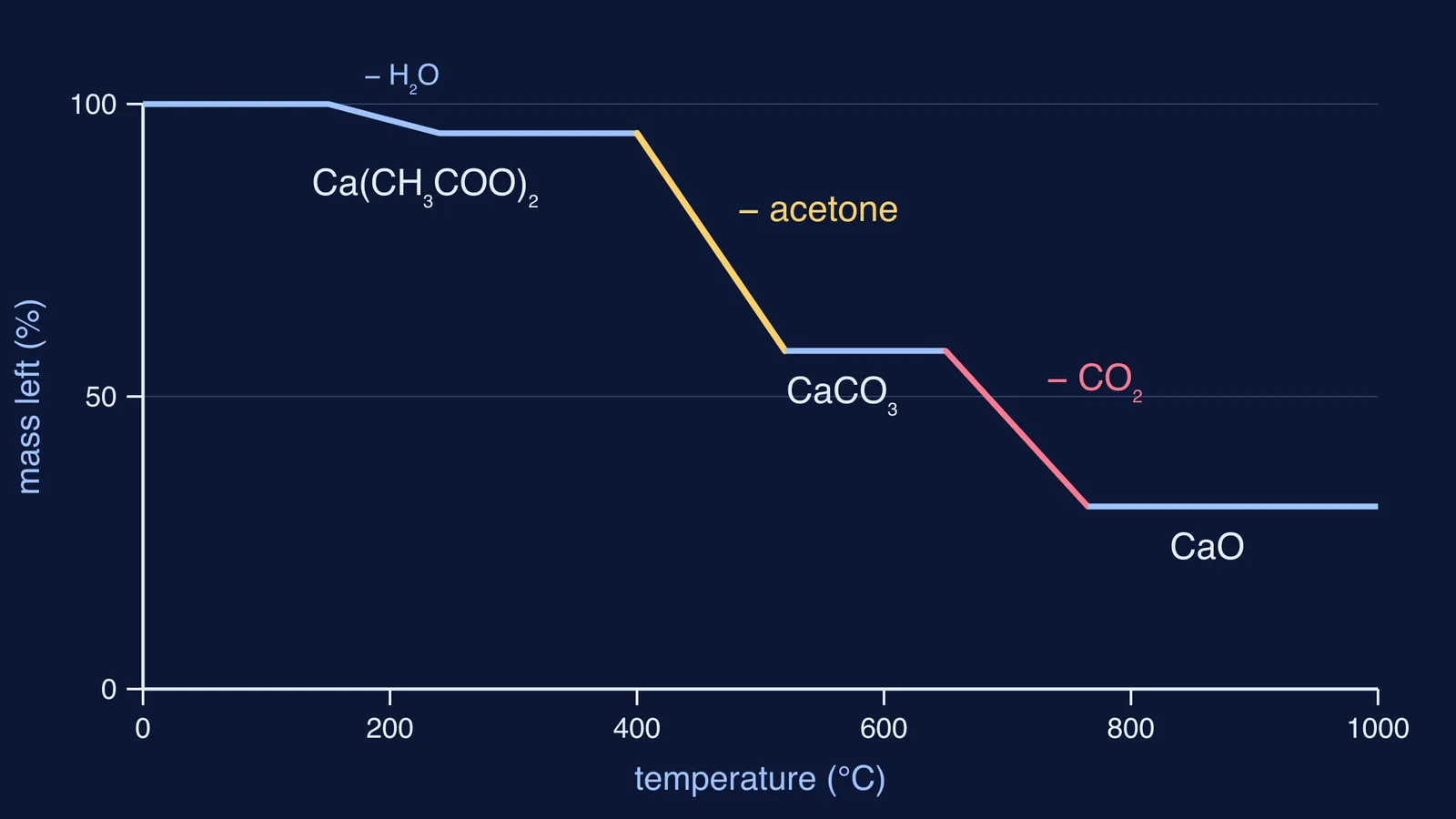
How hot is "strongly"? In a 2012 study at the University of Leeds, M. Bilton, A. P. Brown and S. J. Milne heated calcium acetate hydrate at 20 °C per minute while weighing it (Bilton et al., 2012). It lost water at about 150–240 °C, then lost 37.2% of its mass between about 400 and 520 °C, the step that, citing earlier work, they attribute to the salt breaking down into acetone and calcium carbonate. The carbonate only turned into calcium oxide at about 650–765 °C.
How much acetone do you get from ethanol?
Use rounded atomic masses (C = 12, H = 1, O = 16, Ca = 40) and start with 46 g of ethanol, which is 1 mol.
Oxidation is 1:1, so at best you get 1 mol of ethanoic acid, 60 g.
Two acids make one salt, so 1 mol of acid gives 0.5 mol of calcium acetate, 79 g (molar mass 158 g/mol).
One salt gives one acetone, so you get 0.5 mol of acetone, 29 g (molar mass 58 g/mol).
The ratio to remember is one acetone for every two ethanols, and real yields are lower at each step. Step 3 also tells you that acetone makes up 58 ÷ 158, about 37%, of the mass of dry calcium acetate, which is the most you could ever collect from it.
Which mistakes cost marks on this conversion?
Stopping at ethanal. With excess alcohol and the product distilled off as it forms, dichromate gives ethanal; to reach the acid you heat under reflux with excess oxidising agent (LibreTexts, oxidation of alcohols).
Dropping the 2. The salt holds two acetate ions, so the balanced equation needs two moles of acid per mole of salt.
Using the sodium salt. Sodium acetate decarboxylates to methane (sodium acetate), which removes a carbon instead of adding one.
Losing the carbon count. Before writing any reagent, write the carbon numbers: 2 → 2 → 2 + 2 → 3. If your chain does not add up, a step is wrong.
If you can write the steps but not explain why the carbons rearrange, look up decarboxylation and the oxidation of alcohols in the Fermi Concept Library, where every concept in chemistry has its own lesson and its place in the map. For practice, the Fermi Problem Library has worked problems with a step-by-step solver that explains the reasoning rather than printing an answer.
Where does this conversion fit with others?
This is one of several ways to add a carbon; compare it with three routes for stepping up ethanol to propanoic acid. For other ketone-making reactions, see methods of preparation of aldehydes and ketones in Class 12. And once you have acetone, the next common question runs it forward: how to convert propanone to propene in two steps.
Write the three-step chain once from memory today, carbon counts included, and you will have it for the exam.


