

On this page
Moving from a ketone (propanone, or acetone) to an alkene (propene) is a common sequence in organic chemistry exams. It requires changing the oxygen-containing functional group into a hydroxyl group before eliminating it entirely.
In short
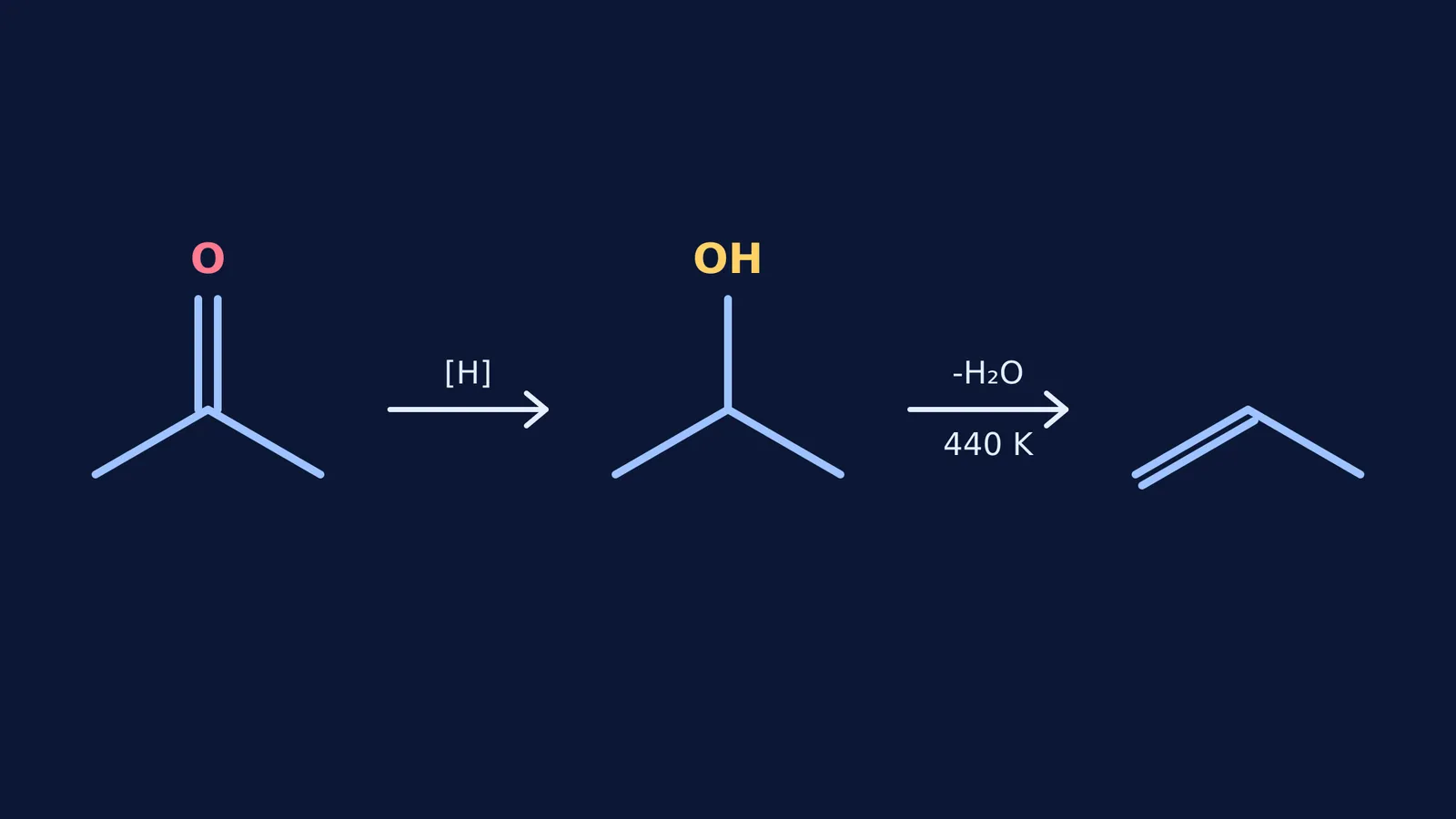
To convert propanone to propene, you first reduce the ketone to a secondary alcohol, propan-2-ol, using sodium borohydride (NaBH4). You then dehydrate the propan-2-ol by heating it with 85% phosphoric acid at 440 K to form the carbon-carbon double bond in propene.
This is a classic two-step process: reduction followed by dehydration. Because these reactions are foundational to organic synthesis, understanding why we choose specific reagents and temperatures is just as important as memorising the sequence. We will walk through the conditions and mechanisms for each step.
How do you reduce propanone to propan-2-ol?
The first step in the pathway is a reduction reaction. Propanone is a ketone, and ketones reduce to secondary alcohols.
By adding a reducing agent such as sodium borohydride (NaBH4) or lithium aluminium hydride (LiAlH4), the carbon-oxygen double bond is broken. The nucleophilic hydride ion (H-) attacks the electrophilic carbonyl carbon, pushing the electrons onto the oxygen atom to form an alkoxide intermediate. A proton is then added from water or an acid to yield propan-2-ol (isopropyl alcohol).
Alternatively, you can use hydrogen gas over a finely divided nickel, platinum or palladium catalyst (H2/Ni). This catalytic hydrogenation adds hydrogen atoms across the double bond.
Sodium borohydride is often preferred in textbook sequences and real-world laboratories. It is a mild, selective reagent that safely reduces aldehydes and ketones without affecting carboxylic acids, esters, or isolated carbon-carbon double bonds. LiAlH4, while powerful, reacts violently with water and must be handled in strictly anhydrous conditions. If moisture is present, LiAlH4 will immediately react to release highly flammable hydrogen gas. Therefore, NaBH4 is much safer to use in a standard undergraduate or high school chemistry lab, as it can be dissolved in aqueous ethanol or methanol without posing an explosion risk.
How do you dehydrate propan-2-ol to propene?
Once you have produced propan-2-ol, the next step is an elimination reaction to create the alkene. This requires removing a water molecule from the adjacent carbon atoms.
To dehydrate the alcohol, you heat it with an acid catalyst like 85% phosphoric acid (H3PO4) at a high temperature, typically around 440 K. First, it protonates the hydroxyl group (-OH) to turn it into a good leaving group (-OH2+). Why do we use 85% phosphoric acid instead of the concentrated sulphuric acid commonly used for ethanol? Secondary alcohols like propan-2-ol are easier to dehydrate than primary alcohols. The secondary carbocation that forms is stabilised by the inductive effect and hyperconjugation from two adjacent methyl groups. Because it is more stable, it forms faster and under milder conditions. If you were to use concentrated sulphuric acid at extremely high temperatures, you could end up with unwanted side reactions, including polymerisation or oxidation of the carbon skeleton.
As the water molecule leaves, it forms a secondary carbocation on the central carbon atom. This step is the slowest part of the reaction, making it the rate-determining step. Finally, a proton is removed from one of the adjacent methyl groups, and the carbon-carbon bond collapses to form the double bond of propene.
If you are working with longer, unsymmetrical carbon chains, this elimination step can yield multiple alkene products. In such cases, the reaction follows Zaitsev's rule, favouring the more substituted alkene. You can learn more about how carbocations dictate the final product in our explainer on Dehydration of alcohols: the carbocation route and major alkene.
How do you plan organic conversions?
When you are asked to convert one functional group to another, working backwards from the product is often the most effective strategy. If your target is an alkene like propene, you know that dehydrating an alcohol is a reliable and standard way to get there. If your starting material is a ketone, you know that reducing it will give you that necessary alcohol.
If you struggle to remember which reagents do what, mapping out these chemical connections helps build a mental web. For more practice with multi-step pathways, read our guide to Organic conversions: a roadmap from one compound to another.
Instead of memorising isolated reactions, seeing the bigger picture makes predicting products much easier. The Fermi Concept Library holds every concept in physics, chemistry, biology, mathematics and computing, each with its own lesson and its place in the map, so you can see exactly why a reaction happens.
What is a worked example for your exams?
When writing this conversion out in an exam, present it as a clear sequence. Write the structural formulas, and place all reagents and conditions clearly over the reaction arrows. Examiners look for both the correct intermediate and the specific reaction conditions. If you forget to state the temperature or the concentration of the acid, you may lose marks.
CH3-CO-CH3 + [H] → CH3-CH(OH)-CH3
*Reagent:* NaBH4 in aqueous ethanol.
CH3-CH(OH)-CH3 → CH3-CH=CH2 + H2O
*Reagent:* 85% H3PO4, heated to 440 K.
By explicitly noting the temperature, you demonstrate to the examiner that you understand the conditions required to favour an elimination reaction over a substitution reaction. Whether you are preparing for JEE, NEET or board exams, mastering these two-step bridges is the key to solving longer organic synthesis puzzles. When you understand the underlying mechanism behind the reagents, the steps snap into place automatically without the need for rote memorisation.


