On this page
Ask why a standing wave carries no energy and you often hear that it has no energy at all (wrong) or that the nodes block it (half right). Three lines of algebra give the full answer, and show where the energy goes.
What is a standing wave, in one line?
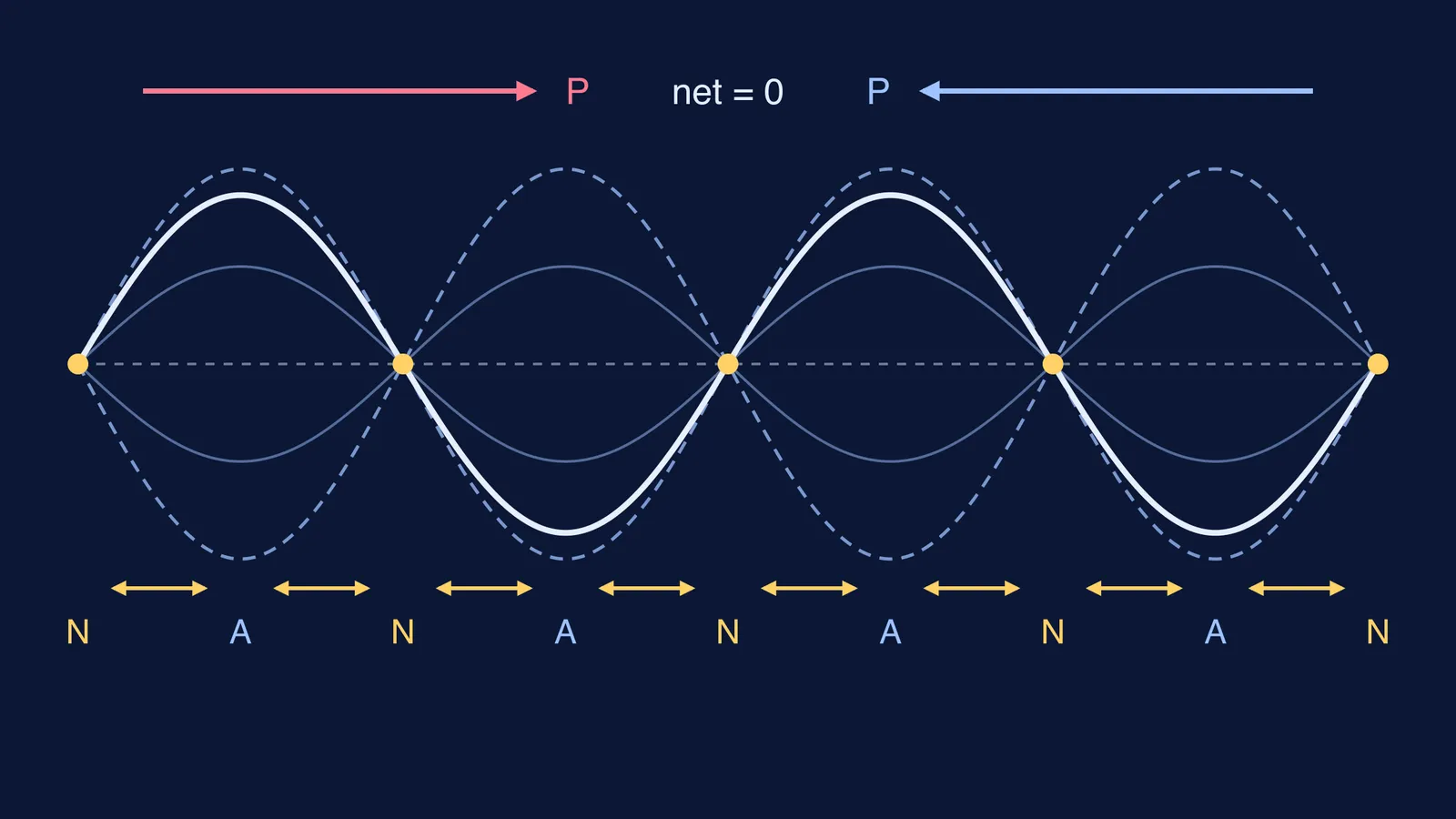
A standing wave is the result of two waves of the same frequency and amplitude travelling in opposite directions, as LibreTexts' introductory physics text/14:_Waves/14.07:_Standing_waves) defines it. Add y = A sin(kx − ωt) and y = A sin(kx + ωt) and you get y = 2A sin(kx) cos(ωt), the form given in OpenStax University Physics. Nodes, where sin(kx) = 0, sit at x = 0, λ/2, λ and so on, and never move. New to that step? Read how two travelling waves add up to the standing wave equation.
Why does a standing wave not transfer energy?
Start with one travelling wave on a string. Its average power is P = ½μA²ω²v, where μ is mass per unit length, according to OpenStax's section on wave energy and power. That power depends on μ, A, ω and v, not on direction. A standing wave is two such waves with identical values, so one carries P to the right and the other the same P to the left. Net power: P − P = 0.
Richard Fitzpatrick's Oscillations and Waves notes at the University of Texas at Austin show that the mean energy flux of the combination is the right-going flux minus the left-going flux. They conclude: "a standing wave has zero associated net energy flux." LibreTexts/14:_Waves/14.07:_Standing_waves) says the same thing more plainly: no energy is transmitted by a standing wave, for example through the nodes.
Where does the energy go if it does not travel?
The same Fitzpatrick page gives the energy densities on a string: kinetic ½μ(∂y/∂t)², potential ½T(∂y/∂x)², and the energy flux I = −T(∂y/∂t)(∂y/∂x). (Fitzpatrick writes ρ for the mass per unit length.) Put y = 2A sin(kx) cos(ωt) into them and use T k² = μω² (because v² = T/μ and ω = vk):
Kinetic energy density: 2μA²ω² sin²(kx) sin²(ωt), largest at antinodes.
Potential energy density: 2μA²ω² cos²(kx) cos²(ωt), largest at nodes, where the string's slope is steepest.
Energy flux: I = 2P sin(2kx) sin(2ωt).
At full stretch (ωt = 0), all the energy is potential and piled up near the nodes. A quarter period later the string is flat, and all the energy is kinetic, at the antinodes. In between, energy flows from node to antinode and back.
The flux line explains why it never escapes. sin(2kx) is zero at every node and every antinode, at every instant, so no energy ever crosses those points. Each quarter-wavelength strip between a node and its neighbouring antinode is a sealed box. Energy sloshes inside it at twice the wave's frequency and averages to zero flow.
Worked example: how much energy sloshes on a real string?
Take a string with μ = 0.01 kg/m under tension T = 100 N, driven at f = 100 Hz, with each travelling wave of amplitude A = 2 mm. The power and energy formulas are the ones in OpenStax's wave energy section.
Wave speed v = √(T/μ) = 100 m/s, so λ = v/f = 1 m.
Angular frequency ω = 2πf ≈ 628 rad/s.
Power of each travelling wave: P = ½ × 0.01 × (0.002)² × 628² × 100 ≈ 0.79 W.
Net power along the string: 0.79 W − 0.79 W = 0.
Largest local flux, at λ/8 = 12.5 cm from a node: 2P ≈ 1.58 W, reversing direction as it oscillates at 200 Hz.
Energy stored in one 50 cm loop: ½μA²ω²λ ≈ 7.9 mJ, constant in time.
Step 5 is the surprising one: the local flow is twice either wave's power, yet averages to nothing.
What do exam questions on standing wave energy test?
Use this checklist on assertion-reason questions:
Energy in a standing wave is not zero. Net transfer is zero.
Nodes have zero kinetic energy always, but potential energy density there is at its largest when the string is at full stretch.
No energy crosses a node or an antinode at any instant.
If the reflected wave is weaker than the incoming one, the flows no longer cancel; the Wikipedia article on standing waves notes that in a lossless medium a finite standing-wave ratio means energy does get through.
For the side-by-side picture, see four differences between stationary and progressive waves.
How can you see the sloshing for yourself?
Try finding harmonics in a standing wave simulation and watch where the string moves fastest and where it bends most. The Fermi Simulation Lab has interactive simulations for ideas like this that are easier to see than read. If energy density or wave power still feels shaky, each idea has its own lesson in the Fermi Concept Library, so you can fix the gap before the next mock test.