On this page
Your NCERT Class 12 Biology textbook asks the question in one line and moves on: "Endosperm development precedes embryo development. *Why?*" Here is the answer, the coconut example and an exam-ready version.
What happens right after double fertilisation?
The pollen tube delivers two male gametes into the embryo sac. According to the NCERT Class 12 Biology chapter on sexual reproduction in flowering plants (Chapter 1 in the 2026-27 reprint), one male gamete fuses with the egg to form the diploid zygote, and the other fuses with the two polar nuclei in the central cell to form the triploid primary endosperm nucleus (PEN).
Because that second fusion joins three haploid nuclei, NCERT calls it triple fusion; together with syngamy it makes up double fertilisation, an event unique to flowering plants. The central cell becomes the primary endosperm cell and develops into the endosperm, while the zygote develops into the embryo. For the history, see how Sergei Nawaschin found the two sperm cells of the lily.
Why does endosperm develop before the embryo?
Because the endosperm is the embryo's food. NCERT says the cells of the endosperm are filled with reserve food materials and are used for the nutrition of the developing embryo (NCERT, section 1.4.1).
The key line is in section 1.4.2 of the same chapter: most zygotes divide only after a certain amount of endosperm is formed, and NCERT calls this an adaptation to provide assured nutrition to the developing embryo.
Plant research shows how much the embryo depends on a working endosperm. In a 2012 study in *Development*, Hehenberger, Kradolfer and Köhler found that in two *Arabidopsis* mutants (*fis2* and *ede1*) whose endosperm failed to turn cellular, embryo development was impaired. When the team restored endosperm cellularisation in *fis2* seeds, embryo development improved. The *fis2* seeds that failed to cellularise also had higher levels of hexose sugars, which the authors suggest means nutrients were not being moved to the embryo.
What is the difference between free-nuclear and cellular endosperm?
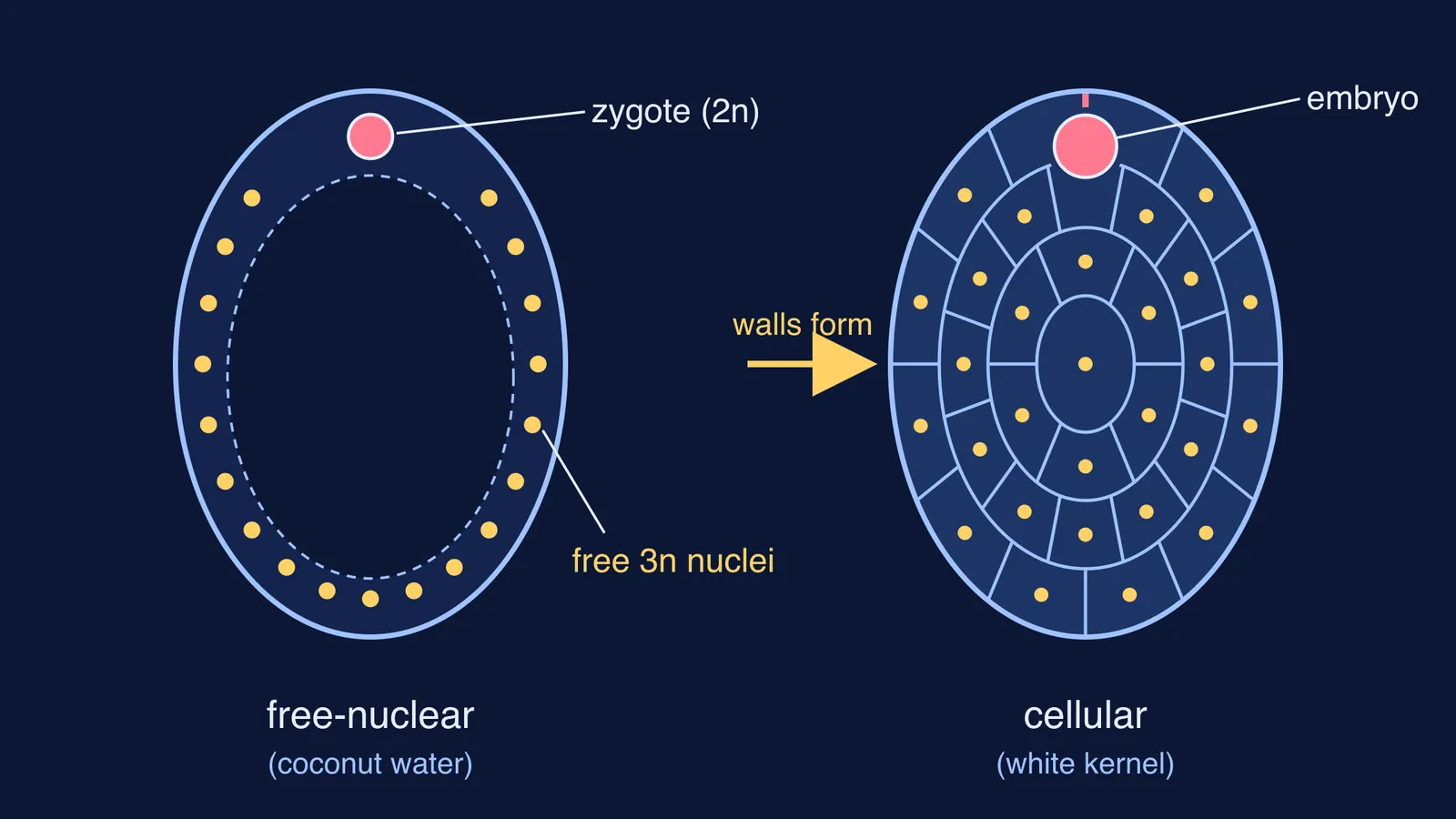
In NCERT's account of the most common type of endosperm development, these are two stages of one process, not two unrelated tissues (NCERT, section 1.4.1):
Free-nuclear stage: the PEN divides again and again without cell walls forming, so you get many free nuclei in one shared cytoplasm.
Cellular stage: cell walls then form and the endosperm becomes cellular. The number of free nuclei formed before this varies greatly.
Ploidy: both stages come from the PEN, so the nuclei are triploid (3n) throughout.
The coconut shows both stages in one fruit. NCERT says the water of a tender coconut is free-nuclear endosperm made up of thousands of nuclei, and the surrounding white kernel is cellular endosperm. A 2009 review in *Molecules* by Yong and colleagues also describes coconut water as coconut liquid endosperm, containing sugars, vitamins, minerals, amino acids and plant hormones. For more on the tender-coconut example, read why tender coconut water is free-nuclear endosperm.
Is the endosperm still there in the mature seed?
It depends on the plant. NCERT gives two outcomes (NCERT, sections 1.4.1 and 1.4.3):
Used up before the seed matures: pea, groundnut and beans. These are non-albuminous seeds, and their food is stored in the cotyledons instead.
Still there in the mature seed: castor and coconut, along with the albuminous seeds of wheat, maize and barley. The endosperm is then used up when the seed germinates.
To see how this compares with seeds that have no fruit around them, read gymnosperms vs angiosperms: naked seeds, fruits and endosperm.
How do you write this answer in an exam?
Here is a three-point answer for a 3-mark question, "Why does endosperm develop before the embryo?":
After double fertilisation, the triploid PEN divides to form the endosperm, a tissue whose cells store reserve food.
This food is used to nourish the developing embryo.
Most zygotes divide only after a certain amount of endosperm has formed, an adaptation that gives the embryo assured nutrition.
Add the coconut if the question asks for an example. Before the exam, check yourself on these common slips:
Is the endosperm 3n and the zygote 2n, not the other way round?
Does the endosperm come from the central cell after triple fusion, not from the zygote?
Is coconut water the free-nuclear stage and the kernel the cellular stage, not the other way round?
Do pea and groundnut lack endosperm only in the mature seed, not during development?
If terms like PEN, triple fusion and albuminous still feel tangled, the Fermi Concept Library gives each concept in biology its own lesson and shows where it fits in the map. When you are ready to practise, the Fermi Problem Library has worked problems with a step-by-step solver that explains the reasoning rather than printing an answer.
Next time you drink tender coconut water, you will know you are drinking the free-nuclear stage of a seed's food supply.