On this page
Emerging modes of business is the short chapter in Class 11 Business Studies about doing business over computer networks. "Distinguish" questions need careful pairs. Here is what CBSE asks for in 2026-27, the scope of e-business, a point-by-point comparison and a 3-mark answer plan.
What does Emerging Modes of Business cover in Class 11 for 2026-27?
The CBSE Business Studies curriculum for 2026-27 keeps it as Unit 5 of Part A, Foundations of Business. Units 5 and 6 (social responsibility and business ethics) share 10 of the 80 theory marks in that curriculum. The listed content for Unit 5 is narrow: the concept, scope and benefits of e-business, and how it differs from traditional business.
The NCERT chapter, reprinted for 2026-27, still explains online transactions, payment methods, security risks and the resources a firm needs for e-business. It no longer has a section on business process outsourcing (BPO), though outsourcing still appears in its objectives, introduction, summary, key terms and two exercises.
What is e-business, and how is it different from e-commerce?
In the NCERT chapter, e-business means carrying out industry, trade and commerce through computer networks such as the internet or a firm's own private network. E-commerce is the narrower idea: a firm's dealings with its customers and suppliers over the internet. E-business includes e-commerce and also internal work done electronically, such as production, inventory, product development, accounting, finance and HR.
A simple test: buying a phone case online is e-commerce. The seller's warehouse software telling the factory to make more is e-business, but not e-commerce.
What is the scope of e-business?
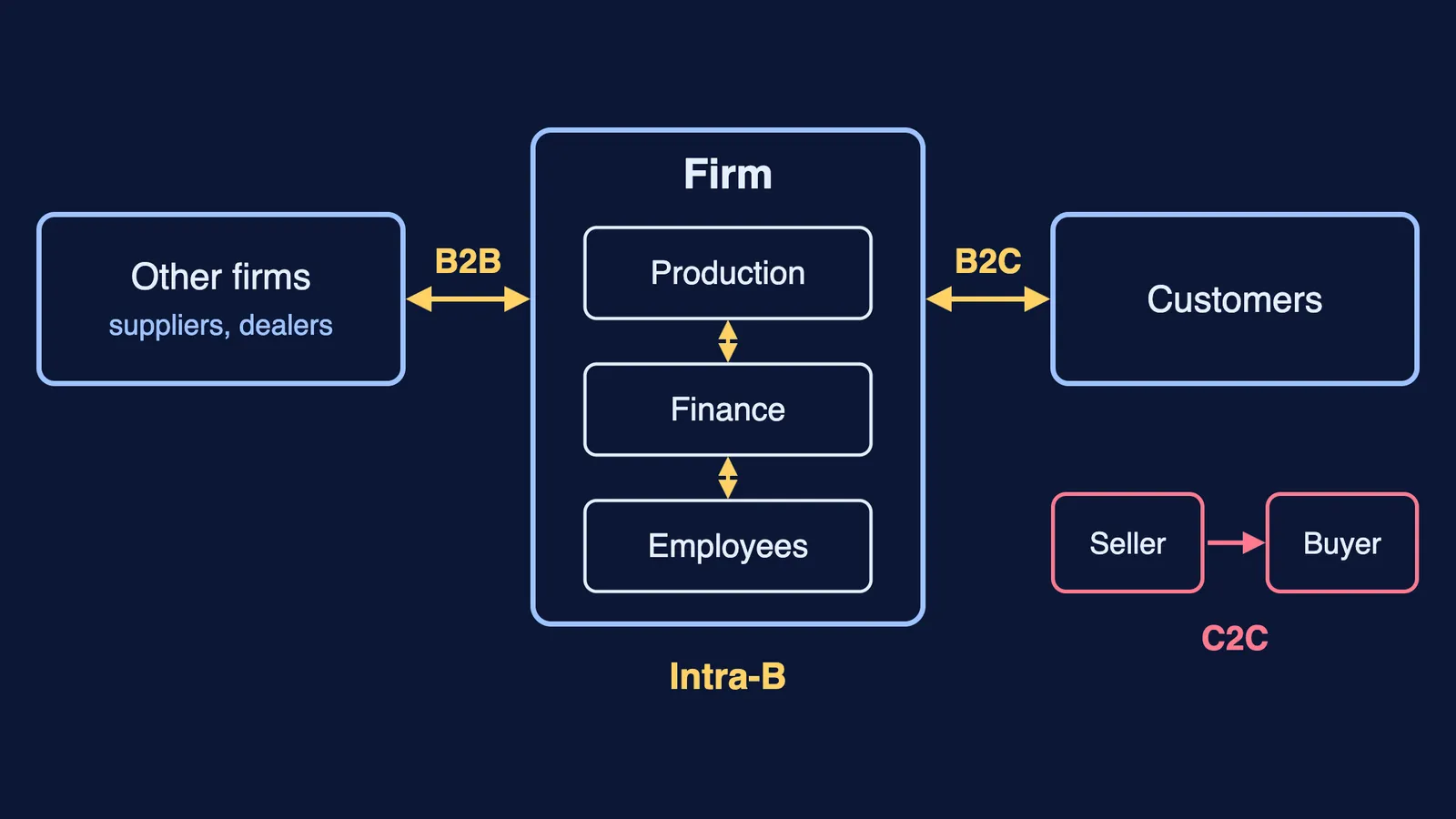
Scope can be described by function (almost every function can run on a network) or by who is transacting. The chapter details the second, shown in the diagram above.
B2B: firm to firm. A car maker orders components from several vendors, tracks deliveries and pays them over a network.
B2C: firm to customer. Not just selling, but promotion, surveys and after-sales support. C2B is the reverse flow, from customers to the firm.
Intra-B: inside one firm. Departments share information over an intranet, which makes customised production possible. Dealings with employees (training, recruitment, field reports) are sometimes called B2E.
C2C: consumer to consumer, such as reselling used books or clothes on a platform where buyers and sellers rate each other.
How is e-business different from traditional business?
The NCERT chapter compares them on many bases. These are the ones worth memorising, each written as a pair:
Ease of formation: a traditional business is harder to set up; an e-business is simpler.
Physical presence and location: a traditional business needs premises near raw materials or buyers; an e-business needs neither.
Setting-up and operating cost: high for a traditional business because it owns facilities; lower for an e-business, which relies on a network of relationships.
Contact with suppliers and customers: indirect, through intermediaries, versus direct.
Business process cycle: steps follow one another in traditional business; in e-business they run at the same time, so the cycle is shorter.
Personal touch and physical sampling: more in traditional business; less in e-business, though digital goods such as music or e-books can be sampled online.
Transaction risk: low when parties meet face to face; higher online because parties are distant and can stay anonymous.
Benefits follow from this: easy start, round-the-clock convenience, speed, global reach and less paperwork. So do limitations: low personal touch, delivery slower than ordering, the need for digital skills, fraud and hacking risk, staff resistance and ethical worries such as employers monitoring email.
How does an online transaction work?
The chapter splits an online purchase into three stages: before the sale (advertising and searching), the sale itself (price negotiation, closing the deal and payment), and delivery. A shopper registers, fills a cart, checks out and picks a payment method. The book lists cash on delivery, cheque, net-banking transfers, cards and digital cash. Today you may also pay by UPI, which NPCI runs: an instant payment system for transfers between bank accounts.
The textbook names three transaction risks, and they make a neat 3-mark answer: the order is denied by one side, the delivery fails or goes wrong, or payment is disputed.
How should you revise this chapter?
Draw the scope diagram from memory and add one example for each arrow.
Write five comparison pairs in under five minutes.
List four benefits and four limitations without looking.
Explain in two sentences why e-business is wider than e-commerce.
For the basics this chapter builds on, revisit the nature and purpose of business and the four forms of business organisation. Looking ahead to Class 12, see how to check which management principle a case shows. If mathematics is also on your timetable, the Fermi Concept Library has a lesson for every maths concept.