On this page
Every organ in your body was built from three sheets of cells in the early embryo. Once you know which sheet makes what, questions from "which organ comes from mesoderm?" to "why is a jellyfish diploblastic?" become one idea, not a list to cram.
What are the three germ layers?
Germ layers appear during gastrulation. OpenStax Biology 2e explains that gastrulation does two things at once: it forms the primitive gut (the archenteron) and it forms the embryonic germ layers. In humans, the two-layered disc of cells becomes a three-layered disc through gastrulation as the third week of development begins, according to OpenStax Anatomy and Physiology 2e.
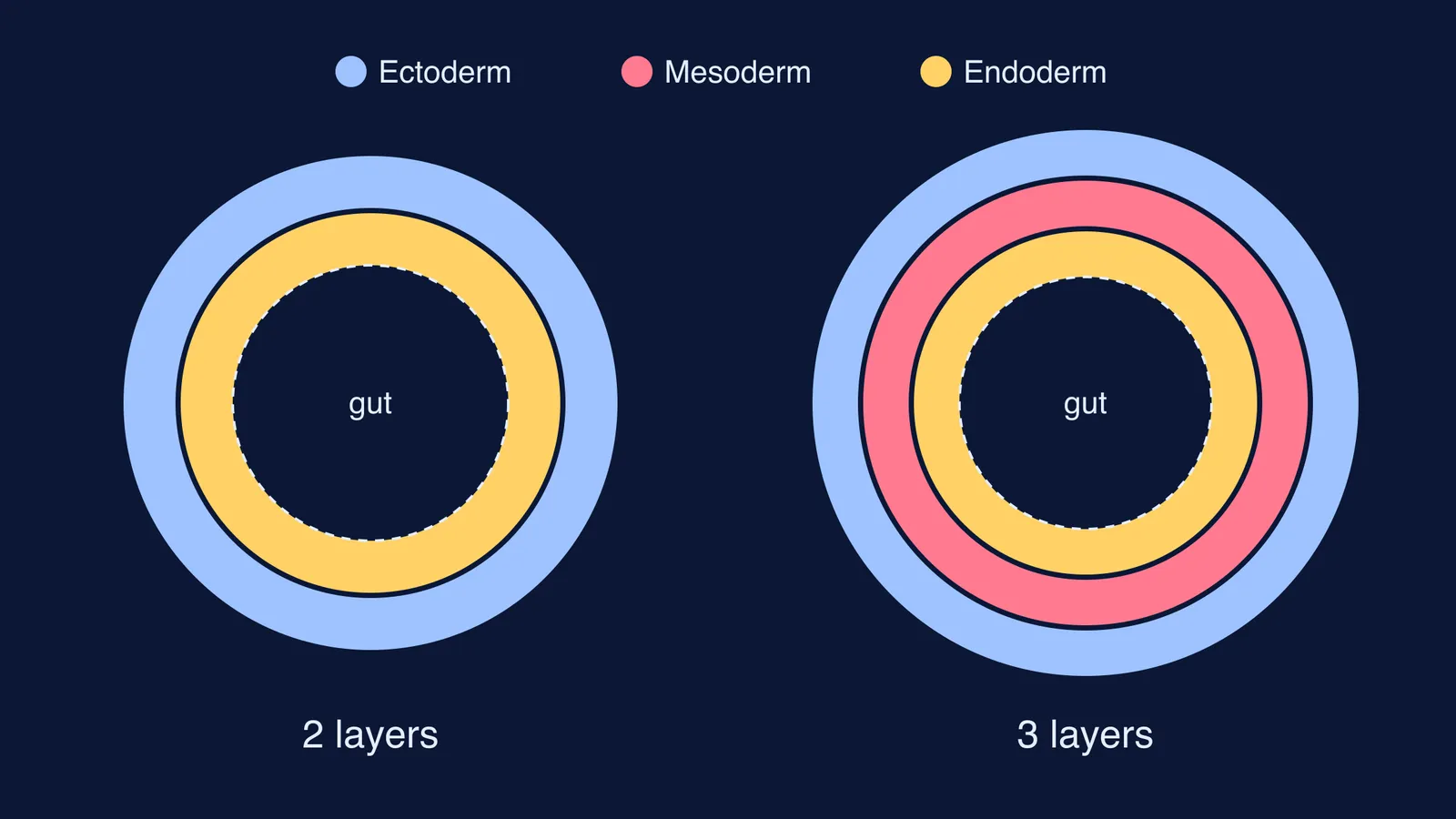
Ectoderm is the outer layer; it covers the surface of the animal.
Endoderm is the inner layer; it forms the wall of the digestive tract.
Mesoderm is the middle layer, which forms between ectoderm and endoderm in triploblastic animals.
A useful picture is a tube inside a tube: the outer tube is your epidermis and nervous system, the inner tube is the lining of your gut, and almost everything packed between them is mesoderm. If you want to place this stage in time, our explainer on the difference between a zygote, an embryo and a foetus sets out the sequence.
What organs does the ectoderm form?
The ectoderm gives rise to the central and peripheral nervous systems, the sensory organs, the epidermis, hair and nails, according to OpenStax Anatomy and Physiology 2e.
The nervous system is the one that surprises students. It starts on the surface: during the fourth week, the edges of the neural plate fold upward and meet to form the neural tube, the same source explains. So your brain and spinal cord are ectoderm, even though they end up deep inside the body.
What organs does the mesoderm form?
Mesoderm becomes the skeleton, muscles, connective tissue, heart, blood vessels and kidneys, as OpenStax Anatomy and Physiology 2e lists them. The same chapter notes that blocks of mesoderm called somites become the axial skeleton, skeletal muscle and dermis.
OpenStax Biology 2e adds that mesoderm gives rise to all specialised muscle tissue, including cardiac muscle and the muscles of the intestines, to connective tissues such as the skeleton and blood cells, and to most other visceral organs.
What organs does the endoderm form?
The endoderm gives rise to the lining of the digestive tract (including the stomach, intestines, liver and pancreas) and to the lining of the trachea, bronchi and lungs, according to OpenStax Biology 2e.
Notice the word "lining". The endoderm makes the inner surface of the gut and airways, not the whole tube.
Worked example: can you sort these ten structures?
Use three questions, in this order:
Is it nervous tissue, a sense organ, or the outer covering (epidermis, hair, nails)? Then it is ectoderm.
Is it the inner lining of the gut or airway, or the liver or pancreas? Then it is endoderm.
Is it muscle, bone, blood, heart, vessels, kidney or other connective tissue? Then it is mesoderm.
Now cover the answers and try these:
Spinal cord: ectoderm, because it forms from the neural tube.
Fingernail: ectoderm.
Lining of the bronchi: endoderm.
Pancreas: endoderm.
Thigh bone: mesoderm, part of the skeleton.
Heart: mesoderm.
Red blood cells: mesoderm, since blood cells count as connective tissue.
Kidney: mesoderm.
Muscle layer of the small intestine: mesoderm, not endoderm.
Dermis of the skin: mesoderm.
Items 9 and 10 are the two-layer traps from the box above. If you got one wrong, write down which of the three questions you skipped, not just the right answer.
Sort a fresh list of ten structures from your textbook without looking, then repeat after two days. If germ layers still feel like a list of facts, the Fermi Concept Library gives each biology concept its own lesson and its place in the map, so you can see where germ layers sit among related ideas. When you want to practise, the Fermi Problem Library has worked problems with a step-by-step solver that explains the reasoning rather than printing an answer.
How do germ layers split animals into diploblastic and triploblastic?
Diploblastic organisms have two germ layers, endoderm and ectoderm, while triploblastic animals form a third layer, mesoderm, between them, according to OpenStax Biology 2e. That section adds that mesoderm forms structures including the lining of the body cavity.
OpenStax's classification chapter places cnidarians, the group that includes jellyfish and sea anemones, among the radially symmetric diploblasts, and says more complex animals, usually those with bilateral symmetry, are triploblasts. Sponges sit outside both groups, because they have no true tissues.
Triploblasts with no coelom are acoelomates, such as flatworms; roundworms are pseudocoelomates; and annelids, molluscs, arthropods, echinoderms and chordates are coelomates, the same chapter explains. For the full comparison with examples, read our posts on diploblastic vs triploblastic animals and acoelomate, pseudocoelomate and coelomate examples.