On this page
An electric eel does not carry a battery. It carries thousands of living cells that each make a small fraction of a volt, wired so that their voltages add up. If you have met cells in series in physics and action potentials in biology, you already know both halves of the trick.
How does an electric eel produce electricity?
The voltage comes from electrocytes, the cells that make up the eel's electric organs. An electrocyte is a cell that evolved from muscle and is specialised to make voltage instead of movement. A University of Texas at Austin report on a 2014 genome study explains that all muscle cells have an electrical potential, and some fish amplified it "by evolving from muscle cells another type of cell called an electrocyte". Electric organs evolved six separate times in vertebrates, according to a 2012 paper in the Journal of Experimental Biology.
Each electrocyte has two faces that behave differently. Thomas Schroeder and colleagues describe the eel's cells in their 2017 Nature paper:
At rest, both faces sit at −85 mV but point in opposite directions, so the voltage across the whole cell is zero.
When a nerve signal arrives, sodium channels open on the back (posterior) face only, and that face swings to +65 mV.
The front face stays at −85 mV, so the two now add instead of cancelling: 85 + 65 = 150 mV across one cell.
A firing electrocyte therefore gives about 150 mV, the figure the same paper uses for a single cell. The resting voltage across a membrane is the idea behind Julius Bernstein's membrane theory of the resting potential, and the sodium-driven swing is an action potential, which you can try out in our action potential simulation.
Why do thousands of tiny cells give hundreds of volts?
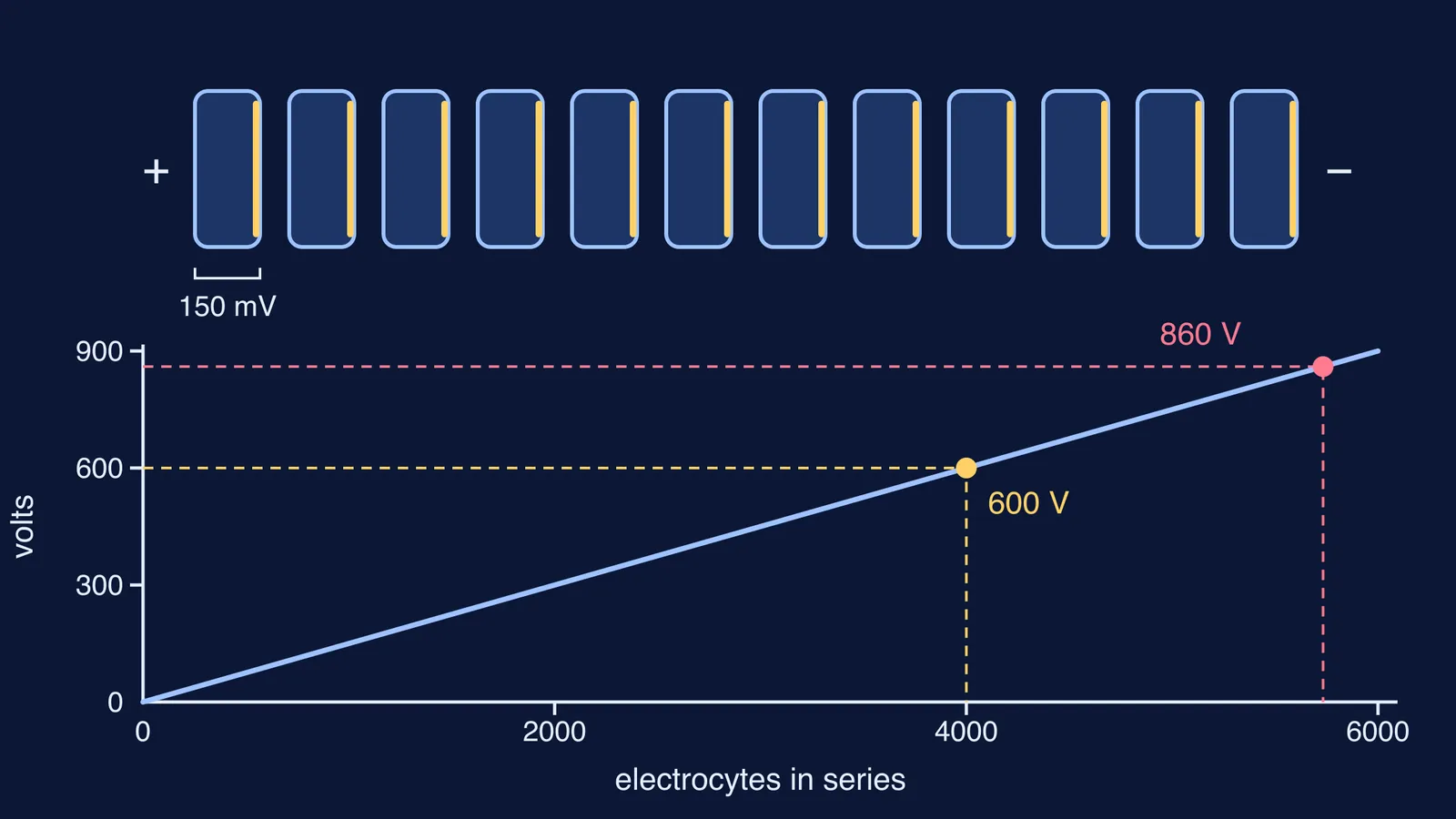
Large electric eels "stack thousands of electrocytes in series and can generate potential differences over 600 V", as Schroeder and colleagues write. Voltages in series add, exactly as they do when you put cells end to end in a torch.
Here is the arithmetic, worked out:
One firing electrocyte: about 0.15 V.
To reach 600 V: 600 ÷ 0.15 = 4,000 electrocytes in one line.
In 2019, researchers recorded a discharge of 860 V from one of two newly described eel species, which the authors call the strongest living bioelectricity generator (de Santana et al., Nature Communications). That needs 860 ÷ 0.15 ≈ 5,700 cells in series.
This assumes every cell fires fully and at the same instant, which is why the nerve signal has to reach the whole stack together.
Series raises the voltage; parallel raises the current. The eel has many stacks lying side by side, and the same paper notes that this parallel arrangement lets peak currents approach 1 A at short circuit. Our guide to cells, EMF and internal resistance works through the same series and parallel rules for ordinary cells.
What does an electric eel use its shocks for?
Kenneth Catania of Vanderbilt University ran a series of experiments on hunting eels and published the results in Science in 2014. The Vanderbilt release on ScienceDaily lists three kinds of discharge:
Low-voltage pulses, used to sense the surroundings.
Doublets or triplets: two or three high-voltage pulses given off while hunting, which make hidden prey twitch and give away where it is.
Volleys of high-voltage, high-frequency pulses, used to capture prey or to defend itself.
The volleys work on the prey's own nerves: Catania showed that the shocks activate the prey's motor neurons, causing whole-body muscle contraction (tetanus), so the fish cannot swim away. The eel's volley reaches 400 pulses per second, against 19 for a Taser, according to the same release.
Shocks are also for defence. In a 2016 PNAS study, Catania showed eels leaping out of the water to electrify a threat directly, which supports Alexander von Humboldt's story of eels attacking horses driven into a muddy pool in 1800.
How should you explain this in an exam answer?
Answer it as a chain of five links:
Name the cell: electrocytes, modified muscle cells.
Give the mechanism: a nerve signal opens sodium channels on one face only, so the two faces stop cancelling.
Give the size: about 150 mV per cell.
Add them up: thousands in series give hundreds of volts; stacks in parallel give a large current.
Give the use: weak pulses to sense, strong volleys to stun prey and fend off threats.
Two slips cost marks. One is saying each cell "stores" hundreds of volts; it is the stack, not the cell. The other is saying parallel stacks raise the voltage; they raise the current.
If the membrane-potential step is the shaky part, the Fermi Concept Library gives every concept in physics, chemistry and biology its own lesson and its place in the map. For practice with the numbers, the Fermi Problem Library has worked problems with a step-by-step solver that explains the reasoning rather than printing an answer.
Next time you see a circuit with cells in series, picture 4,000 of them lined up along a fish.