

On this page
A heavy ball hits a light ball at rest. Many students write down momentum and kinetic energy and end up solving a quadratic under time pressure. You don't need to. Two formulas cover every head-on elastic collision, and three mass ratios tell you what the answer should look like before you calculate.
What are the formulas for a 1D elastic collision?
An elastic collision is one that conserves internal kinetic energy, as OpenStax College Physics defines it. Momentum is conserved too. Solving the two laws together gives the final velocities, set out in Dourmashkin's Classical Mechanics text on LibreTexts/15%3A_Collision_Theory/15.04%3A_One-Dimensional_Collisions_Between_Two_Objects). For a striker of mass m₁ at speed u and a target of mass m₂ at rest:
Striker after the collision: v₁′ = (m₁ − m₂)u / (m₁ + m₂)
Target after the collision: v₂′ = 2m₁u / (m₁ + m₂)
The same text gives a quicker result: in an elastic collision the relative velocity is reversed, so the target moves away from the striker at the speed the striker approached it. We use that shortcut in our post on solving elastic collisions without quadratic equations.
What happens when the two masses are equal?
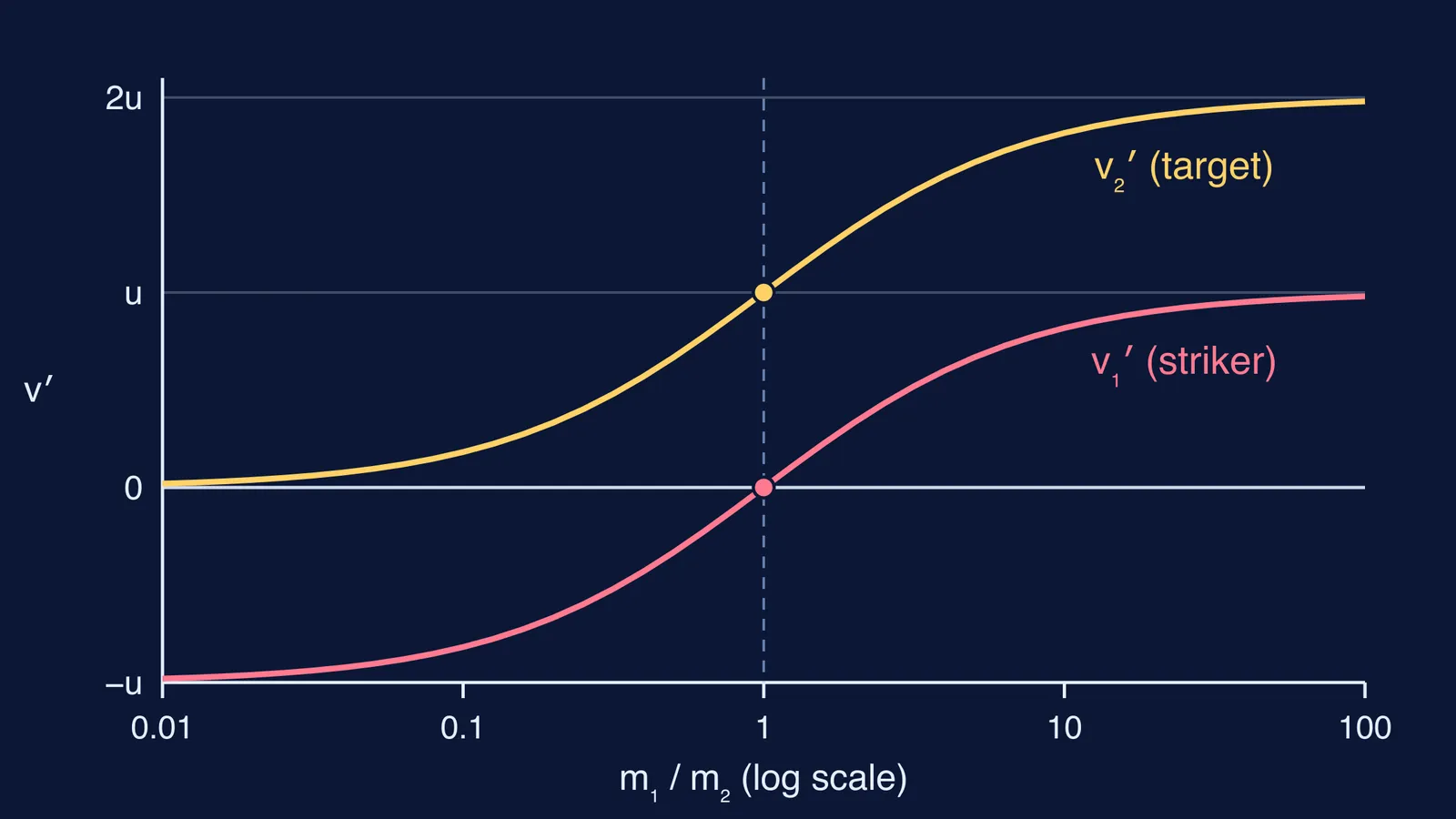
Put m₁ = m₂ into the formulas. The top of the first fraction becomes zero, so v₁′ = 0, and the second fraction becomes 2m/2m, so v₂′ = u. The Dourmashkin text/15%3A_Collision_Theory/15.04%3A_One-Dimensional_Collisions_Between_Two_Objects) states the general version: equal masses exchange velocities.
The striker stops dead and the target leaves at the striker's old speed, carrying all the kinetic energy. That full hand-over happens only at equal masses, the idea behind our post on how much kinetic energy a head-on elastic collision transfers.
What happens when a heavy ball hits a light ball?
Now let m₁ be much larger than m₂. In both formulas m₂ is tiny next to m₁, so v₁′ ≈ u and v₂′ ≈ 2m₁u/m₁ = 2u. The heavy ball hardly changes speed, as the Dourmashkin text/15%3A_Collision_Theory/15.04%3A_One-Dimensional_Collisions_Between_Two_Objects) also notes, and the light ball moves off at almost twice the heavy ball's speed.
Why 2u and not u? The heavy ball closes in at u, so afterwards the light ball must move away from it at u. The heavy ball is still moving at about u, so the light ball needs u + u = 2u.
Worked example: 5 kg ball hits a 0.1 kg ball
A 5 kg ball moving at 2 m/s hits a 0.1 kg ball at rest, head-on and elastically. Using the Dourmashkin formulas/15%3A_Collision_Theory/15.04%3A_One-Dimensional_Collisions_Between_Two_Objects):
Striker: v₁′ = (5 − 0.1) × 2 / 5.1 = 9.8 / 5.1 ≈ 1.92 m/s.
Target: v₂′ = 2 × 5 × 2 / 5.1 = 20 / 5.1 ≈ 3.92 m/s.
Check momentum: 5 × 1.92 + 0.1 × 3.92 ≈ 9.6 + 0.4 = 10 kg m/s, which matches 5 × 2 before.
Check relative speed: 3.92 − 1.92 = 2 m/s, which matches the approach speed.
With a mass ratio of 50, the target gets just under the 2u limit of 4 m/s.
What happens when a light ball hits a heavy ball?
Now let m₁ be much smaller than m₂: v₁′ ≈ −u and v₂′ ≈ 0. The light ball bounces back at nearly full speed, like a ball thrown at a wall.
You can see this in Example 8.4 of OpenStax College Physics: a 0.500 kg object at 4.00 m/s hits a 3.50 kg object at rest, and the answers are −3.00 m/s and 1.00 m/s. Put the numbers into the formulas: (0.5 − 3.5) × 4 / 4 = −3, and 2 × 0.5 × 4 / 4 = 1. With a mass ratio of 1 to 7 the striker already comes back at three-quarters of its speed, well on the way to the −u limit.
How do you check an elastic collision answer quickly?
The three cases are the edges of every answer, so use them as a check before and after you solve:
Write the mass ratio m₁/m₂ first.
Predict the striker's direction: forward if m₁ > m₂, stopped if they are equal, backward if m₁ < m₂.
Predict the target's speed: between 0 and 2u, close to u for similar masses, close to 2u for a much heavier striker, close to 0 for a much lighter one.
After solving, check that the target moves away from the striker at the same speed the striker approached it.
Check momentum with one line of arithmetic.
This is the same habit we describe in our post on checking a physics answer with limiting cases. As the ratio slides from tiny to huge, the answers move steadily between the limits, as the graph above shows.
If an answer fails a check and you can't see why, the Fermi Problem Library has worked problems with a step-by-step solver that explains the reasoning rather than printing an answer. If the gap is in momentum itself, the lesson on it in the Fermi Concept Library shows its place in the map of concepts.
Next collision question: write the mass ratio down first, guess from the three cases, then solve.


