

On this page
When two objects collide in a physics problem, conserving both momentum and kinetic energy often leads to a system of equations where one is linear and the other is quadratic. For students preparing for exams like the JEE Main or NEET, solving this quadratic equation can waste precious minutes and introduce algebraic errors.
The good news? For a perfectly elastic head-on collision, there is a built-in mathematical shortcut. By combining the conservation laws, you can prove that the relative velocity of separation is exactly equal to the relative velocity of approach in magnitude.
What is the relative velocity of approach?
Before a collision, the two objects are moving toward each other. The relative velocity of approach is the speed at which the distance between them is closing. If mass 1 has an initial velocity of u₁ and mass 2 has an initial velocity of u₂ (where u₁ > u₂), the velocity of approach is simply u₁ − u₂.
What is the relative velocity of separation?
After the collision, the objects bounce and move apart. The relative velocity of separation is the rate at which the distance between them is increasing. If their final velocities are v₁ and v₂, the velocity of separation is v₂ − v₁.
Why does velocity of separation equal approach in an elastic collision?
In a perfectly elastic collision, both momentum and kinetic energy are conserved, meaning no energy is lost to heat or sound.
When you divide the kinetic energy conservation equation (which contains squared terms) by the momentum conservation equation, the masses cancel out, and the squares factor into a linear equation. As shown on HyperPhysics, this yields a beautiful, linear relationship: u₁ − u₂ = v₂ − v₁.
Most real-world macroscopic collisions lose some energy and are inelastic, but ideal gases and subatomic particles often undergo perfectly elastic collisions where this rule perfectly applies (HyperPhysics).
The trick to avoid quadratic algebra
Here is how you use this in an exam:
Write down the linear momentum equation: m₁u₁ + m₂u₂ = m₁v₁ + m₂v₂.
Write down the relative velocity equation: u₁ − u₂ = v₂ − v₁.
You now have a system of two simple linear equations.
Solving two linear equations is significantly faster than substituting a linear variable into a quadratic one and finding the roots. It also avoids the mathematically valid but physically useless extraneous root (where the objects simply pass through each other without colliding, meaning v₁ = u₁ and v₂ = u₂).
A worked example: skipping the quadratic
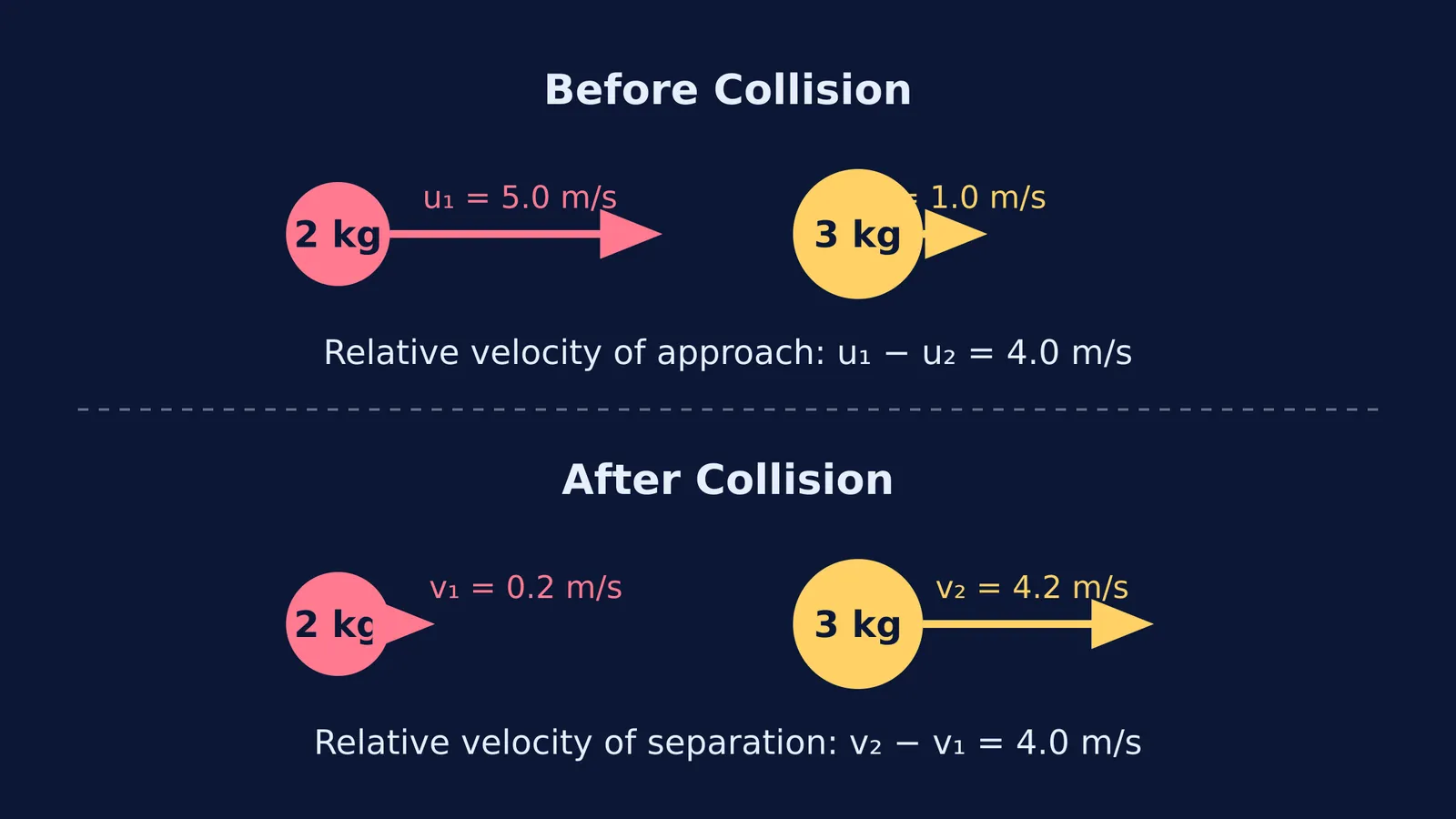
Imagine a 2.0 kg block moving at 5.0 m/s to the right colliding elastically with a 3.0 kg block moving at 1.0 m/s to the right. What are their final velocities?
The hard way (with the quadratic): First, set up momentum conservation: (2.0)(5.0) + (3.0)(1.0) = 2.0(v₁) + 3.0(v₂) 10.0 + 3.0 = 2.0v₁ + 3.0v₂ 13.0 = 2.0v₁ + 3.0v₂
Next, set up kinetic energy conservation: ½(2.0)(5.0)² + ½(3.0)(1.0)² = ½(2.0)(v₁)² + ½(3.0)(v₂)² 25.0 + 1.5 = 1.0(v₁)² + 1.5(v₂)² 26.5 = (v₁)² + 1.5(v₂)²
At this point, you would need to isolate v₁ in the momentum equation (v₁ = 6.5 − 1.5v₂), substitute it into the kinetic energy quadratic equation, expand the squared binomial, collect terms, and solve for v₂ using the quadratic formula. It is tedious and error-prone.
The smart way (with relative velocity): First, set up the same momentum conservation: 13.0 = 2.0v₁ + 3.0v₂
Instead of kinetic energy, use the velocity of separation rule. The relative velocity of approach is u₁ − u₂: 5.0 − 1.0 = 4.0 m/s
Set this equal to the relative velocity of separation (v₂ − v₁): v₂ − v₁ = 4.0 v₂ = v₁ + 4.0
Substitute this simple linear expression into the momentum equation: 13.0 = 2.0v₁ + 3.0(v₁ + 4.0) 13.0 = 2.0v₁ + 3.0v₁ + 12.0 1.0 = 5.0v₁ v₁ = 0.2 m/s
Now plug v₁ back into the separation equation: v₂ = 0.2 + 4.0 = 4.2 m/s
In a fraction of the time, we found the final velocities (v₁ = 0.2 m/s, v₂ = 4.2 m/s) without squaring a single unknown variable.
If you are struggling to spot these algebraic shortcuts while practicing, the Fermi Problem Library has worked problems with a step-by-step solver that explains the reasoning rather than printing an answer. Fermi's AI tutor notices where a student is stuck and can show you when to apply this linear rule instead of grinding through quadratic equations.
Next time you encounter an elastic collision, skip the squared terms. Set separation equal to approach, solve the linear system, and move on to the next question.
For more on momentum and motion, see how to test if two projectiles will collide midair or trace the energy when a shell explodes midair.


