

On this page
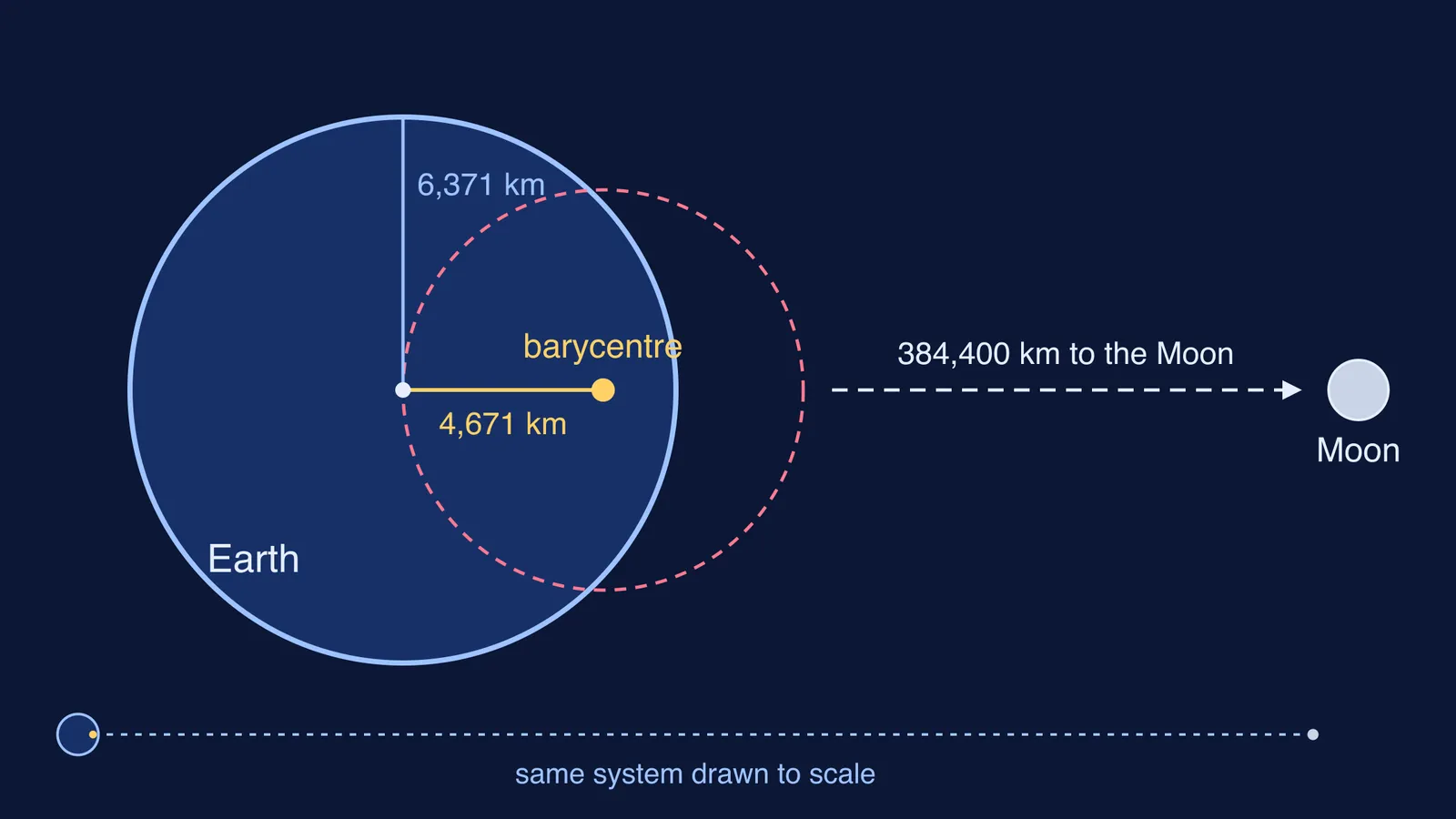
Ask most people what the Moon orbits and they will say "the Earth". The more exact answer is that the Earth and the Moon both orbit a shared point, their centre of mass. Because Earth is so much heavier, that point is not halfway between them. It is buried inside the Earth. Here is the four-line working, from NASA's own numbers.
What is the barycentre of the Earth-Moon system?
A barycentre is the point around which two bodies orbit each other, and it is usually closest to the body with more mass, as NASA Space Place explains. In JEE language it is simply the centre of mass of a two-particle system.
For two masses a distance r apart, the centre of mass lies on the line joining them, at a distance from the heavier mass of:
d = r × m₂ / (m₁ + m₂)
Here m₁ is Earth and m₂ is the Moon. Notice that only the ratio of the masses matters, which is why the Earth-to-Moon mass ratio is all you really need.
Where is the centre of mass of the Earth and Moon?
Take the values from NASA's fact sheets. The NASA Moon Fact Sheet gives the Moon's mass as 0.07346 × 10²⁴ kg and the mean Earth-Moon distance (the semimajor axis) as 384,400 km. The NASA Earth Fact Sheet gives Earth's mass as 5.9722 × 10²⁴ kg and its mean radius as 6,371 km.
The worked example:
Mass ratio: 5.9722 ÷ 0.07346 ≈ 81.3. Earth is about 81 times as massive as the Moon.
Divide the distance by (ratio + 1): d = r ÷ (81.3 + 1) = 384,400 ÷ 82.3.
Result: d ≈ 4,670 km from Earth's centre, towards the Moon.
Compare with Earth's radius: 4,670 ÷ 6,371 ≈ 0.73, so the point is about 73% of the way from the centre to the surface, roughly 1,700 km underground.
Step 2 is the shortcut worth remembering. If one mass is n times the other, the centre of mass sits 1/(n + 1) of the way from the heavy one.
Is the barycentre always inside the Earth?
Yes. The Moon's orbit is an ellipse, so the separation changes. The NASA Moon Fact Sheet lists a mean perigee of 363,300 km and a mean apogee of 405,500 km. Using the same 1/82.3 factor, the barycentre moves between about 4,410 km and 4,930 km from Earth's centre. Both are less than Earth's 6,371 km radius from the Earth Fact Sheet, so the point stays well inside the planet.
It does move around inside it, though. As the Moon goes round once a month, Earth's centre swings in a small loop of radius about 4,670 km around the barycentre. It is this shared point, rather than Earth's centre, that traces the Earth-Moon system's orbit around the Sun. Earth's centre wobbles slightly either side of that path each month.
If you have read about why the Moon raises two high tides a day, this monthly wobble is a separate effect. Keep the two ideas apart in your answers.
What mistakes do students make with this question?
Check your working against this list, which uses the same NASA Moon and Earth fact-sheet values.
Measuring from the wrong body. d = r × m₂/(m₁ + m₂) gives the distance from m₁. Put the Moon's mass on top to measure from Earth.
Dividing by n instead of n + 1. Dividing 384,400 km by 81 instead of 82.3 gives about 4,746 km, a small but avoidable error.
Confusing it with the zero-field point. The centre of mass is not where the gravitational pulls cancel. That point is much closer to the Moon, as our post on where the gravitational field is zero between Earth and Moon works out.
Forgetting to compare with the radius. "Is it inside the Earth?" needs the 6,371 km radius as the last step.
How do you practise centre-of-mass problems?
The same idea, a mass-weighted balance point, appears in many JEE and board questions. The classic is the person walking on a boat: the system's centre of mass stays put, so the boat slides back. Try it in our worked post on how far the boat moves when a man walks on it.
When you get a centre-of-mass problem wrong and cannot see why, the Fermi Problem Library has worked problems with a step-by-step solver that explains the reasoning rather than printing an answer. If the gap is the idea itself, look up centre of mass in the Fermi Concept Library, where each concept has its own lesson.
Next time someone says the Moon goes round the Earth, you can tell them the real pivot is buried deep under their feet.


