

On this page
Somewhere between Earth and the Moon, Earth's pull and the Moon's pull are equal and opposite, so the net gravitational field is zero. It is a standard Class 11 and JEE gravitation question, usually with a trap attached: is the potential zero there too? It is not.
How do you find where the field is zero?
You need three numbers. NASA's Earth fact sheet gives Earth's mass as 5.9722 × 10²⁴ kg. NASA's Moon fact sheet gives the Moon's mass as 0.07346 × 10²⁴ kg and its orbit's semimajor axis, the mean Earth–Moon distance, as 384,400 km. NIST lists the gravitational constant as G = 6.674 30 × 10⁻¹¹ m³ kg⁻¹ s⁻² (CODATA 2022).
Put the null point a distance x from Earth's centre, so it is d − x from the Moon's centre. Then:
Write each field: Earth's is GM/x², the Moon's is Gm/(d − x)².
Set them equal. G cancels: M/x² = m/(d − x)².
Take the square root of both sides: (d − x)/x = √(m/M).
Solve: x = d√M / (√M + √m) = d / (1 + √(m/M)).
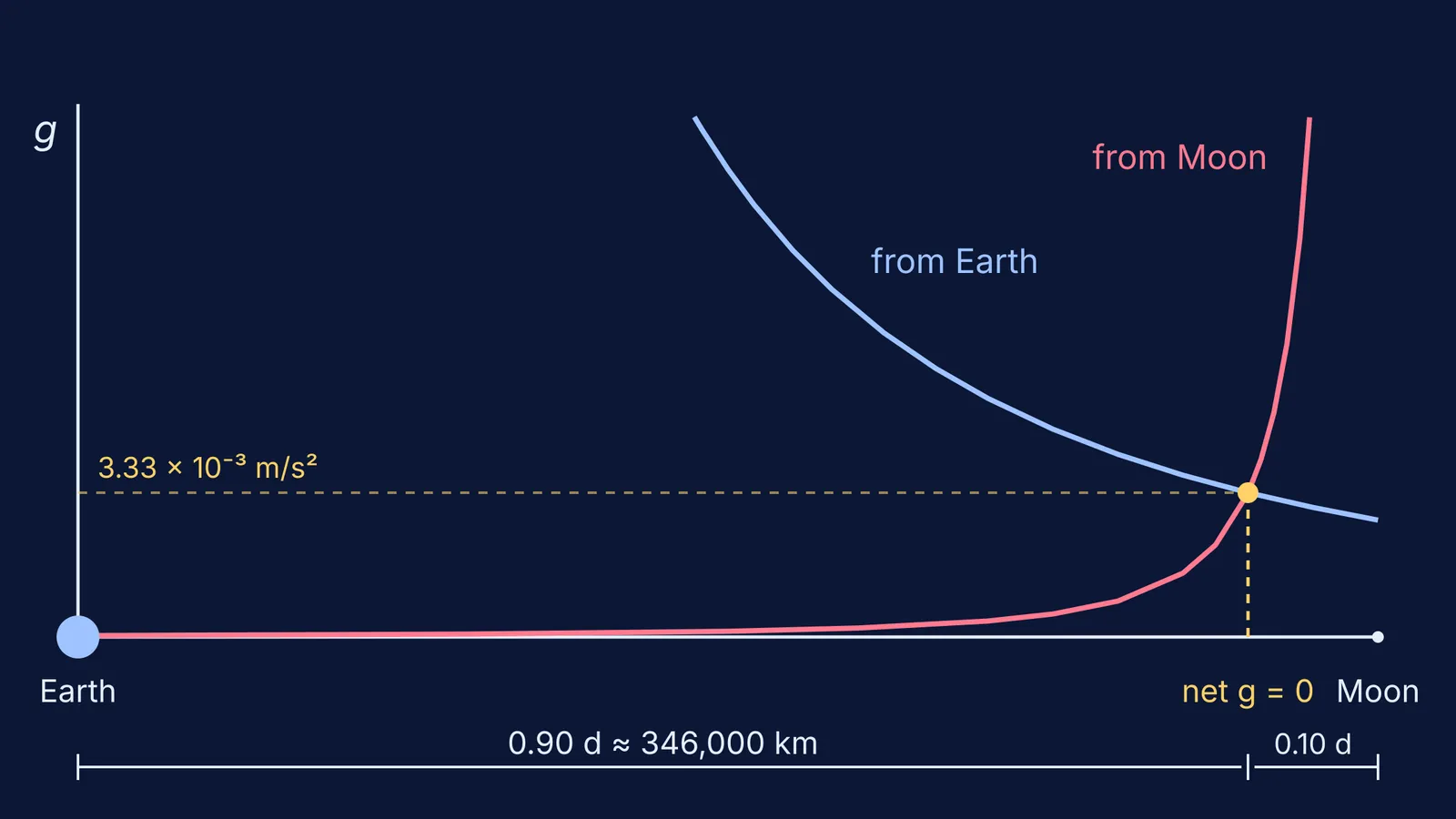
Put in the numbers. M/m = 5.9722/0.07346 = 81.30, so √(M/m) = 9.017 and x = 0.9002 d.
With d = 384,400 km, the null point is about 346,000 km from Earth's centre and about 38,400 km from the Moon's centre. Check: each field there is 3.33 × 10⁻³ m/s², in opposite directions.
Why is the zero-gravity point closer to the Moon?
A small mass can only match a big one's pull if you stand much closer to it. The Moon fact sheet puts the Moon/Earth mass ratio at 0.0123, so Earth is about 81 times heavier.
The field falls off as 1/r², so distance only has to make up the square root of the mass ratio. √81 = 9, so the null point is 9 times farther from Earth than from the Moon: nine-tenths of the way across. Exam shortcut: when told M = 81m, write x = 9d/10 straight away.
Is the gravitational potential zero where the field is zero?
No. Field is a vector, so the two fields can cancel. Potential is a scalar and is negative at every finite distance, so the two contributions add. With GM values from NASA's Earth and Moon fact sheets:
Earth's part: −GM/x = −(3.986 × 10¹⁴)/(3.460 × 10⁸ m) = −1.152 × 10⁶ J/kg.
Moon's part: −Gm/(d − x) = −(4.903 × 10¹²)/(3.838 × 10⁷ m) = −1.28 × 10⁵ J/kg.
Total: V ≈ −1.28 × 10⁶ J/kg.
The field is the negative slope of the potential, so zero field means the potential graph is flat at that point, not that it touches zero. Along the Earth–Moon line, this flat spot is the highest point of the potential: the least negative value between the two bodies. That is why it matters for the minimum speed to send a probe from Earth to the Moon: once past the hump, the Moon pulls it the rest of the way. Our post on the graph of gravitational field and potential of a spherical shell shows the same slope idea.
Does the null point stay in one place?
Not exactly. The Moon's orbit is an ellipse. The Moon fact sheet gives a perigee of 363,300 km and an apogee of 405,500 km. Because x = 0.9002 d at any separation, the point moves between about 327,000 km and 365,000 km from Earth.
Two more effects are left out:
The Sun. NASA's Sun fact sheet gives GM = 1.327 × 10²⁰ m³/s² and a mean distance of 149.6 million km, so the Sun's field near Earth is about 5.9 × 10⁻³ m/s². That is stronger than either field at the null point, but it pulls Earth, the Moon and the point almost equally, so textbooks leave it out.
Orbital motion. NASA describes Lagrange points as places where the pull of two large masses equals the centripetal force a small object needs to move with them. An object circling with the Moon needs a net pull towards Earth, so the Earth–Moon L1 point sits on Earth's side of the null point. It is a different point.
A quick check before you write the answer
Did you measure x from Earth's centre, not its surface?
Did you use √(M/m), not M/m?
Is your point nearer the lighter body?
Did you add the two potentials as negative numbers, not subtract them?
Does your answer say the potential is non-zero and negative?
The same set-up works for two stars or two point charges. To practise it, the Fermi Problem Library has worked problems with a step-by-step solver that explains the reasoning rather than printing an answer. If the scalar-versus-vector idea trips you up, look up gravitational potential in the Fermi Concept Library, and keep the symbols straight with our explainer on small g and big G. Zero field is also not the same as weightlessness; see why a pendulum clock stops in an orbiting satellite.


