

On this page
In bright sunlight an e-reader looks like printed paper while your phone screen washes out. That is because an e-ink screen makes no light at all. It shows a picture by moving tiny charged particles of pigment, using the electrostatics you meet in Class 12.
How does an e-ink display work?
According to E Ink, the company that makes these panels, the screen holds millions of tiny microcapsules, each about the diameter of a human hair.
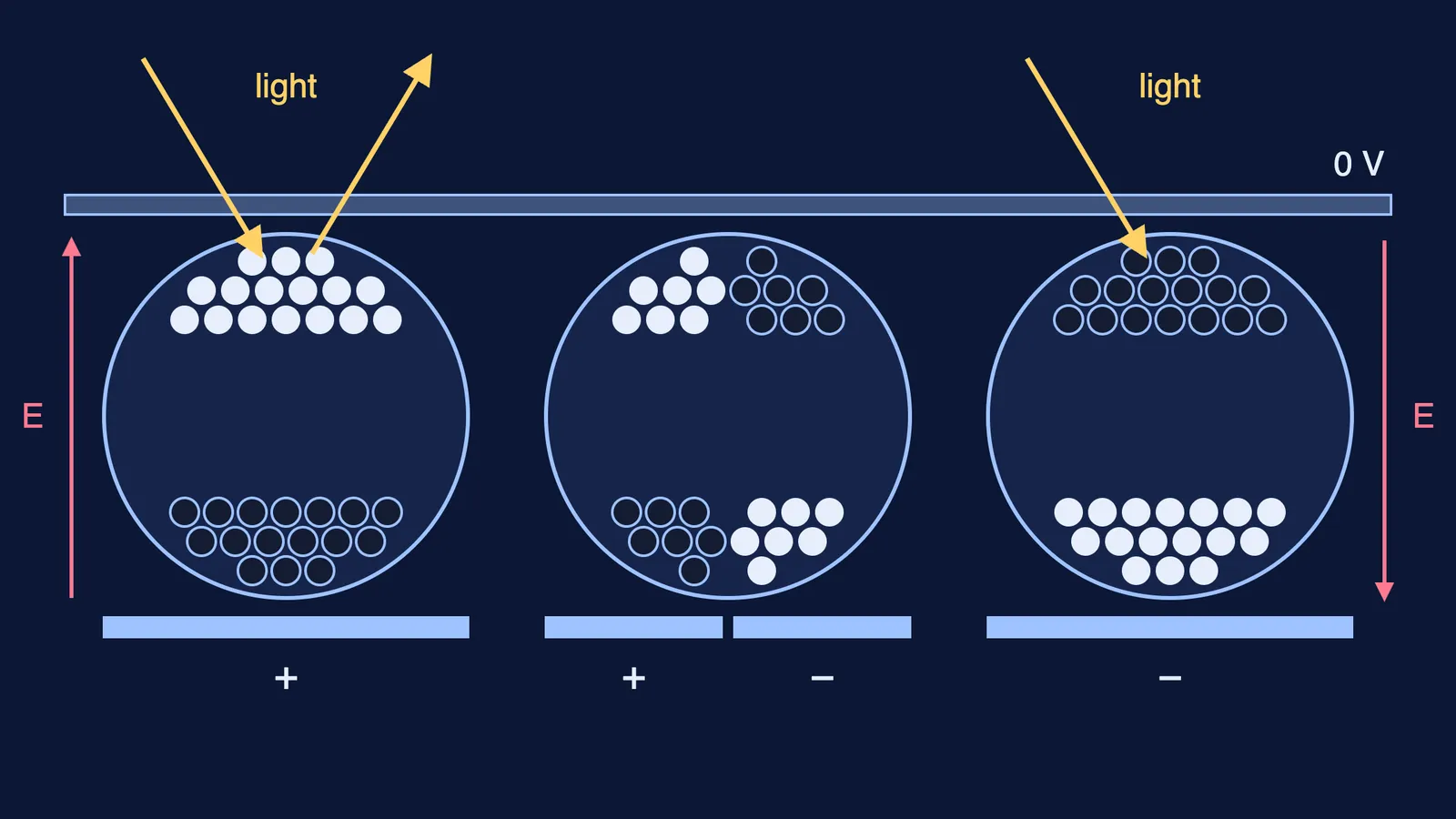
Each capsule contains white particles and black particles suspended in a clear fluid, and the two colours carry opposite electric charges. In a typical panel, a transparent electrode sits on top and pixel electrodes sit below.
When a pixel electrode is given a voltage, an electric field E appears across the capsules above it. Each particle feels a force F = qE, so the positive particles drift one way and the negative ones the other. E Ink says the particles that reach the top become visible, which makes that spot look white or black.
In the original design, as told by Science Friday, the white particles were positive and the black ones negative, in oil; descriptions vary, but the charges are always opposite. Charged particles drifting through a liquid in an electric field is called electrophoresis, the same effect chemists use to show that ferric hydroxide sol particles carry a positive charge.
Why doesn't an e-ink screen need a backlight?
Phones and laptops are emissive: OLED pixels make their own light, and an LCD shines a backlight through its pixels. A 2019 review in Nano Convergence explains that reflective displays have no internal light source and use ambient light, mostly sunlight.
The same review notes that bright light washes out an emissive screen but makes a reflective display easier to read. White pigment at the top of a capsule scatters the light back to your eye, and black pigment absorbs it, just as ink on paper does. That is also why printed pages mix colours differently from glowing screens, as our piece on why screens use RGB but printers use CMYK explains.
Why does e-ink use so little power?
The Nano Convergence review says reflective displays can reach near-zero power use, because they do not have to generate light; they only reflect it.
The second reason is that e-ink is bistable: once the particles are in place, they stay there. E Ink explains that only the regions of the screen that are changing need updating, and pixels that are not changing need nothing.
A rough worked example, using E Ink's best case: it says a full-screen update can take as little as 120 milliseconds. Turn a page once a minute and the particles are pushed for about 0.12 of every 60 seconds: 0.12 / 60 = 0.002, or about 0.2% of the time. A glowing screen must make light the whole time you look at it.
The trade-off is speed. E Ink notes that constant updates reduce the power efficiency of its inks, which is why e-readers suit books, not video.
Who invented e-ink?
The microcapsule version of electronic ink came from the MIT Media Lab. Science Friday reports that professor Joseph Jacobson recruited Barrett Comiskey, then an undergraduate, and his classmate JD Albert. On 23 January 1997, Comiskey recalls, he and Albert put a microcapsule between copper electrodes under a microscope and showed that an outside electric field could move a particle inside it. Their paper, An electrophoretic ink for all-printed reflective electronic displays, appeared in Nature in July 1998.
A photocopier also uses static charge to place pigment; e-ink seals the pigment in a capsule so it can be moved back.
Four checks to try on an e-reader
If you have an e-reader at home, test each idea above in a few minutes:
Sunlight test: take it outside next to a phone. The e-reader gets easier to read in bright light; the phone gets harder.
Dark test: with any built-in reading light off, in a dark room, you cannot read the page, because it makes no light of its own.
Page turn: watch closely. You may see a brief flash as the particles are pushed to new places.
Scroll test: scroll quickly. It lags, because every frame means moving particles through a liquid.
Then make it a Class 12 question. In the first capsule of the diagram above, the bottom electrode is positive and the top is at 0 V, so E points up. A positive white particle feels qE upwards and rises, so the pixel looks white. Reverse the voltage and it sinks.
If fields and forces are hard to picture from a textbook figure, the Fermi Simulation Lab has interactive simulations for ideas that are easier to see than to read. And if electrostatics as a whole feels shaky, Fermi's AI tutor works out what you already know and builds a plan for the session, so you start from your own gaps rather than from page one.


