On this page
Your body looks the same from one week to the next, but its molecules are being broken down and replaced all the time. That is the dynamic state of body constituents, and it ties together metabolic pathways, anabolism versus catabolism, and ATP.
What does dynamic state of body constituents mean?
It means the biomolecules in a living body are not a fixed stock. They are made, broken down and converted into one another all the time; what stays steady is the level, not the molecule. Think of a railway platform at rush hour: the crowd looks the same size at 9:00 and 9:15, but the people keep changing.
A revision note: the current NCERT Class 11 Biology Chapter 9, Biomolecules (reprint 2026-27) ends at section 9.8 (Enzymes) and has no separate section on the dynamic state, although section 9.2 still refers to a section 9.10 that this reprint does not contain. Check your current official syllabus for how much detail you need. For the same chapter's extraction experiment, see acid-soluble pool vs acid-insoluble fraction.
Who proved that body constituents are always turning over?
Rudolf Schoenheimer. A history of his work in The Journal of Nutrition (Guggenheim, 1991) records that he introduced the isotopic tracer technique into metabolic research in 1935 and that the results of his experiments led to the concept of a "dynamic state of body constituents". Earlier thinkers such as Claude Bernard and F. G. Hopkins had held a dynamic view of metabolism; Schoenheimer provided clear experimental evidence for it.
His 1941 Dunham lectures became the book The Dynamic State of Body Constituents (Harvard University Press, 1942).
What is metabolic flux, and what is a metabolic pathway?
NCERT defines a metabolic pathway as a multistep chemical reaction in which each step is catalysed by the same enzyme complex or by different enzymes (NCERT Chapter 9, section 9.8.1). Its example is glucose becoming pyruvic acid through ten enzyme-catalysed reactions; for why enzymes speed each step, see how enzymes lower activation energy on a graph.
Metabolic flux is the rate and direction of that flow, like traffic on a road network. Biochemists who model it describe flux balance analysis as "a mathematical approach for analyzing the flow of metabolites through a metabolic network" (Orth, Thiele and Palsson, Nature Biotechnology, 2010).
Worked example: one pathway, three exits
NCERT shows how the glucose pathway, with one or two extra reactions, ends differently (Chapter 9):
In skeletal muscle under anaerobic conditions, lactic acid is formed.
Under normal aerobic conditions, pyruvic acid is formed.
In yeast during fermentation, the same pathway gives ethanol.
Same start, same early steps; conditions decide where the flux goes.
Anabolic vs catabolic: how do you tell them apart?
NCERT puts it in one line: breaking down processes within the living organism is catabolism, and synthesis is anabolism (NCERT Class 11 Biology, Chapter 12, section 12.6).
Glucose to pyruvic acid: catabolic.
Acetyl CoA to fatty acids: anabolic.
Amino acids to protein: anabolic.
The trap: respiration is not purely catabolic. Its intermediates, such as acetyl CoA, can be withdrawn to make fatty acids and proteins, so NCERT calls the respiratory pathway amphibolic.
Why is ATP called the energy currency of the cell?
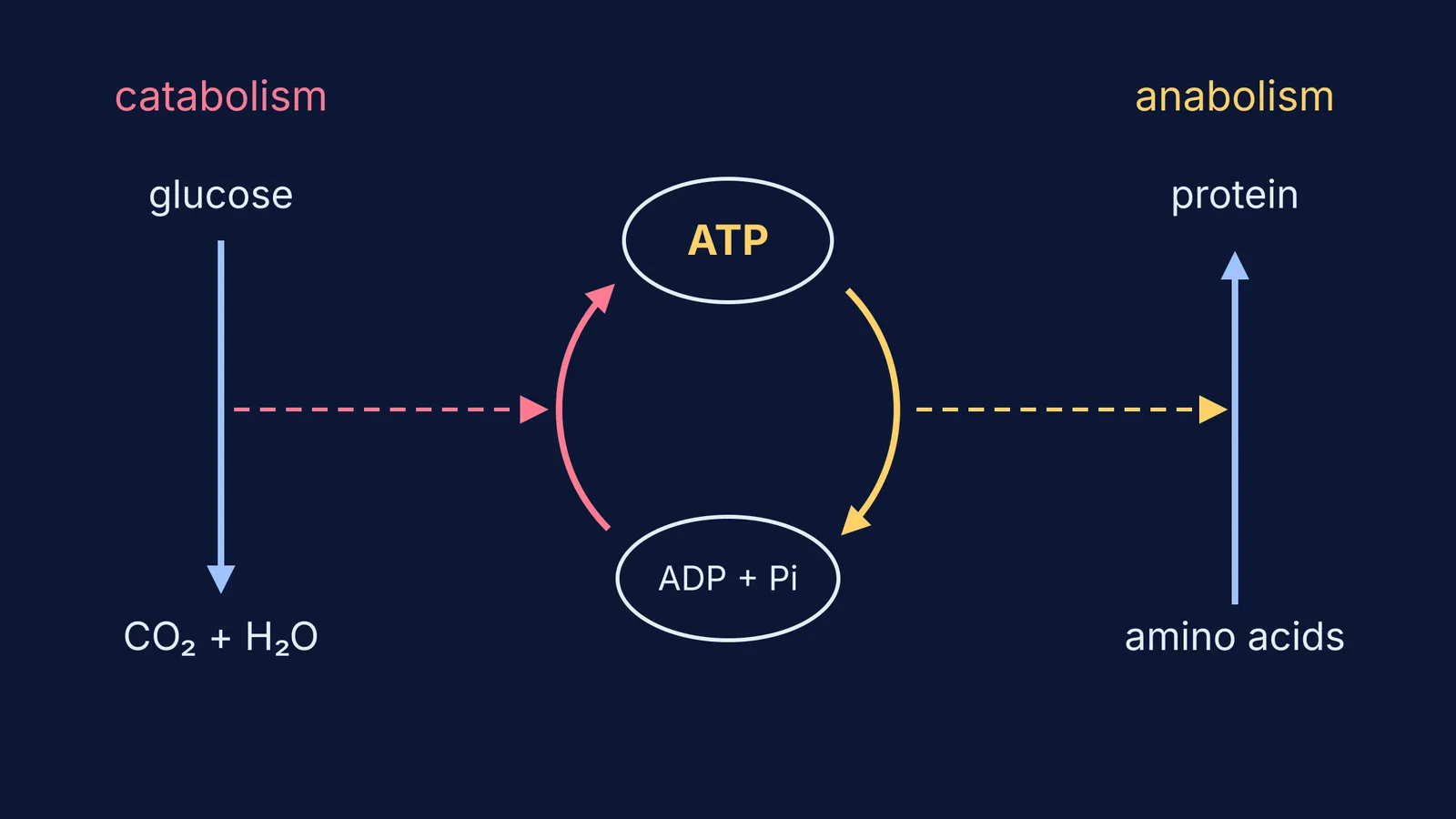
Because the energy released by breaking down food is not used directly. NCERT says it is used to synthesise ATP, "which is broken down whenever (and wherever) energy needs to be utilised. Hence, ATP acts as the energy currency of the cell" (Chapter 12). You earn it in catabolism and spend it in anabolism, movement and transport; for storage, NCERT names starch and glycogen (Chapter 9 summary).
The currency moves fast. A 2008 commentary in PNAS states: "On any given day you turn over your body weight equivalent in ATP" (Törnroth-Horsefield and Neutze, PNAS). You do not carry that much at once; the same molecules are spent and remade, ADP back to ATP, over and over. For the count from one glucose, see how many ATP are produced from one glucose molecule.
How do you write the dynamic state answer in an exam?
Use this five-line plan for a short-answer question:
Definition: biomolecules are constantly made, broken down and interconverted; levels stay steady, molecules do not.
Mechanism: enzyme-catalysed metabolic pathways, with a rate and direction (flux).
Example: glucose to pyruvic acid in ten enzyme-catalysed steps (NCERT Chapter 9); lactic acid in muscle, ethanol in yeast.
Energy link: catabolism releases energy captured as ATP; anabolism spends it.
Evidence, for extra credit: Schoenheimer's isotope tracers.
Then check for four common slips:
Calling respiration only catabolic (it is amphibolic).
Calling ATP an energy store (starch and glycogen are the stores).
Saying body composition is fixed (levels are steady, molecules are not).
Mixing up a metabolite (a molecule) with a pathway (a sequence of reactions).
If one link is shaky, the Fermi Concept Library gives every biology concept its own lesson and its place in the map. To practise, the Fermi Problem Library has a step-by-step solver that explains the reasoning rather than printing an answer.
Write the five-line plan from memory tomorrow, then check it against this page.