

On this page
The drinking bird dips its beak into water, swings back up and repeats, for hours. It looks like perpetual motion, but it is a heat engine running on the temperature difference between its wet head and its warmer body. Miles V. Sullivan filed the US patent for this "novelty device" in August 1945 (US patent 2,402,463).
How does the drinking bird toy work?
The bird is two glass bulbs joined by a tube that reaches deep into the lower bulb, the body. The body is almost filled with dichloromethane (CH₂Cl₂), a liquid that boils close to room temperature, and there is no air inside, only the liquid and its vapour, as physicist J. Güémez and colleagues describe in the American Journal of Physics. The head is covered in felt. One cycle:
Water evaporates from the wet felt and carries heat away, so the head cools.
Some vapour in the cooler head condenses, so the pressure in the head drops.
The body, still at room temperature, now has the higher vapour pressure and pushes liquid up the tube.
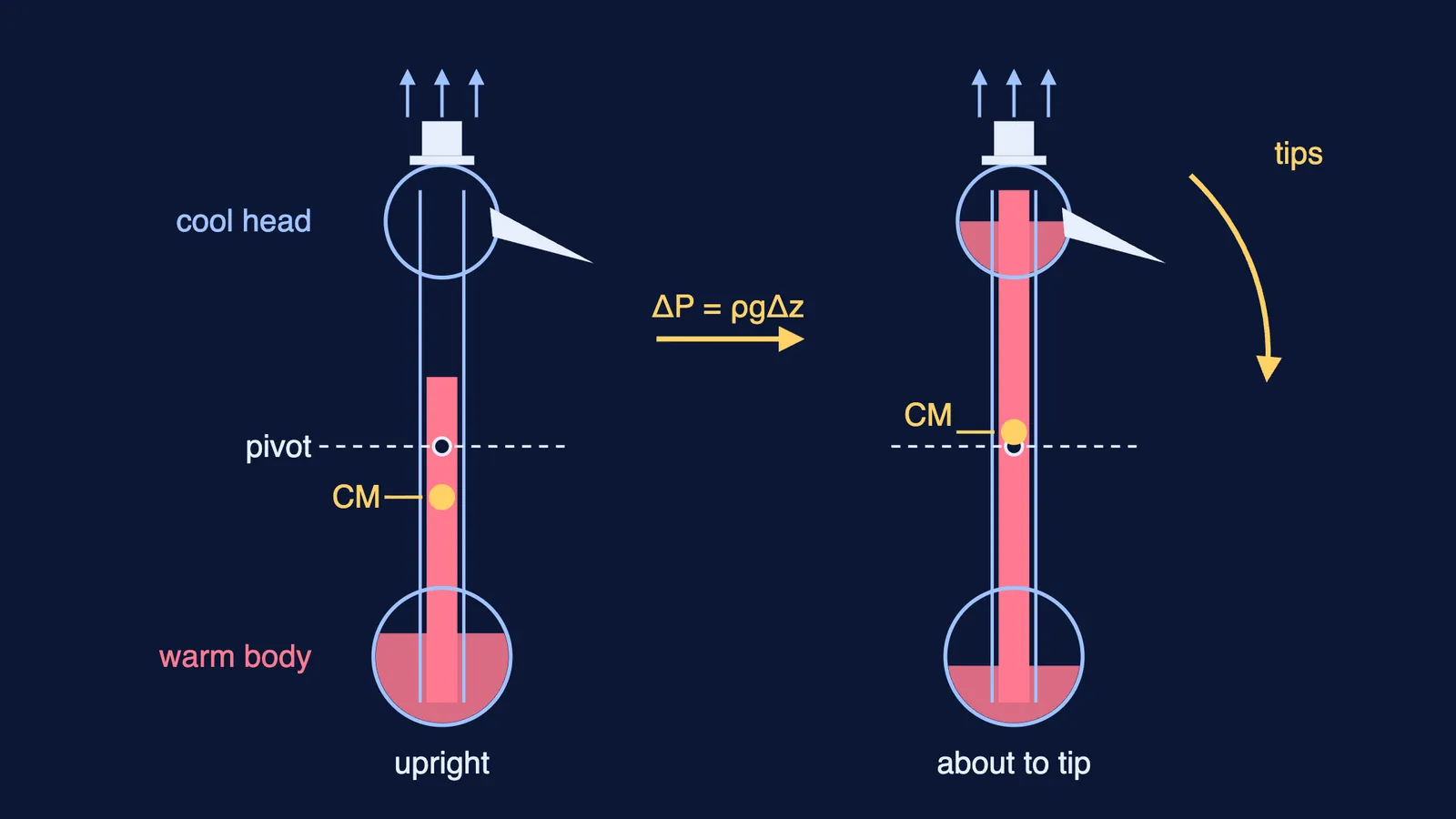
As the liquid climbs, the centre of mass rises and the bird tips forward, beak into the water.
Tipped, the tube's lower end leaves the liquid, vapour passes through, pressures equalise and part of the liquid drains back.
The heavier body swings the bird upright with a wet beak, and the cycle repeats.
Why does such a small temperature drop lift the liquid?
Dichloromethane is volatile, so its vapour pressure changes a lot per degree. PubChem lists it at 47.4 kPa at 20 °C and 435 mmHg (about 58.0 kPa) at 25 °C (PubChem: dichloromethane), roughly 2 kPa for every degree.
The Güémez team used the Clausius–Clapeyron equation to turn this into one constant for their bird, ΔT = ΔP / B, where B = ΔH·P/(RT²) (Güémez et al., 2003). Here is their calculation, with their values:
Find B. With ΔH = 28,094.5 J/mol, P = 0.535 × 10⁵ Pa at a room temperature of 22.5 °C (295.65 K) and R = 8.3145 J/(mol·K): B = (28,094.5 × 53,500) / (8.3145 × 295.65²) ≈ 2.07 × 10³ Pa/K.
Find the pressure difference. The internal liquid (density 1.336 g/cm³) rose Δz = 4.2 cm in one cycle, so ΔP = ρgΔz = 1336 × 9.81 × 0.042 ≈ 550 Pa.
Find the cooling. ΔT = ΔP / B = 550 / 2070 ≈ 0.27 °C.
So their bird's head had to cool by only about a quarter of a degree per cycle, and B agrees with the PubChem figures. For more practice, see the Clausius–Clapeyron equation for water's boiling point in Shimla.
Where does the centre of mass come in?
The temperature difference only moves liquid; gravity does the tipping. As the liquid rises, the bird's centre of mass rises until its weight tips it forward. The authors saw their bird's head half filled just before each dip (Güémez et al., 2003).
For the diagram above, we estimated the centre of mass from the dimensions and masses the paper lists (felt and pivot left out). Upright with the tube half full, it sits about 0.7 cm below the pivot, so the bird is stable. With the tube full and the head half full, it sits about 0.2 cm above the pivot, so it tips. These are estimates: they depend on where the tube ends inside each bulb, which the paper does not give.
Is the drinking bird a perpetual motion machine?
No. It runs only while water evaporates from its head and keeps it colder than the body. Güémez and colleagues found the period is longer on humid days than on dry ones, and at very high humidity the toy does not work at all (Güémez et al., 2003).
Like every heat engine, it is capped by the Carnot efficiency, 1 − T_cold/T_hot, with temperatures in kelvin. If the head ran 1 °C colder than a 22.5 °C room, the cap would be 1/295.65, about 0.34%, and a real bird does worse (here is why Carnot efficiency needs kelvin). The paper also ran the bird with ethyl alcohol on its head instead of water; see why alcohol evaporates faster than water.
How can you check you understand it?
Say the six steps out loud, in order. If you cannot say why step 3 follows from step 2, revisit vapour pressure. Then predict two things. Wrap the head in dry cloth: nothing evaporates, so it stops. Warm the body instead: it can keep going, because Güémez and colleagues note the temperature difference can also come from lighting a black-painted body with a lamp or sunlight.
If the cycle is hard to picture from words, the Fermi Simulation Lab has interactive simulations for ideas that are easier to see than to read, and Fermi's AI tutor can draw the figure and check your understanding as it goes.
Next time you see one bobbing on a shop counter, you are watching a heat engine run on a quarter of a degree.


