

On this page
Most students learn dominance as a contest: the capital-letter allele wins. That gets you through a Punnett square, but not through a question asking *why* round beats wrinkled. A dominant allele is not stronger. It usually still does its job, and one copy doing the job is often enough.
What does NCERT mean by a modified allele?
The Class 12 NCERT Biology chapter Principles of Inheritance and Variation explains dominance by starting with what a gene does: it carries the information for a product, often an enzyme that converts a substrate.
A diploid organism has two copies of each gene, and one may have changed. NCERT says the normal allele makes the normal enzyme, and the modified allele could make:
the normal or a less efficient enzyme
a non-functional enzyme
no enzyme at all
In the first case the two alleles behave the same, and NCERT notes such pairs are very common. In the second and third cases the trait depends only on the unmodified, working allele. That working allele is the dominant one, and the modified allele is generally recessive.
Why is one allele dominant over another at the molecular level?
In a heterozygote, the working allele is not suppressing the other one. The broken allele simply adds nothing, and the trait you see is the enzyme's product, not a vote between alleles. Only when both copies are broken does the product go missing. That is why NCERT says the recessive trait appears because of a non-functional enzyme or no enzyme.
What happens in Mendel's round and wrinkled peas?
Seed shape is one of the seven pea traits in NCERT's Table 4.1. A 1990 paper in *Cell* by Bhattacharyya, Smith, Ellis, Hedley and Martin found that the wrinkled-seed character is caused by a 0.8 kb transposon-like insertion in a gene for starch-branching enzyme; its PubMed abstract adds that wrinkled lines make an aberrant transcript and lack that enzyme form.
The John Innes Centre, where the work was done, explains why that matters: without the enzyme the seed makes less starch and keeps more sugar, which draws in water by osmosis, so the seed swells and then wrinkles as it dries. Mendel's own seeds no longer exist, so the John Innes researchers say they are confident, rather than certain, that this was his mutation; other wrinkled-seed mutations are now known.
In NCERT's terms, the round allele is the unmodified allele that makes the enzyme, and the wrinkled allele is the modified one. One working copy keeps the seed round, so round is dominant.
Can the same allele be dominant and incompletely dominant?
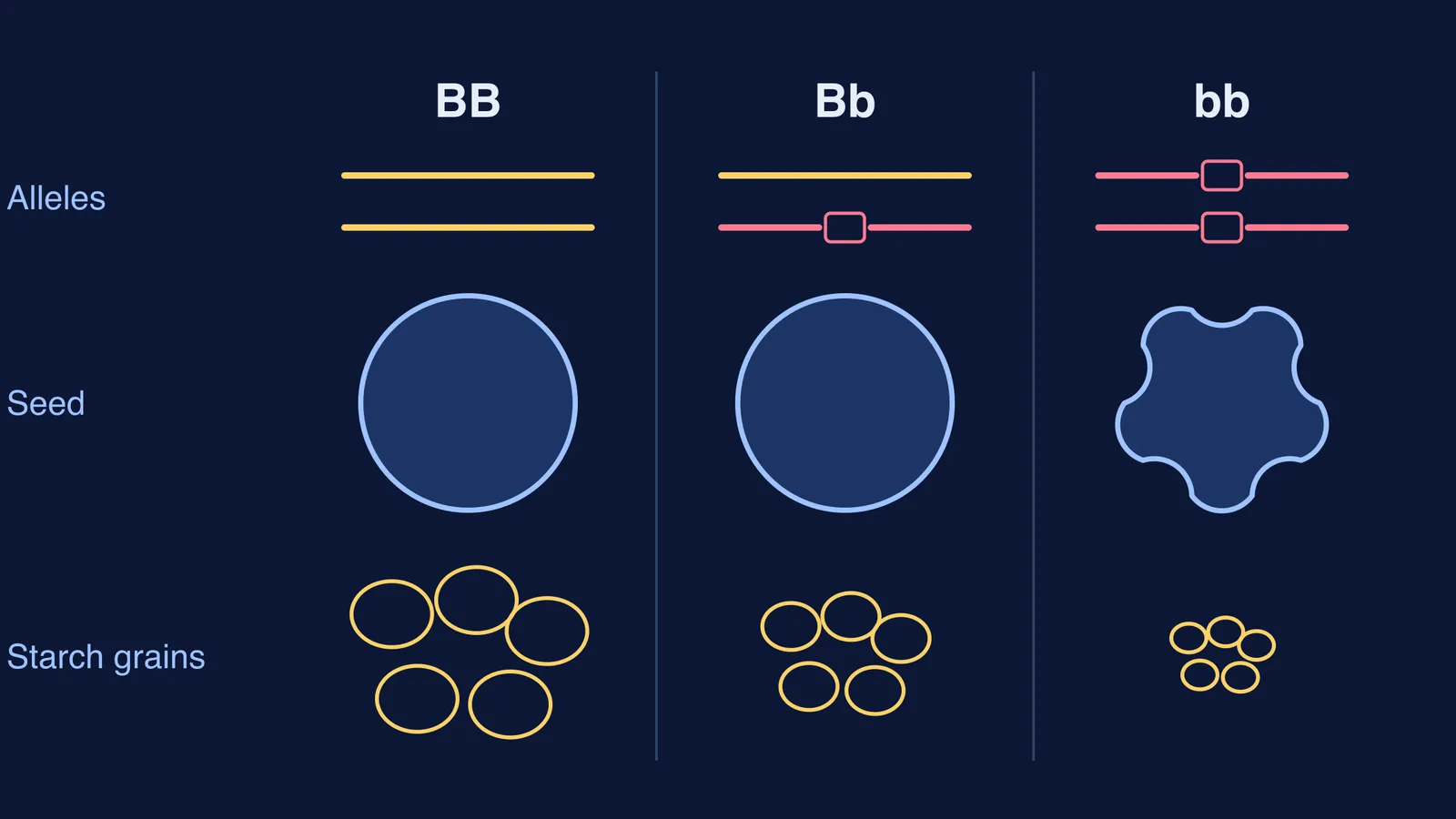
Yes. In the same NCERT chapter, pea starch synthesis is controlled by one gene with alleles B and b. BB seeds make starch effectively, have large starch grains and are round. bb seeds have smaller grains and are wrinkled. Bb seeds are round, so B looks dominant for shape, but their grains are of intermediate size: judged by grain size, the alleles show incomplete dominance.
NCERT's conclusion is the point of this post: dominance is not an autonomous feature of a gene. It depends on the gene product and on which phenotype you choose to examine.
If incomplete dominance and codominance still blur together, our guide on how incomplete dominance differs from codominance separates them with examples.
How do you answer a dominance question in an exam?
Use this three-step check whenever a question asks why one allele is dominant:
Name the product. What protein or enzyme does the gene make? (Starch-branching enzyme for pea seed shape.)
Classify the modified allele. Does it make a less efficient enzyme, a non-functional one, or none?
Pick the phenotype. Is it an either-or trait (round or wrinkled) or one that tracks the amount of product (grain size)? The second kind is where an intermediate heterozygote, as in Bb grains, can show up.
A model two-mark answer: "The dominant allele produces a functional enzyme. The recessive allele produces a non-functional enzyme or no enzyme. In the heterozygote, the one functional copy is enough to produce the normal phenotype, so the recessive trait appears only in the homozygous recessive."
See why a dominant allele is not always the more common one, and if allele, locus and genotype still feel slippery, our plain guide to gene, allele and locus.
To see where dominance sits beside gene expression and enzymes, the Fermi Concept Library gives every biology concept its own lesson and its place in the map. For practice on crosses, the Fermi Problem Library has worked problems with a step-by-step solver that explains the reasoning rather than printing an answer.
Next time you write "R is dominant over r", add one more clause: because R still makes the enzyme.


