On this page
Release a homing pigeon at a spot it has never seen, far from its loft, and it will usually set off for home. Biologists have spent decades working out how. The short answer: pigeons carry a toolkit of senses and switch between them. The long answer is a set of clever experiments, each one taking away a single cue to see what breaks.
Do pigeons use magnetism to fly home?
Probably yes, but mostly as a backup. William Keeton glued small bar magnets to the backs of pigeons and compared them with birds carrying non-magnetic brass bars (Keeton, PNAS 1971).
Keeton found that magnets often disoriented experienced pigeons released 17 to 31 miles (27 to 50 km) from home under total overcast, while similar releases under clear skies showed no such disorientation (Keeton, PNAS 1971).
That pattern is the clue. When the sun is visible, the bird can lean on it instead. Hide the sun and the magnetic cue matters more, so scrambling it causes trouble. Keeton also saw magnets often upset young birds on their first flights even in sunshine, and some disturbance in experienced birds released under sun from longer distances, so the backup picture is not the whole story.
What nobody has settled is where the sensor is. For years, iron-rich cells in the upper beak were the favourite candidate. In 2012, a team including David Keays showed those clusters were macrophages, a kind of white blood cell, not nerve cells that could sense a field (Treiber et al., Nature 2012; IMP Vienna news release). So the behaviour is well supported, while the hardware is still debated.
How does a pigeon use the sun as a compass?
The sun moves across the sky during the day, so a bird can only steer by it if it knows the time. Pigeons use their internal body clock for this.
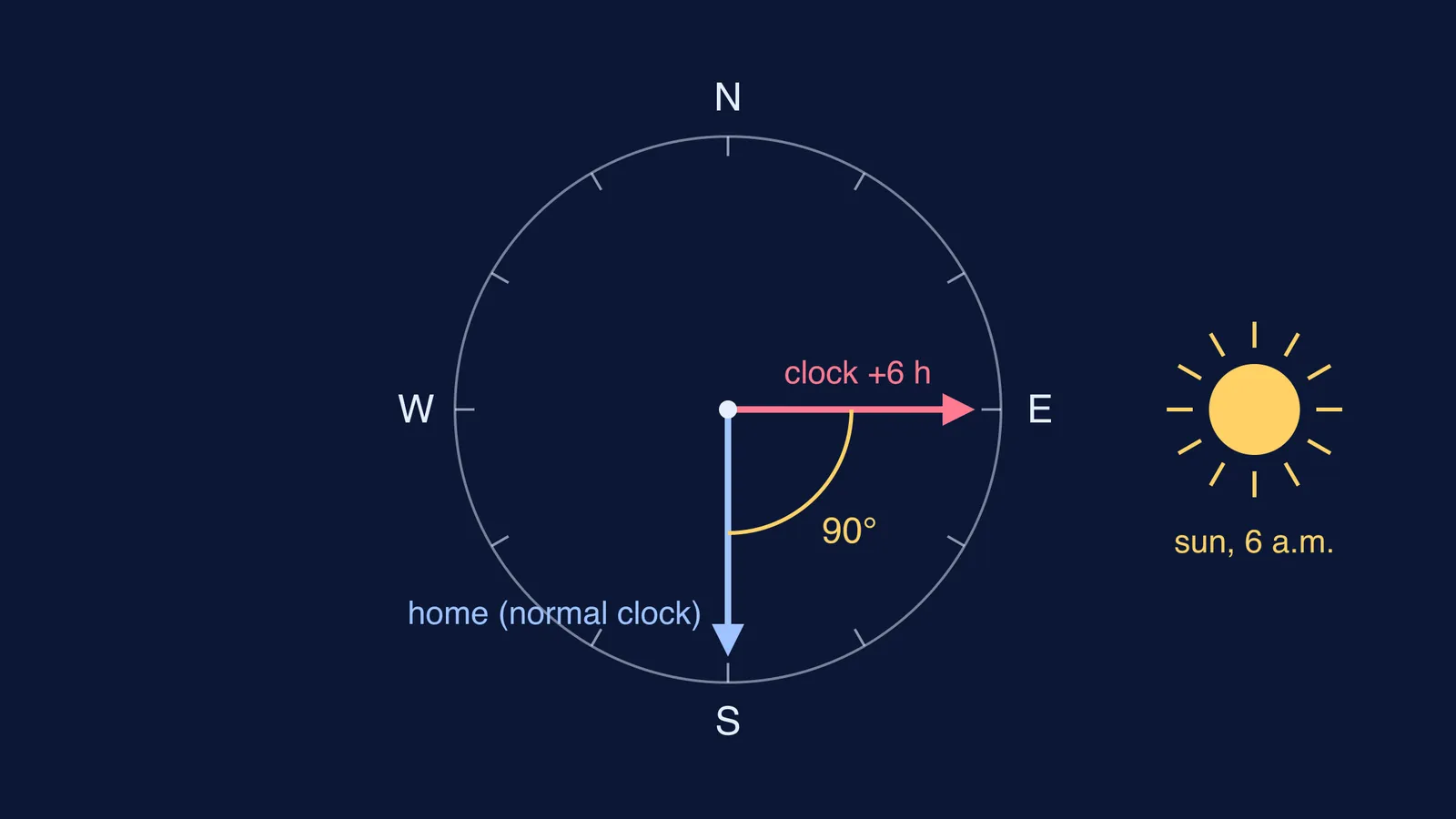
Researchers tested it by shifting that clock: birds kept under lights that switch on hours early come to believe it is a different time of day. Klaus Schmidt-Koenig reported that a 6-hour clock shift made pigeons head off about 90 degrees from their normal initial direction, and a 12-hour shift about 180 degrees (Schmidt-Koenig, 1972).
Can pigeons smell their way home?
In Italy, Floriano Papi and colleagues found that pigeons unable to smell cannot find their way home from unfamiliar sites. They proposed that pigeons learn which smells arrive on which winds at their home loft, then use the local smell at a release site to tell which way they have been moved (Gagliardo, Journal of Experimental Biology 2013).
Anna Gagliardo's review of forty years of this work notes that the exact odours are still unknown, though airborne chemicals form fairly stable gradients that could support odour-based navigation. Smell may be the map that tells a bird where it is, while the sun or magnetism is the compass that tells it which way to fly.
Do pigeons follow roads and landmarks?
Near home, they often do. Dora Biro, Jessica Meade and Tim Guilford fitted 9 pigeons with GPS loggers and found each bird settled on its own fixed route home from training sites about 10 km away (Biro, Meade and Guilford, PNAS 2004).
Released 1 to 1.5 km off those routes, the birds usually flew back to rejoin their personal route (in 76% of off-route releases) rather than heading straight home. Part of one route ran along a major road and a railway line. The authors suggest pigeons store landmarks as waypoints, like a memorised list of turns.
How can you read a navigation experiment yourself?
Every study above follows the logic of a good school practical. Use this checklist on any animal behaviour claim:
Name the cue being tested: sun, smell, landmarks or the magnetic field.
Find the manipulation: magnets, a clock shift, blocked smell, or an off-route release.
Check for a fair control: brass bars instead of magnets, birds kept on normal light.
Write the prediction first: a 6-hour shift should give about 90 degrees of error (Schmidt-Koenig, 1972).
Look for conditions that change the result: sunny or cloudy, familiar or new sites.
Separate behaviour from mechanism: birds can react to magnets even while the sensor is unknown.
The magnetic side links to your physics syllabus. See how a phone compass senses direction without a needle and how to make a compass from a needle and water. For more pigeon biology, read why pigeons bob their heads when they walk.
If Earth's magnetic field is hard to picture, the Fermi Simulation Lab has interactive simulations for ideas that are easier to see than to read.
Next time you see pigeons circling a rooftop in your city, try the checklist: which cue would you take away first, and what would you predict?