

On this page
A sewing needle, a bowl of water, and a magnet are all you need to detect the invisible force field that wraps around our planet. This classic physics experiment shows how magnetism works and gives you a working compass in just a few minutes.
How do you make a compass with a needle and water?
You will need a steel sewing needle, a strong magnet (like a refrigerator magnet), a small square of tissue paper, and a plastic or glass bowl filled with tap water.
Magnetise the needle: Hold the needle by the eye. Press the magnet against the eye and drag it down to the sharp point. Lift the magnet away, bring it back to the eye, and repeat this motion.
Do not rub back and forth: Stroke the needle in one direction only, repeating the motion several dozen times.
Float the tissue: Gently drop the square of tissue paper onto the surface of the water in the middle of the bowl.
Float the needle: Carefully lay the magnetised needle flat on top of the floating tissue paper.
Wait for the paper to sink: As the tissue paper becomes waterlogged, it will slowly sink to the bottom, leaving the needle floating on the surface.
Why does stroking the needle magnetise it?
A steel needle contains iron, a ferromagnetic metal. Inside the metal, the magnetic poles of the iron atoms group together into tiny, aligned clusters. These microscopic regions (1 to 100 micrometres across) are called magnetic domains (Wikipedia).
Each domain acts like its own microscopic magnet. In an ordinary, unmagnetised needle, these domains point in completely random directions, constantly pulling against one another, so their magnetic fields cancel each other out.
When you drag a strong magnet along the needle, the magnetic force pulls on these domains. Stroking repeatedly in one direction forces the domains to rotate and snap into the same alignment. Suddenly, their individual microscopic fields add up rather than cancel out. This turns the entire needle into one unified, temporary bar magnet with its own distinct north and south pole.
Why does the needle point north?
Because the needle is now a magnet, it behaves like a dipole in a non-uniform field—or in this case, the mostly uniform field of the Earth. The Earth acts like a giant magnet, generating a field that stretches in long arcs between its northern and southern hemispheres.
The Earth's magnetic field at its surface has a strength of 25 to 65 microteslas, or 0.25 to 0.65 gauss (Wikipedia). This field is incredibly weak—a typical refrigerator magnet is hundreds of times stronger. If you placed the magnetised needle on a dry table, the friction of the table would resist the Earth's pull, and the needle would sit completely still.
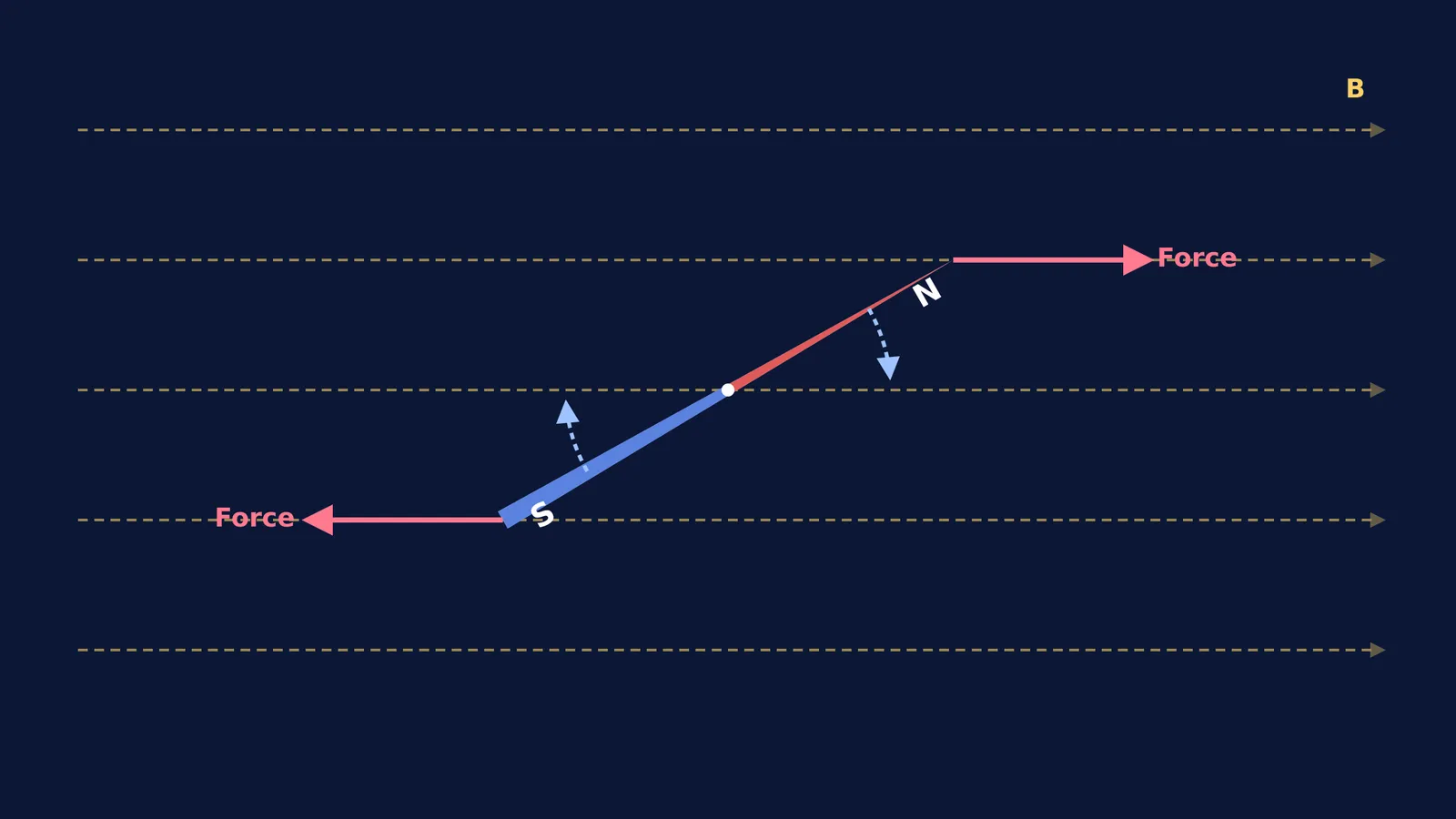
However, once the needle is floating on the water, it is free to rotate with almost zero friction. Even though the Earth's field is weak, the frictionless surface of the water allows it to exert a small turning force, or torque, on the needle. The field pulls the needle's north pole in one direction and its south pole in the opposite direction. The needle will effortlessly spin until it lines up perfectly with the Earth's magnetic field lines.
When you look at your floating compass, it points towards the Earth's magnetic North Pole. The magnetic pole wanders slowly over time due to the shifting of liquid iron deep inside the Earth's core, meaning it sits slightly apart from the geographic North Pole.
Troubleshooting your compass
If your needle refuses to move or points in the wrong direction, check these three things:
Did it sink? Dry the needle completely and try the tissue paper trick again. Ensure you place it perfectly flat so it does not pierce the surface tension.
Is it stuck? Surface tension often pulls floating objects to the sides of the bowl. Gently push the water to coax the needle back to the centre.
Is there interference? Move laptops, phones, and heavy metal objects off the table, as their local magnetic fields will easily overpower the Earth's field.
Visualising magnetic fields
The forces turning your needle are real, but they are completely invisible. You can see the needle turn, but you cannot see the field lines passing through the water.
When you are studying electromagnetism and want to picture these forces—whether you are working out the helical path of a charge in a magnetic field or tracking the torque on a compass needle—you can use the Fermi Simulation Lab. It provides interactive simulations for the ideas that are easier to see than to read, letting you watch exactly how invisible forces push and pull.


