On this page
One short line in NCERT answers a classic exam question: what pays for copying DNA? The building blocks themselves.
Where does the energy for DNA replication come from?
Section 5.4.2 of Chapter 5, Molecular Basis of Inheritance, in the NCERT Class 12 Biology textbook says: "Deoxyribonucleoside triphosphates serve dual purposes. In addition to acting as substrates, they provide energy for polymerisation reaction". The same passage gives the reason: "the two terminal phosphates in a deoxynucleoside triphosphates are high-energy phosphates, same as in case of ATP".
So each of the four dNTPs (dATP, dGTP, dCTP and dTTP) does two jobs at once:
Substrate: it supplies the nucleotide (a base, a deoxyribose sugar and one phosphate) that becomes part of the new strand.
Energy source: its other two phosphates are cut off, and that release pays for the new bond.
The same chapter is blunt about the cost: "energetically replication is a very expensive process."
How does a dNTP pay for its own bond?
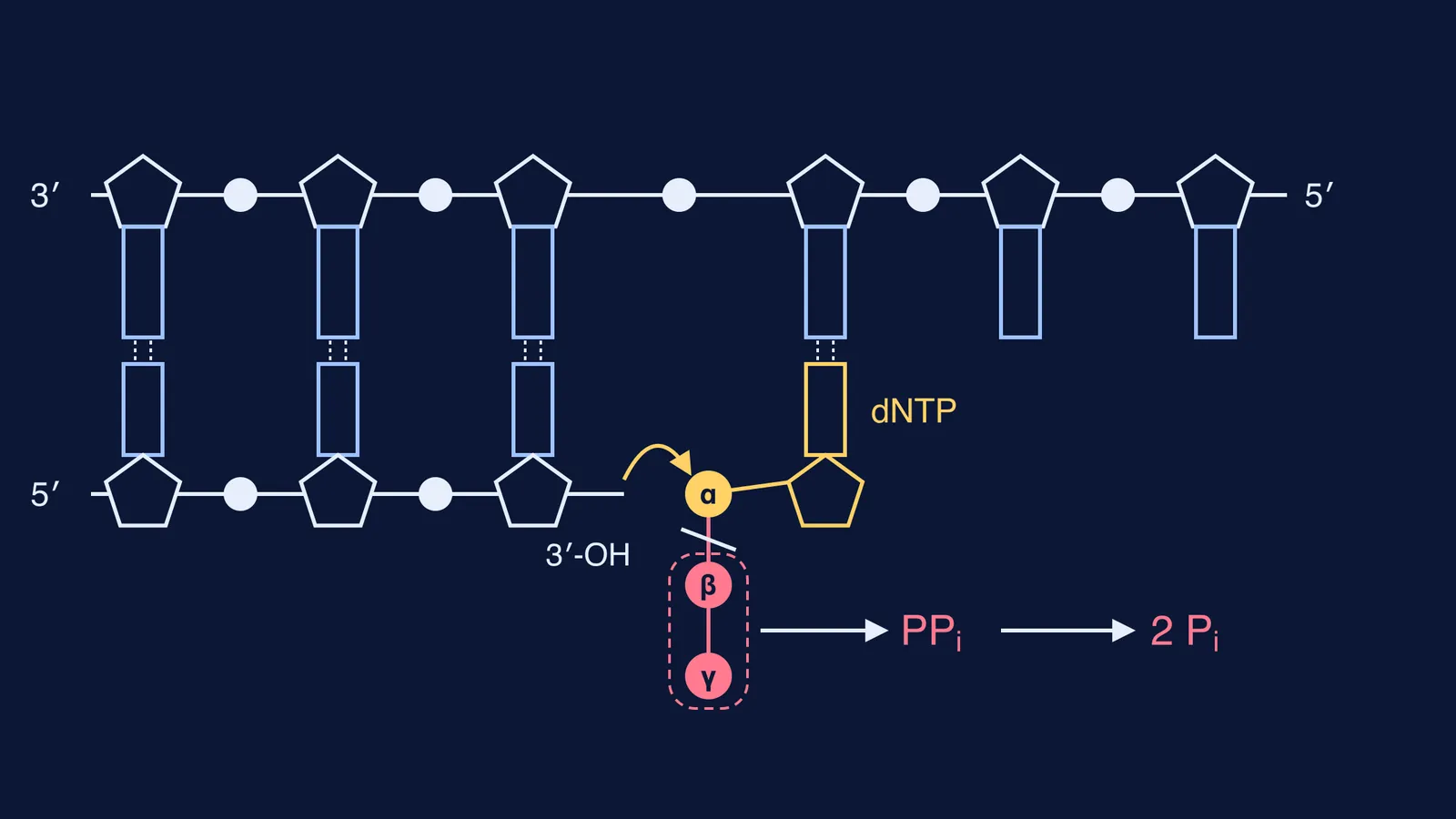
Picture the growing strand with a free 3'-OH group at its end, as in the diagram above. A 2016 study of DnaE, the catalytic subunit of E. coli's replicative DNA polymerase III, describes what DNA polymerases do: they "promote the nucleophilic attack by the 3'-OH of the primer to the α-phosphate of an incoming deoxynucleotide triphosphate (dNTP), releasing pyrophosphate" (Lapenta and colleagues, PLOS ONE).
The 3'-OH of the last nucleotide on the growing strand attacks the innermost (alpha) phosphate of the incoming dNTP.
A phosphodiester bond forms, and the new nucleotide joins the chain.
The outer two phosphates (beta and gamma) leave together as pyrophosphate, written PPi.
An enzyme called pyrophosphatase splits PPi into two separate phosphates (Pi).
A 2021 review in Frontiers in Microbiology gives the standard free energy of PPi hydrolysis as −21 kJ per mole. The same review explains that by destroying PPi, which the reverse reaction needs, "the rate of the back reaction effectively approaches zero". It also notes that protein, RNA and DNA synthesis, which make about 80% of cell mass, all release PPi.
The mechanism also explains why NCERT says polymerases work "only in one direction, that is 5'→3'": the triphosphate sits on the 5' end of each incoming nucleotide, and the chain grows from its 3' end. See what antiparallel means and why 5' to 3' matters.
Is ATP used in DNA replication at all?
Yes, but for different jobs. The two strands must be pulled apart before they can be copied. NCERT notes that the strands "cannot be separated in its entire length (due to very high energy requirement)", which is why copying happens at a small opening called the replication fork.
A 2025 study in Nature describes genome unwinding as "driven by ring-shaped hexameric helicases", and the SV40 virus helicase it studied unwinds DNA using ATP hydrolysis. For a Class 12 answer, keep the two separate: dNTPs pay for building the new strand, and ATP powers machines such as helicase.
Worked example: how many dNTPs does one E. coli copy use?
NCERT gives the numbers: E. coli "has only 4.6 × 10^6 bp" and "completes the process of replication within 18 minutes", which it says means about 2000 bp per second (NCERT, Chapter 5).
Replication is semiconservative, so each of the two daughter molecules has one new strand. New nucleotides = 2 × 4.6 × 10^6 = 9.2 × 10^6.
Each new nucleotide arrives as a dNTP and releases one PPi. That is about 9.2 million PPi per genome copy.
Pyrophosphatase splits each PPi into two Pi, giving about 18.4 million Pi.
Check the speed: 4.6 × 10^6 bp ÷ 1080 seconds ≈ 4260 bp per second for the whole genome. That is about twice NCERT's figure. One way to reconcile them: bacterial replication starts at one origin, oriC, and runs in both directions (Scientific Reports, 2019), so two forks sharing the work would each need roughly 2000 bp per second.
This rough estimate ignores the short RNA primers.
How should you write this in an exam?
A two-mark answer to "State the dual role of dNTPs" can be four lines:
They act as substrates: each provides the nucleotide added to the 3' end of the growing strand.
They provide energy: the two terminal high-energy phosphates are released as pyrophosphate.
Hydrolysis of pyrophosphate drives polymerisation forward.
Name the enzyme: DNA-dependent DNA polymerase, working 5' to 3'.
Assertion-reason questions can twist this line by pairing a true assertion with a wrong reason, for example that dNTPs proofread the new strand. Our post on assertion-reason traps in replication and gene expression covers more of these.
If phosphate bonds and free energy feel shaky, the Fermi Concept Library has a lesson for each idea in biology and chemistry and shows where it sits in the map. To practise the calculation style above, the Fermi Problem Library has worked problems with a step-by-step solver that explains the reasoning rather than printing an answer.