On this page
You open a question on DNA replication and two enzyme names look interchangeable: helicase and topoisomerase. Both seem to "deal with unwinding". They do different jobs in different places, and placing each on a fork diagram clears up most of the confusion.
One thing to know first. The NCERT Class 12 chapter Molecular Basis of Inheritance explains the replication fork in section 5.4.2 and draws it in Figure 5.8, but that section names DNA polymerase and DNA ligase, not helicase or topoisomerase. It does say why a fork exists: the two strands of a long DNA molecule cannot be separated along their entire length because of the very high energy that would need, so replication happens within a small opening called the replication fork. Helicase makes that opening; topoisomerase deals with the strain it causes. If you want the fork itself first, see our guide on how to draw the replication fork diagram step by step.
What does helicase do in DNA replication?
Helicase is the unzipper. In the words of OpenStax Biology 2e, "an enzyme called helicase unwinds the DNA by breaking the hydrogen bonds between the nitrogenous base pairs." That separation creates the Y-shaped replication fork. Near the fork, single-strand binding proteins coat the separated strands so they do not wind back into a double helix, according to the same chapter.
The same OpenStax chapter gives the fork speed in the bacterium E. coli as about 1000 nucleotides per second. Keep helicase to one verb: it separates.
What does topoisomerase do, and why is it needed ahead of the fork?
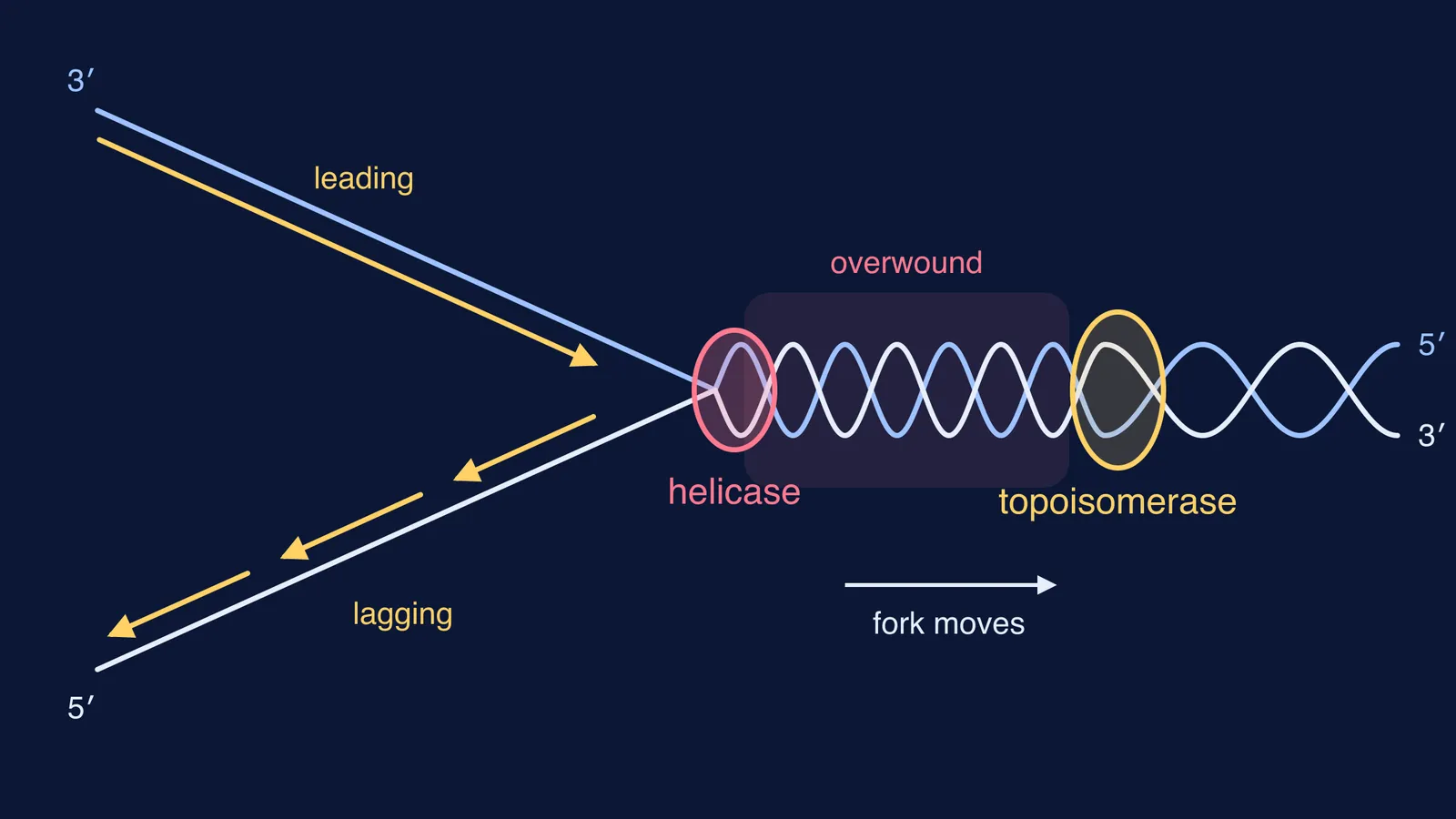
Picture pulling apart the two strands of a twisted rope from one end. The part in your hands opens, but the twist does not disappear; it bunches up further along the rope. DNA behaves the same way. Teaching notes by Michael Blaber of Florida State University on Biology LibreTexts/1:_DNA/1.6:_DNA_Supercoiling_and_Topoisomerases) put it plainly: movement of the growing fork causes the DNA ahead of it to adopt positive supercoils, meaning it becomes overwound.
Topoisomerase relieves that strain. OpenStax Biology 2e says topoisomerase prevents over-winding of the double helix ahead of the replication fork by making temporary nicks in the DNA helix and then resealing it. A review by James Champoux in the Annual Review of Biochemistry (2001) describes topoisomerases as solving the topological problems of replication by introducing temporary single- or double-strand breaks in DNA.
Type I topoisomerases cut one strand of the duplex, according to the Blaber notes linked above.
Type II topoisomerases cut both strands; Champoux notes that the binding and hydrolysis of ATP modulate their shape changes.
DNA gyrase is the name for topoisomerase II in bacteria. OpenStax Microbiology notes that bacterial gyrase is distinct from its eukaryotic counterparts, which is why quinolone antibiotics can target it.
Keep topoisomerase to one verb: it untwists.
Where do helicase and topoisomerase sit in a replication fork diagram?
Read the diagram in three zones, from the arms of the Y towards the unopened DNA.
The arms (behind the fork): single template strands with new strands being built. The leading strand grows continuously towards the fork; the lagging strand is made in short pieces that run away from it. Polymerase, primase, ligase and single-strand binding proteins belong here.
The tip of the Y: helicase, sitting exactly where double helix becomes two single strands.
Ahead of the fork, on the unopened double helix: topoisomerase, where the extra twist builds up.
Two quick checks catch most labelling errors. If an arrow points at single strands, it cannot be topoisomerase. If it points at unopened double helix some distance from the Y, it cannot be helicase. And check that the two template strands run in opposite directions; our explainer on what antiparallel means in DNA and why 5' to 3' matters shows how to label the ends.
How do exam questions mix up helicase and topoisomerase?
Here is a worked example in assertion-reason form, written by us for practice.
Assertion: Topoisomerase breaks the hydrogen bonds between base pairs at the replication fork.
Reason: Positive supercoils build up ahead of a moving replication fork.
Working: The reason is true; it is the overwinding described in the Blaber notes. The assertion is false, because breaking hydrogen bonds is helicase's job. Topoisomerase cuts and reseals DNA strands to remove twist. Answer: assertion false, reason true.
Three swaps to watch for:
"Breaks hydrogen bonds" points to helicase, never topoisomerase.
"Makes temporary cuts and reseals" points to topoisomerase. Ligase joins lagging-strand pieces; it does not relieve twist.
"Gyrase" is a bacterial topoisomerase, not a helicase.
For more traps of this kind, see our guide to assertion-reason traps on replication, genetic code and operons.
If a label still feels like guesswork, the Fermi Concept Library gives every biology concept its own lesson and its place in the map, so you can see how helicase, topoisomerase and the fork connect. For practice, the Fermi Problem Library has worked problems with a step-by-step solver that explains the reasoning rather than printing an answer.
Next time you draw a fork, label the tip and the helix ahead first: helicase separates, topoisomerase untwists.