On this page
Displacing Indigenous Peoples is Theme 6 of NCERT's Class 11 history textbook, Themes in World History, in the section called Towards Modernisation (NCERT chapter PDF, reprint 2026-27). It tells two stories side by side: how European settlers pushed native peoples off their land in North America, and in Australia, where the textbook says the story began nearly 300 years later.
What is the chapter really about?
The chapter is about a clash over land (NCERT, Theme 6). To the natives, goods they exchanged with Europeans were gifts given in friendship. To the Europeans, fish and furs were commodities to sell for profit.
How did native peoples in North America lose their land?
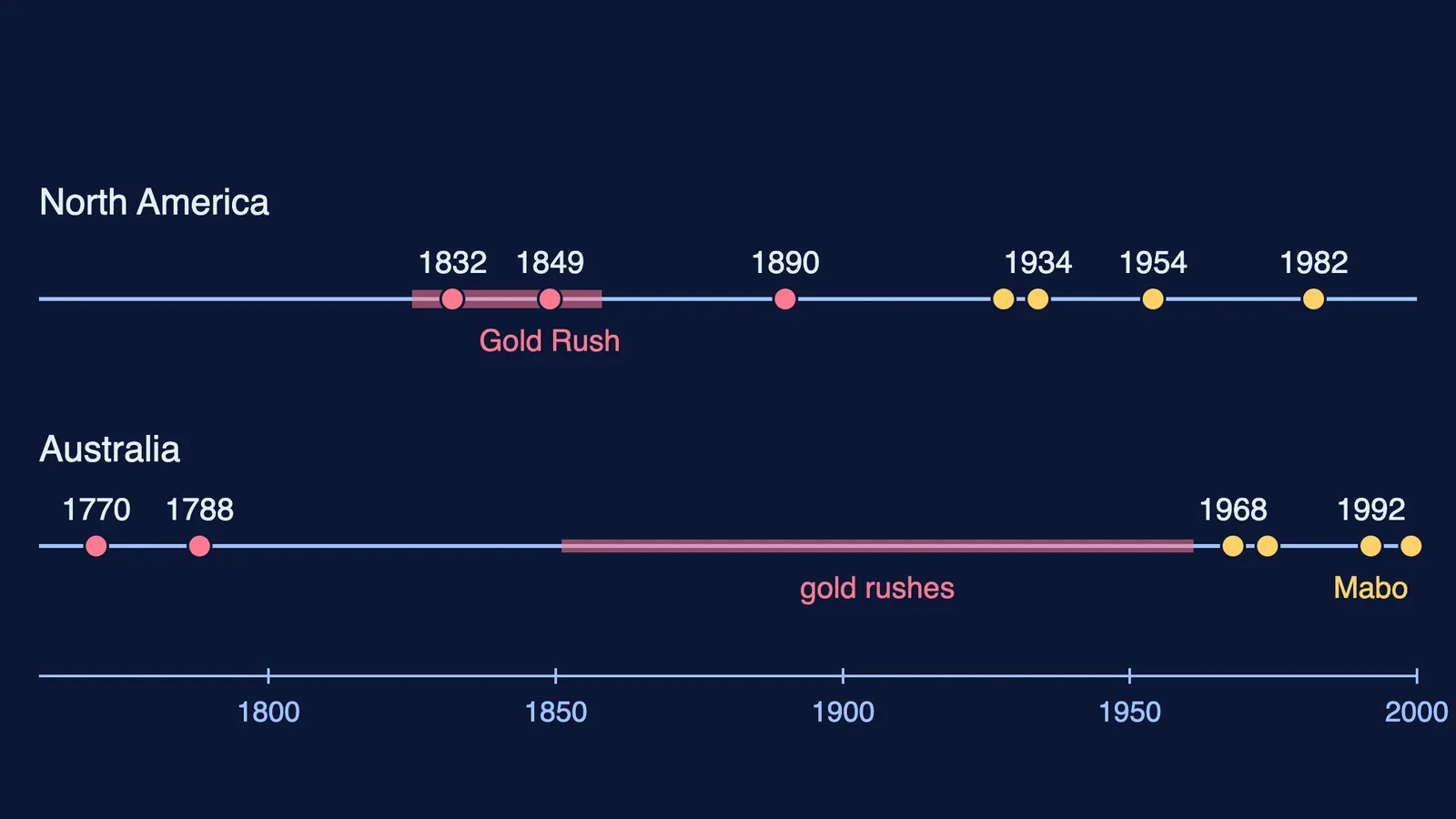
As settlement spread west, natives were induced or forced to sign treaties selling their land at very low prices (NCERT, Theme 6). Its key example is the Cherokee of Georgia. In 1832 Chief Justice John Marshall ruled that the Cherokees were 'a distinct community, occupying its own territory in which the laws of Georgia had no force'. President Andrew Jackson refused to honour the judgment and ordered the army to evict them. NCERT says that of the 15,000 people forced to go, over a quarter died along the 'Trail of Tears'.
Official US sources give other figures. The National Archives says the Indian Removal Act was signed on 28 May 1830, and that removal treaties under Jackson led to the relocation of nearly 50,000 eastern Indians (National Archives). The National Park Service says more than 16,000 Cherokee were evicted in 1838 and more than a thousand died on the trip west (National Park Service).
Natives were promised land 'in perpetuity', then often moved again if lead, gold or oil was found on it. They were locked into small areas called reservations, often land they had no earlier connection with. The US army crushed rebellions from 1865 to 1890, and in Canada the Metis revolted between 1869 and 1885.
Where does the Gold Rush fit in?
Gold was found in California in the 1840s; the textbook's timeline dates the American Gold Rush to 1849 (NCERT, Theme 6). Thousands of Europeans hurried west, and railways followed, built partly by Chinese workers. By 1890 the bison had almost been exterminated, ending the natives' hunting way of life.
What were the winds of change in the USA and Canada?
Things began to improve only in the 1920s (NCERT, Theme 6). A 1928 survey directed by Lewis Meriam described very poor health and education facilities on reservations. The Indian Reorganisation Act of 1934 gave natives in reservations the right to buy land and take loans. In the 1954 Declaration of Indian Rights, native peoples accepted US citizenship on condition that their reservations and traditions were left alone.
In Canada the government announced in 1969 that it would 'not recognise aboriginal rights', and natives answered with demonstrations and debates. Section 35(1) of Canada's Constitution Act, 1982 states: 'The existing aboriginal and treaty rights of the aboriginal peoples of Canada are hereby recognized and affirmed' (Department of Justice Canada).
How is the Australian story different?
NCERT says Aboriginal peoples began arriving over 40,000 years ago, and that in the late eighteenth century there were between 350 and 750 native communities, each with its own language (NCERT, Theme 6). James Cook reached Botany Bay in 1770, and a British penal colony was founded at Sydney in 1788. The textbook says that in the nineteenth and twentieth centuries nearly 90 per cent of native people would die from germs, the loss of their lands and battles with settlers.
The big difference: unlike the USA, Canada and New Zealand, Australia had no treaties with its natives formalising the takeover of land; the government had always called the land terra nullius, belonging to nobody. In 1968 the anthropologist W.E.H. Stanner named historians' silence about Aboriginal people 'the great Australian silence', 'a cult of forgetfulness practised on a national scale' (The Conversation). Then came change: multiculturalism became official policy in 1974, the High Court's 1992 Mabo case declared terra nullius legally invalid, and 26 May 1999 was held as a National Sorry Day.
How do you write a strong answer on this chapter?
Ask four questions and answer each for both countries:
How was land taken? Treaties and removal in the USA; no treaties and terra nullius in Australia.
How was it justified? Settlers said natives did not use the land 'to the maximum'.
How did natives resist? Rebellions, the Metis revolts, the 1954 Declaration, Canada's 1969 protests.
When did recognition come? 1934 and 1982 in North America; 1974, 1992 and 1999 in Australia.
Worked example. NCERT asks why the history of Australia's native peoples was left out of history books. Name the silence (Stanner, 1968). Give the cause: history was written as if it began with Cook's 'discovery', the point of Henry Reynolds' book Why Weren't We Told?. Give the legal root: terra nullius meant no treaties. Show the change: native histories from the 1970s, then Mabo in 1992.
To practise the 'why' questions, build a cause-and-effect chart for a history chapter, and if you revise with a chatbot, check its dates against NCERT. If this chapter shares your week with physics or maths, Fermi's AI tutor can work out what you already know and build a plan for the session.