On this page
You are given f(x) = 1/(1 − x) and asked for the points of discontinuity of f(f(x)). A common slip is to simplify first, get (x − 1)/x, spot the zero denominator at x = 0 and stop there. The full answer is two points, x = 0 and x = 1. The second one vanished during the algebra.
What are the points of discontinuity of f(f(x))?
Work from the inside out, asking at each layer: where does this step fail?
Inner function. f(x) = 1/(1 − x) is undefined when 1 − x = 0, so x = 1 is out.
Outer function. f(f(x)) needs f(x) to be a legal input for f, and the only illegal input for f is 1. Solve f(x) = 1: 1/(1 − x) = 1 gives 1 − x = 1, so x = 0 is out.
Simplify only now. For x ≠ 0, 1: f(f(x)) = 1/(1 − 1/(1 − x)) = (1 − x)/(1 − x − 1) = (1 − x)/(−x) = (x − 1)/x.
So f(f(x)) = (x − 1)/x for all real x except 0 and 1, and it breaks at both points.
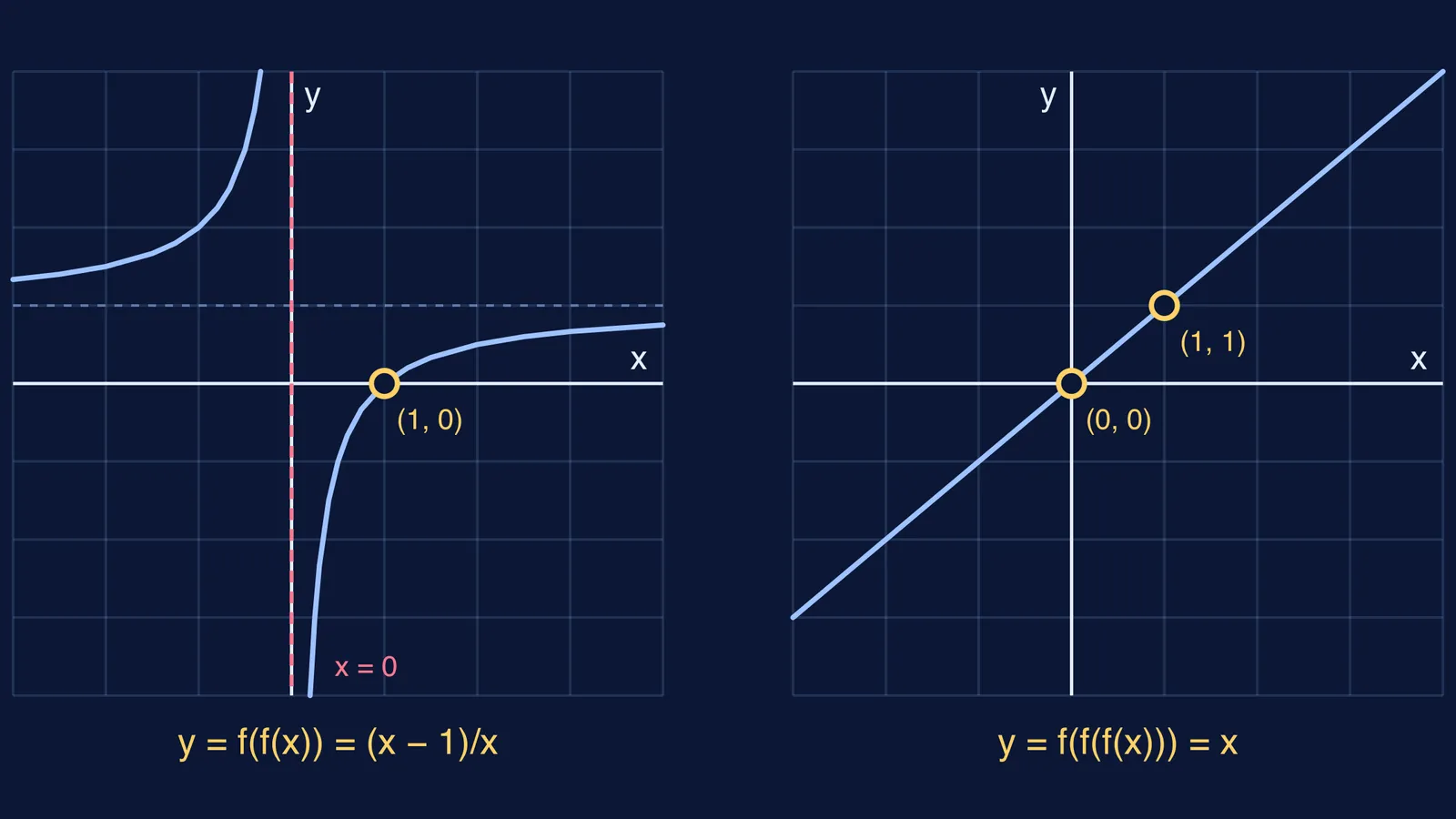
The two breaks look different. At x = 0 the curve shoots off to infinity on both sides: a vertical asymptote. At x = 1 the formula would give 0, so the curve runs smoothly towards (1, 0), but that single point is missing: a hole, not a jump.
Why does simplifying hide a point?
NCERT's Class 12 chapter on continuity says the composite (f o g)(x) = f(g(x)) "is defined whenever the range of g is a subset of domain of f" (NCERT Mathematics Part I, Chapter 5). In practice, the composite keeps every restriction of the inner function, plus any new ones the outer function adds.
When you multiply the top and bottom of 1/(1 − 1/(1 − x)) by (1 − x), you are quietly assuming 1 − x ≠ 0. The final expression (x − 1)/x has no memory of that assumption. It accepts x = 1 and returns 0, but the original never could: its first step, f(1), is 1/0.
This is the same trap as cancelling (x² − 1)/(x − 1) down to x + 1: the formula changes, the domain does not. For a refresher on how denominators set the domain, see our guide to finding the domain of sums and quotients of functions.
What about f(f(f(x)))?
Feed (x − 1)/x into f: 1/(1 − (x − 1)/x) = x/(x − x + 1) = x. So f(f(f(x))) simplifies to plain x, a straight line with no visible break at all.
But to compute it you must pass through f(x) and f(f(x)), so x = 1 and x = 0 are still excluded. The new layer adds nothing, because it would fail only where (x − 1)/x = 1, and that equation has no solution. The graph of f(f(f(x))) is the line y = x with two holes, at (0, 0) and (1, 1). Writing "f(f(f(x))) = x, continuous everywhere" loses both points.
Is x = 1 really a point of discontinuity?
Textbooks and exam questions can use these words a little differently.
NCERT defines continuity at a point c of the domain, and if f is not continuous there, c "is called a point of discontinuity" (NCERT, Chapter 5, Definition 1). By that strict standard, NCERT's Example 9 calls 1/x, x ≠ 0, a continuous function, because 0 is not in its domain. Read the same way, (x − 1)/x is continuous on its domain too.
When a question asks for the "points of discontinuity" of a composite, the safe answer lists every point where it breaks, including points where it is not defined. For this function that list is x = 0 and x = 1. In a written answer, state the domain, then say the function is continuous on it and undefined at 0 and 1. For how continuity carries through sums, products and quotients, read our explainer on the algebra of continuous functions. For the shape near x = 0, see the graph of y = 1/x.
How do you find where any composite breaks?
Use this check whenever a question says f(g(x)), f(f(x)) or fof:
Write the domain of the inner function and strike out its bad points.
List the bad inputs of the outer function, then solve inner output = bad input to find more x values to strike out.
Repeat for each extra layer, carrying every earlier exclusion forward.
Only now simplify, and write the answer as formula, for x ≠ the struck-out values, so the hidden points stay visible.
Self-test: take g(x) = 1/x and find where g(g(x)) breaks. It simplifies to x, but x = 0 is still excluded.
If you get the method right but keep dropping points like these, the Fermi Problem Library has worked problems with a step-by-step solver that explains the reasoning rather than printing an answer, so you can see where each restriction enters. For the definitions themselves, the Fermi Concept Library gives each concept its own lesson.