

On this page
In Class 12 calculus and JEE Main, continuous functions seem comfortably predictable. If you add, subtract, or multiply two continuous functions, the resulting curve never breaks or jumps. But what happens when you mix continuous and discontinuous functions? Specifically, if f(x) is continuous at x = c and g(x) is discontinuous at c, is their sum f(x) + g(x) continuous? The answer is always no. Understanding why—and why that certainty vanishes for products or pairs of discontinuous curves—is crucial for avoiding common exam traps.
What is the algebra of continuous functions?
Calculus relies on the algebra of limits, established formally through Karl Weierstrass and the rigorous definition of a limit. As presented in OpenStax Calculus Volume 1, a function f is continuous at x = c if lim (x → c) f(x) = f(c).
When f and g are both continuous at x = c, their combinations inherit that continuity from limit laws:
Sum and Difference: (f + g)(x) and (f − g)(x) are continuous at x = c.
Product: (f · g)(x) is continuous at x = c because limits distribute across products.
Quotient: (f / g)(x) is continuous at x = c, provided g(c) ≠ 0.
Scalar Multiple: k · f(x) is continuous at x = c for any constant k ∈ ℝ.
Continuous functions on closed intervals also satisfy Bernard Bolzano's intermediate value theorem. To explore how these theorems connect across mathematics, the Fermi Concept Library covers every concept in physics, chemistry, biology, mathematics and computing, each with its own lesson and its place in the map.
Why is the sum of a continuous and discontinuous function always discontinuous?
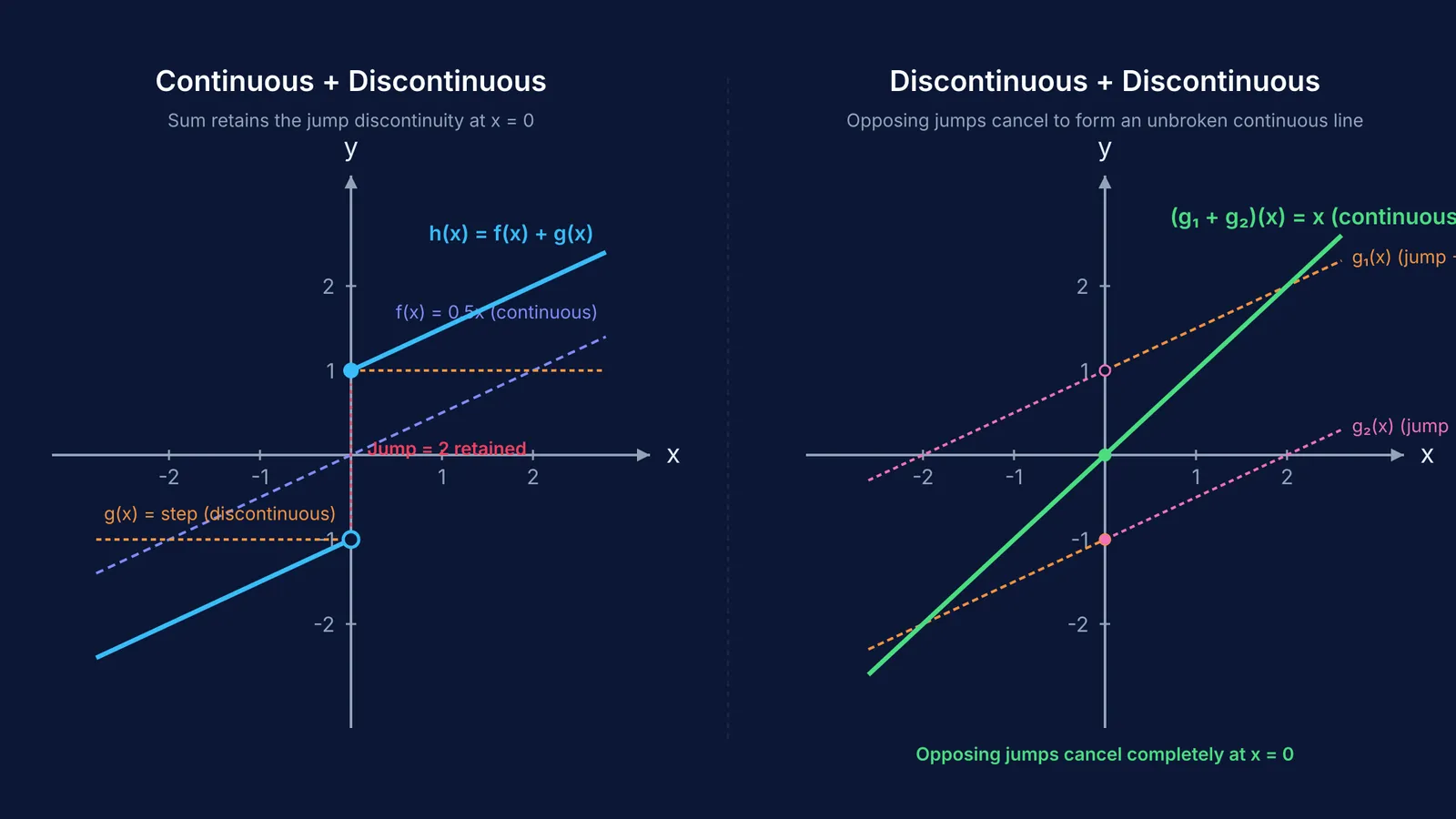
Suppose f is continuous at x = c, while g is discontinuous at x = c. Their sum h(x) = f(x) + g(x) is guaranteed to be discontinuous at x = c.
This follows from an airtight proof by contradiction:
Assume h(x) = f(x) + g(x) is continuous at x = c.
Because f(x) is continuous at x = c, the difference h(x) − f(x) must also be continuous at x = c, as shown in Paul's Online Math Notes.
Expanding this difference yields h(x) − f(x) = [f(x) + g(x)] − f(x) = g(x).
This forces g(x) to be continuous at x = c, directly contradicting our premise.
Thus, h(x) cannot be continuous. A continuous function can never absorb or repair another function's discontinuity through addition.
Can two discontinuous functions add up to a continuous function?
While one continuous and one discontinuous function always sum to a discontinuous function, adding two discontinuous functions can produce a continuous one.
Consider two classic counterexamples:
Floor and fractional part: Let f(x) = ⌊x⌋ (the floor function) and g(x) = {x} = x − ⌊x⌋ (the fractional part function). Both jump at every integer. Yet their sum is (f + g)(x) = ⌊x⌋ + x − ⌊x⌋ = x, which is continuous everywhere on ℝ.
Opposing step functions: Let f(x) = 1 for x ≥ 0 and −1 for x < 0. Let g(x) = −1 for x ≥ 0 and 1 for x < 0. Both jump at x = 0, but (f + g)(x) = 0 for all x, producing an everywhere-continuous constant.
When opposing jumps mirror each other, the discontinuity cancels out. Knowing how to classify removable and jump discontinuities helps you determine whether cancellation is possible.
Can the product of a continuous and discontinuous function be continuous?
Unlike addition, multiplying a continuous function by a discontinuous one can yield a continuous function because multiplying by zero can extinguish a jump.
Take f(x) = x (continuous everywhere) and the discontinuous signum function g(x) = sgn(x), which equals 1 for x > 0, 0 at x = 0, and −1 for x < 0. Their product is h(x) = x · sgn(x) = |x|. At x = 0, the left limit, right limit, and function value all equal 0, making |x| continuous.
However, this cancellation requires f(c) = 0. If f(c) ≠ 0 and f · g were continuous, then (f · g) / f = g would be continuous by the quotient rule, as detailed in LibreTexts Mathematics/02%3A_Limits/2.04%3A_Continuity), contradicting g's discontinuity. Thus, f · g can be continuous at c only when the continuous factor evaluates to zero.
How should you navigate continuity questions in exams?
Use this four-step checklist when evaluating function combinations on exams:
Locate the point c: Identify whether the question concerns an isolated point or an entire interval.
Apply the sum rule: If one function is continuous and the other is discontinuous at c, immediately conclude that f + g is discontinuous at c.
Inspect the zero condition for products: If f is continuous and g is discontinuous at c, check f(c). If f(c) ≠ 0, f · g is discontinuous. If f(c) = 0, evaluate limits directly.
Test piecewise cancellation for two discontinuous functions: Write out the piecewise sum to see if jump heights cancel to produce a smooth curve.
In the Fermi Problem Library, worked problems feature a step-by-step solver that explains the reasoning rather than printing an answer, helping you master these calculus distinctions.


