

On this page
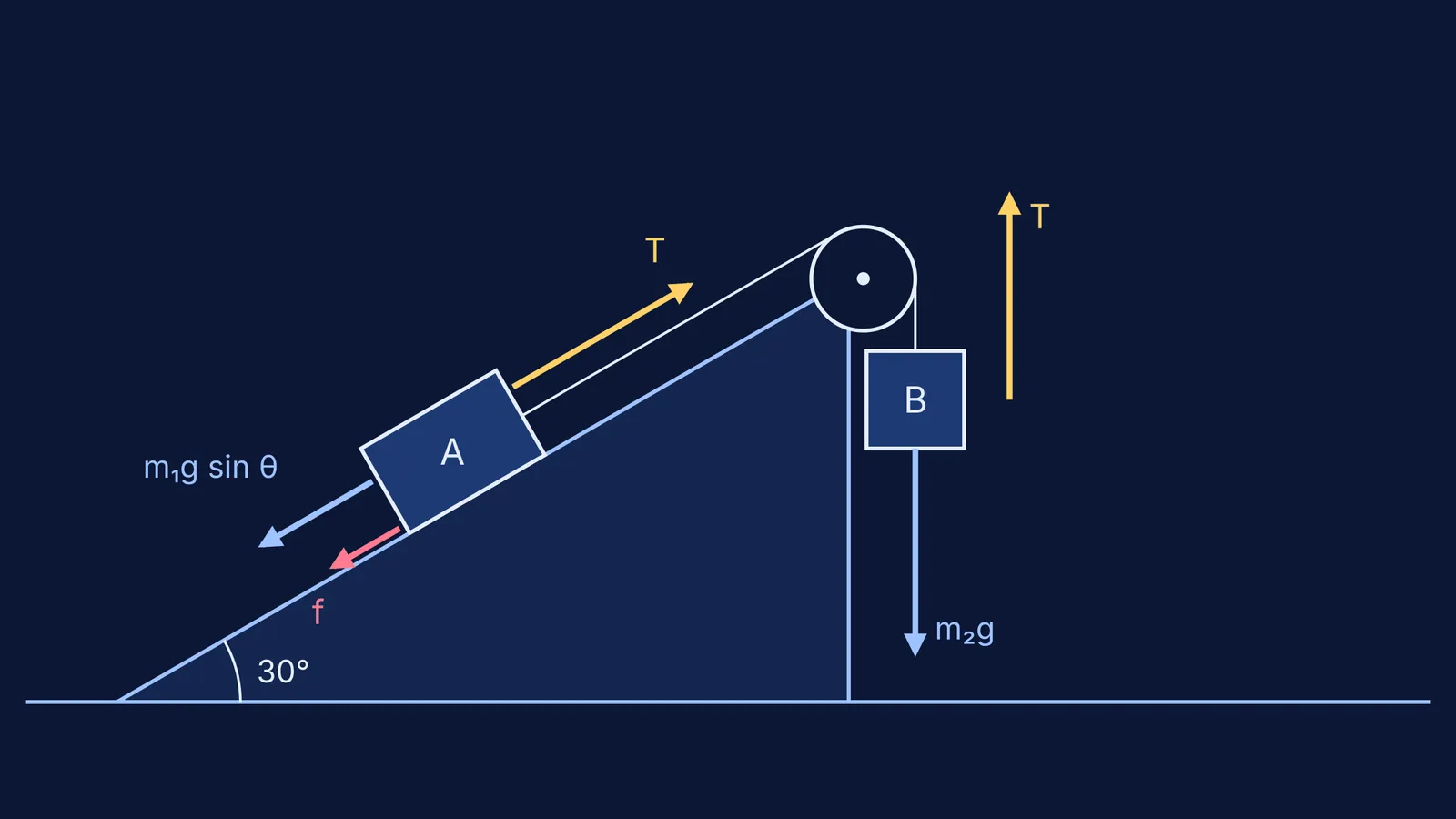
A block sits on a rough incline, tied over a pulley to a second, hanging block. Before writing any equation, you need to know which way friction points. But friction points against motion, so you need the direction of motion first. Many students get stuck in that loop. The way out: decide the direction without friction, then ask whether friction can stop the motion altogether.
Why can't you draw friction first?
Static friction is not a fixed force. OpenStax University Physics Volume 1, section 6.2 puts it plainly: "Static friction is a responsive force that increases to be equal and opposite to whatever force is exerted, up to its maximum limit." Its size obeys fs ≤ μs N, where N is the normal force. So static friction has no direction of its own: it opposes whatever motion would otherwise happen. Only kinetic friction has a fixed size, fk = μk N, once the surfaces are sliding.
That is why guessing a direction and fixing it later with a minus sign fails here. Guess wrong and friction points the wrong way in your equation, so a negative answer no longer means "it moves the other way".
Which way will the blocks move? The two-step test
Call the block on the incline A (mass m₁, slope angle θ) and the hanging block B (mass m₂).
Ignore friction. m₂g pulls the string one way; m₁g sin θ pulls A down the slope. The bigger one sets the direction the system tends to move.
Find the driving difference. D = |m₂g − m₁g sin θ|.
Find the most friction can do. On A, N = m₁g cos θ, so static friction is at most μs m₁g cos θ.
Decide. If D is at most μs m₁g cos θ, nothing moves and friction equals D, opposing the step 1 tendency. If D is larger, the blocks move that way and kinetic friction μk m₁g cos θ opposes the motion.
Rearranged, the system stays at rest whenever m₁(sin θ − μs cos θ) ≤ m₂ ≤ m₁(sin θ + μs cos θ). The same idea appears when you find the force range that holds a block on an incline.
A worked example with real numbers
For wood on wood, the friction table in OpenStax section 6.2 lists μs = 0.5 and μk = 0.3. Let A be a 10 kg wooden block on a 30° wooden slope, with g = 9.8 m/s².
m₁g sin θ = 49 N down the slope.
N = m₁g cos θ ≈ 84.9 N, so maximum static friction ≈ 42.4 N and kinetic friction ≈ 25.5 N.
Now try three hanging masses.
m₂ = 8 kg (weight 78.4 N). B wins without friction, so A tends to move up. D = 29.4 N, less than 42.4 N. Nothing moves; friction on A is 29.4 N down the slope, as in the diagram above.
m₂ = 10 kg (weight 98 N). D = 49 N, more than 42.4 N. A slides up, with 25.5 N of kinetic friction acting down the slope. The acceleration is a = (98 − 49 − 25.5) ÷ 20 ≈ 1.18 m/s².
m₂ = 1 kg (weight 9.8 N). Now A tends to slide down. D = 39.2 N, less than 42.4 N, so the system stays still, but friction now points up the slope.
Case 3 is the trap. Skip the check and you write a = (49 − 9.8 − 25.5) ÷ 11 ≈ 1.25 m/s². It looks reasonable, but the blocks never start: up to 42.4 N of static friction holds them.
With these numbers, A stays put for any hanging mass from about 0.67 kg to 9.33 kg.
What mistakes should you watch for?
Treating the blocks as one body too early. That works for the acceleration only after you know the system moves; see why connected blocks can be treated as one system.
Fixing friction's direction in advance. On the same incline it points down the slope in case 1 and up it in case 3.
Mixing up sin and cos. Along the slope is m₁g sin θ; into it is m₁g cos θ. If that feels shaky, revisit resolving forces on an incline.
How should you practise this?
Take five incline-pulley problems from a textbook or past paper. Before solving, write only the step 1 direction and the step 4 verdict (moves or holds). Then solve and check. The habit: decide before you calculate.
To see that reasoning laid out line by line, the Fermi Problem Library has worked problems with a step-by-step solver that explains the reasoning rather than printing an answer. If the gap is friction itself, the Fermi Concept Library gives every physics concept its own lesson.
Next time you see a pulley at the top of a slope, ask "which way would it go without friction?" first.


