

On this page
When a block sits on a rough inclined plane, gravity naturally pulls it down. To keep the block exactly where it is, you must apply a force. But unlike simple equilibrium problems on flat surfaces, there is no single "correct" force required. Because static friction is a responsive force that can act in either direction along the surface, there is a wide range of forces you can apply to keep the block perfectly still.
Whether you are pushing a heavy crate up a ramp or parking a car on a steep hill, understanding this force range is essential. The block will only break its equilibrium and start to accelerate when your applied force falls outside this specific minimum and maximum window.
How do gravity and friction balance on a rough inclined plane?
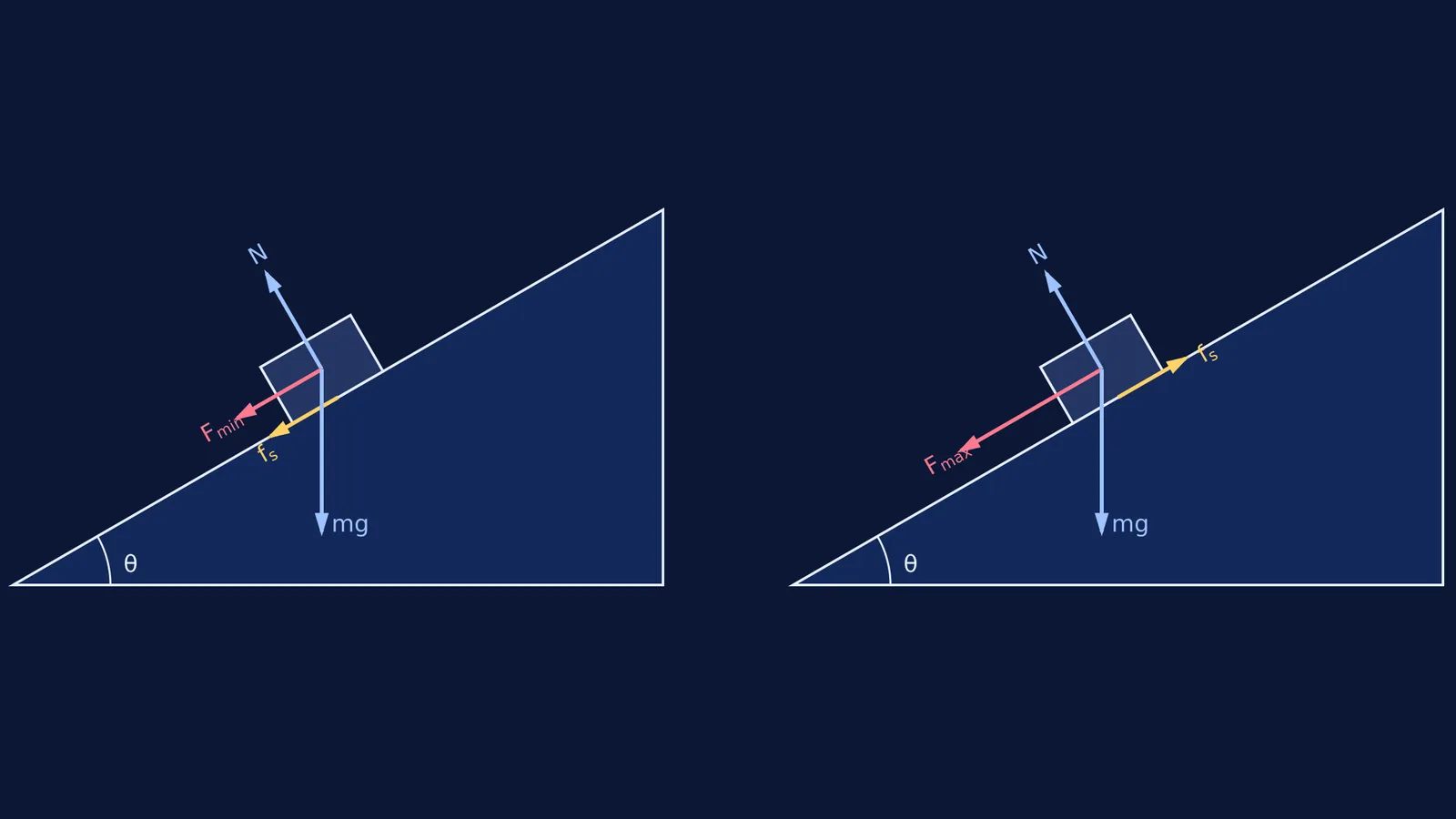
To understand the forces acting on the block, we must draw a free-body diagram. The most effective method is to tilt our coordinate system so that the x-axis runs parallel to the inclined plane and the y-axis is perpendicular to it. Here are the key forces to plot:
Gravity (mg): Pulls straight down toward the center of the Earth.
Normal force (N): Pushes perpendicularly outward from the surface.
Static friction (f_s): Acts parallel to the surface to prevent sliding.
Applied force (F): Your push, acting parallel to the incline.
First, we split the block's weight (mg) into two perpendicular components. The component pulling the block directly down the slope is mg sin θ. The component pressing the block firmly into the solid surface is mg cos θ. Because the block does not sink into the ramp, this perpendicular weight component exactly equals the normal force (N).
According to the OpenStax University Physics textbook, the maximum possible static friction (f_s) is equal to μ_s N. This means the rough surface can provide up to μ_s mg cos θ of frictional force to oppose any impending motion.
What is the minimum force to keep a block at rest on a rough incline?
If the angle of the incline is steep enough, the component of gravity pulling the block down (mg sin θ) becomes quite large. The block will naturally want to slide down the ramp. To stop this, you must apply a minimum push force (F_min) directed up the slope.
In this scenario, static friction helps your effort. Because the block's impending motion is downward, static friction points up the slope to oppose the downward pull of gravity.
Writing the force balance equation for the axis parallel to the plane gives: F_min + f_s = mg sin θ
When the block is on the absolute verge of sliding down, static friction is at its maximum limit to help you. Substituting f_s = μ_s mg cos θ, we can solve for the minimum push: F_min = mg(sin θ − μ_s cos θ)
If the coefficient of static friction (μ_s) is greater than or equal to tan θ, the friction is strong enough to hold the block entirely on its own. In that specific case, F_min is effectively zero, because the block will not slide even if you let go completely. The angle where this transition happens is known in physics as the angle of repose.
What is the maximum force before the block slides up?
If you start pushing harder than F_min, the block does not immediately move. Instead, the static friction simply decreases to maintain a perfect balance. There is even a specific push force where friction drops exactly to zero.
However, if you continue to push harder, the block will eventually want to slide up the slope. To oppose this entirely new impending motion, static friction switches direction and acts down the slope, working alongside gravity to fight your push.
The maximum force (F_max) you can apply before the block breaks loose and accelerates upward is calculated by pointing friction down the ramp: F_max = mg sin θ + f_s
Substituting the maximum limit for static friction again, we get: F_max = mg(sin θ + μ_s cos θ)
How can an AI tutor help with free-body diagrams?
The trick to solving incline problems in exams like JEE Main or NEET-UG is getting the direction of friction right every time. If you consistently struggle to know which way the vectors point, the Fermi Concept Library covers the foundational rules of static and kinetic friction.
If you are stuck on a specific homework problem, Fermi's AI tutor can help. Instead of just printing the final equation, Fermi works out what you already know, builds a plan for the session, and teaches through it—drawing the figure and checking your understanding as it goes.
To practice applying these equations, read our guide on how to solve physics problems step by step, or explore when to treat connected blocks as one system.


