

On this page
You meet the triangle-and-bar symbol in every Class 12 electronics circuit. Which way does the current go, and what is the arrow telling you?
What does the arrow in a diode symbol mean?
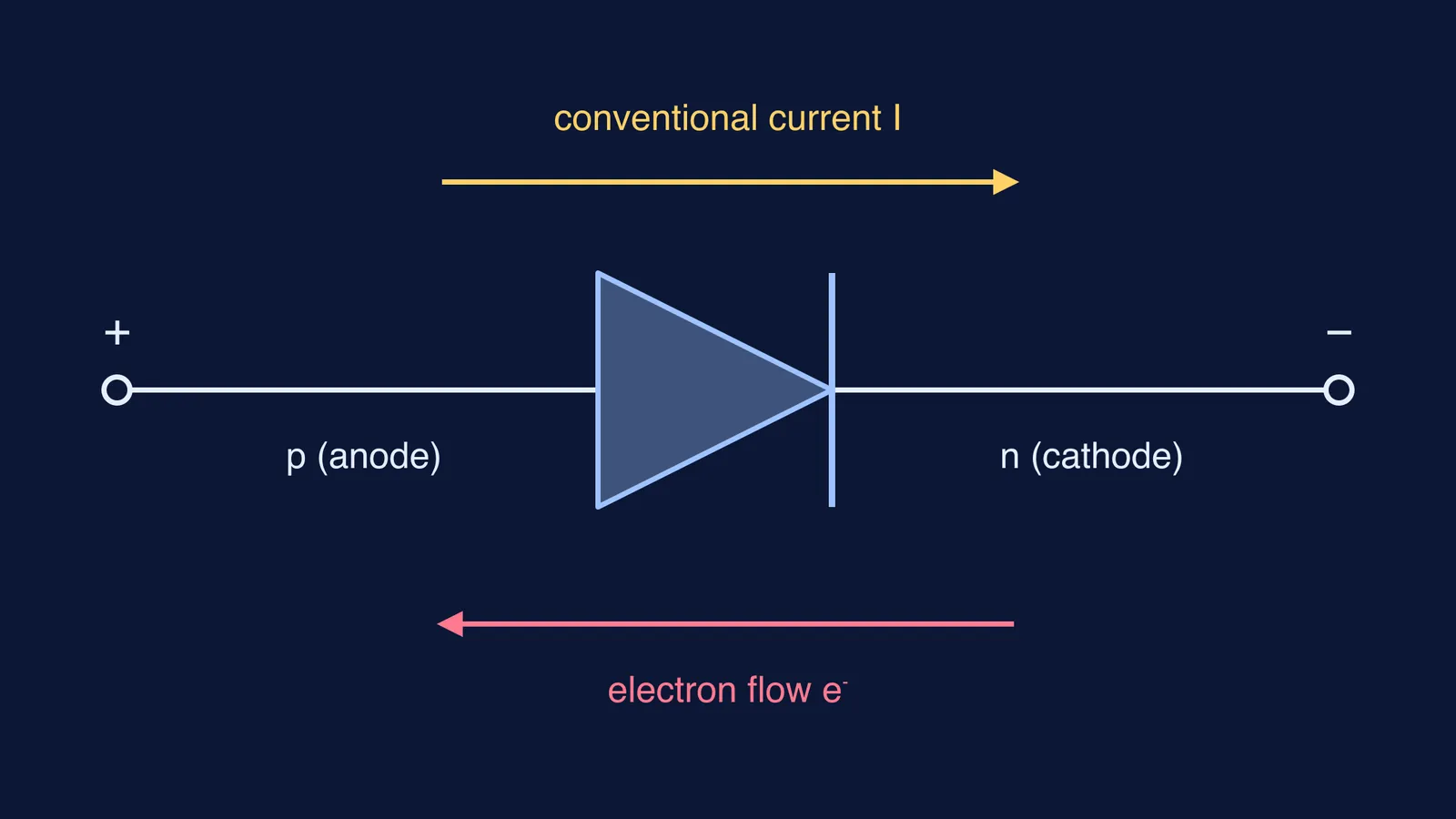
The arrow points in the direction of conventional current when the diode is forward biased. The NCERT Class 12 Physics chapter on semiconductor electronics puts it in one line: "The direction of arrow indicates the conventional direction of current (when the diode is under forward bias)."
NCERT's symbol (Fig. 14.12(b)) labels the triangle p and the bar n; in electronics these terminals are called the anode and the cathode:
The triangle is the p side, called the anode.
The bar is the n side, called the cathode.
The arrow points from triangle to bar, so from p to n.
The Wikipedia article on diodes agrees: the triangle points in the forward direction, the direction of conventional current flow.
Why does the arrow point from p to n?
Because that is the only direction in which a large current can flow. A diode is forward biased when the p side is connected to the positive terminal of the battery and the n side to the negative terminal, as the NCERT chapter defines it (section 14.6.1). The applied voltage then lowers the barrier potential at the junction, so more carriers can cross it.
NCERT describes what happens next: holes from the p side cross into the n side, and electrons from the n side cross into the p side. Those two movements look opposite, but they add up. Holes carry positive charge moving p to n; electrons carry negative charge moving n to p. Both give a conventional current from p to n, which is the way the arrow points.
Which way do electrons flow in a diode?
Against the arrow. Conventional current is defined as the direction positive charge would move, and electron flow is the reverse of it, as the Wikipedia diode article notes. So in a forward-biased diode, electrons travel from the cathode (bar) to the anode (triangle).
Wikipedia also notes that most real diodes carry a white or black painted band that identifies the cathode. The band on the body matches the bar in the symbol. Our lab guide on how to identify a diode, LED, transistor and resistor shows what this looks like on the bench.
When does current actually follow the arrow?
Only once the forward voltage is large enough. In forward bias, the current stays almost negligible until the voltage crosses the threshold, or cut-in, voltage, which the NCERT chapter gives as about 0.2 V for germanium and about 0.7 V for silicon. Above it, the current rises sharply.
In reverse bias, the current is very small, of the order of microamperes, and almost constant; NCERT calls it the reverse saturation current. Forward current, by contrast, is usually in milliamperes. At a high enough reverse voltage, the breakdown voltage, the reverse current suddenly increases, and the diode can be destroyed if that current is not limited. So the arrow tells you the easy direction, not the only possible one.
Every LED follows the same rule: it is a p-n junction that glows when forward biased. Our explainer on how an LED turns current into light follows the carriers across the junction.
How to read any diode in a circuit: a 30-second check
Run this on every diode before you write an equation:
Find the triangle and the bar. Triangle = p = anode; bar = n = cathode.
Trace the triangle end back to the supply. If it reaches the higher potential (the + side), the diode is forward biased.
If it is forward biased and the supply is well above the threshold (about 0.7 V for silicon), treat it as conducting, with current along the arrow.
If it is reverse biased, treat it as an open switch; only the tiny reverse saturation current flows.
If the question asks about electrons, reverse the arrow.
Worked example. A 5 V battery, a silicon diode and a 1 kΩ resistor are in series, with the triangle facing the + terminal. Step 2 says forward biased. If you model the diode as a fixed 0.7 V drop (a simplification of the real curve), the current is (5 − 0.7) V ÷ 1000 Ω = 4.3 mA, flowing through the diode from anode to cathode. Flip the diode and it is reverse biased: only a microampere-level reverse current flows, effectively zero here.
If the junction picture itself feels shaky, read how diffusion and drift build the depletion layer in a p-n junction, or open the Fermi Concept Library, which gives every concept in physics its own lesson and its place in the map. For practice, the Fermi Problem Library has worked problems with a step-by-step solver that explains the reasoning rather than printing an answer.
Next time you see the symbol, say it out loud once: triangle is p, arrow is conventional current, electrons go the other way.


