

On this page
In short An LED produces light when electrons in a forward-biased p-n junction drop from a higher energy state to a lower one, releasing the difference as photons. The colour of the light depends on the semiconductor's band gap, with red LEDs needing about 1.77 eV and violet needing 3.1 eV.
Unlike a traditional incandescent bulb that forces current through a high-resistance tungsten filament until it glows white-hot, a light-emitting diode (LED) generates light without heat. This process, called electroluminescence, happens inside a tiny chip of semiconductor material.
To understand how it works, we have to look at how electrons behave when they cross the boundary between two different types of semiconductor.
How does a p-n junction work?
An LED is built around a p-n junction, which is a slice of semiconductor (like gallium arsenide or gallium nitride) divided into two zones. The n-type zone is doped with impurities that give it an abundance of mobile electrons. The p-type zone is doped to have an abundance of "holes", which are empty spaces where an electron could be, acting as positive charge carriers. Both zones start out electrically neutral; for a deeper explanation of this common confusion, read Is an n-Type Semiconductor Negatively Charged?.
When the LED is connected to a battery in forward bias — meaning the positive terminal is connected to the p-type side and the negative terminal to the n-type side — the electrical pressure pushes electrons and holes toward the boundary between them. (To see how this affects the junction barrier itself, read about how depletion layer width changes in forward and reverse bias.)
How does an LED produce light?
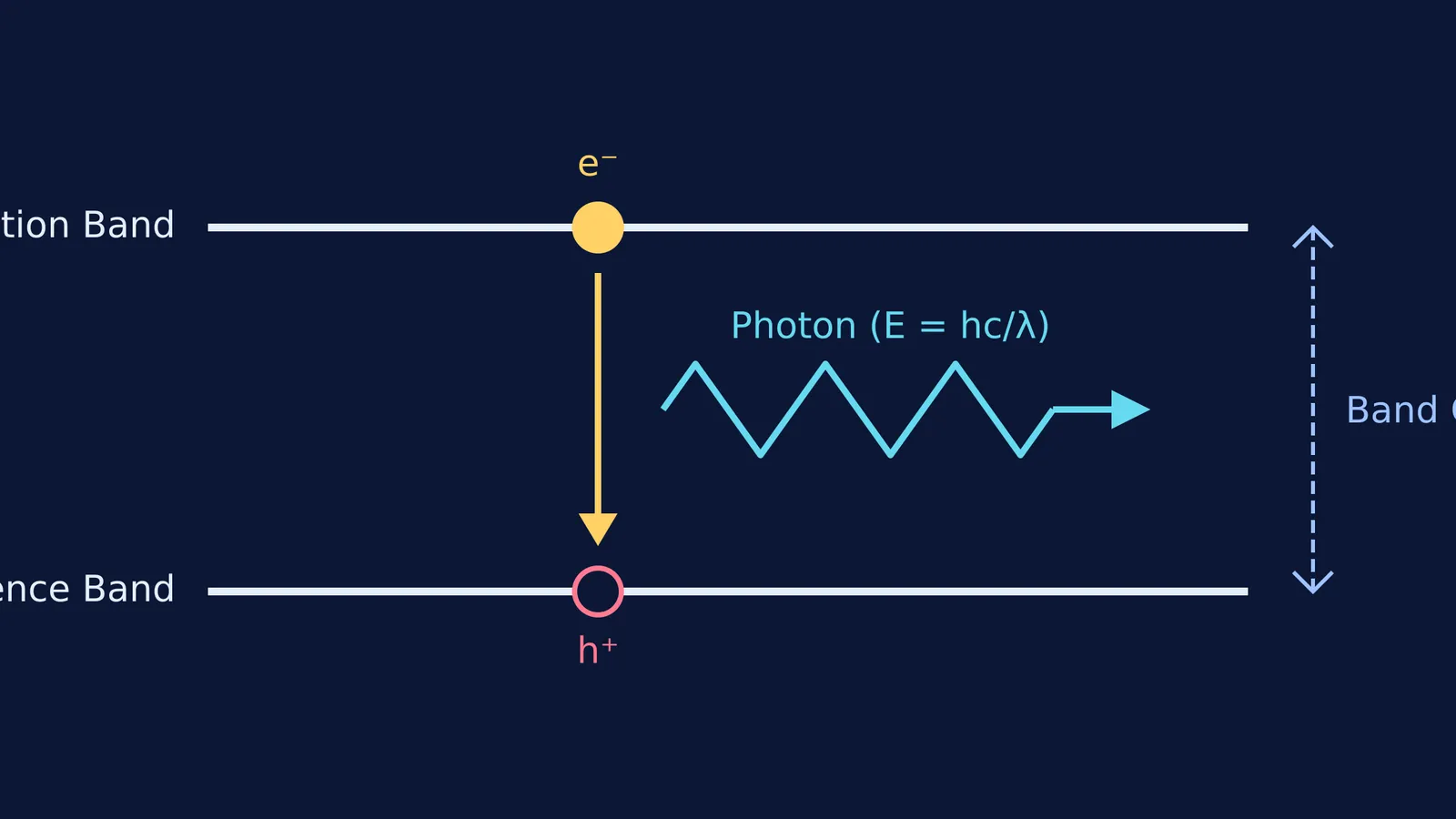
As electrons from the n-type side cross the junction, they meet holes from the p-type side. In energy terms, these electrons are sitting in a higher energy state called the conduction band, while the holes are in a lower energy state called the valence band.
When an electron meets a hole, it drops into it. Because the electron is falling from a high energy state to a lower one, it must shed its excess energy. In an LED, this energy is released instantly as a photon, which is a fundamental particle of light.
If you find it hard to picture electrons moving across energy bands and emitting waves, interactive tools can help. The Fermi Simulation Lab provides interactive simulations for the ideas that are easier to see than to read, allowing you to experiment with energy levels and circuits firsthand.
Why do LEDs have different colours?
An LED does not emit white light directly; it emits a single, specific colour. That colour depends entirely on the size of the energy drop, known as the band gap.
The larger the band gap, the more energy the electron releases, and the higher the energy of the resulting photon. A red photon requires an energy release of approximately 1.77 eV, while a violet photon requires about 3.1 eV.
Manufacturers change the band gap by using different semiconductor materials. For example, gallium arsenide phosphide is used for red and yellow LEDs, while gallium nitride creates a large enough band gap for blue LEDs.
How do you calculate LED wavelength from the band gap?
In Class 12 physics and entrance exams, you are often asked to find the wavelength of the light emitted by an LED if you know its band gap energy. As explained on HyperPhysics, the photon's energy equals the band gap.
You can find the wavelength using the Planck-Einstein relation: E = hc / λ.
Where:
E is the band gap energy in joules or electron-volts
h is Planck's constant
c is the speed of light
λ is the wavelength of the emitted photon
Worked Example: Suppose an LED is made of a semiconductor with a band gap of 1.9 eV. What is the wavelength of the emitted light?
Instead of multiplying out the tiny constants in standard SI units, use the practical shortcut hc ≈ 1240 eV·nm. This allows you to find the wavelength directly in nanometres.
λ = 1240 / E = 1240 / 1.9 ≈ 652 nm.
A wavelength of 652 nm falls squarely in the red part of the visible spectrum. By understanding this single relationship, you can predict the colour of any LED just by looking at its material's band gap.


