

On this page
It is easy to assume that because an "n-type" semiconductor has a surplus of electrons, it must carry a negative charge. The "n" literally stands for negative. However, this is a common misunderstanding of how doping works.
An n-type semiconductor is completely electrically neutral. The negative electrons are exactly balanced by positive ions that are locked in the crystal lattice.
Why does "n" stand for negative?
In a pure (intrinsic) semiconductor like silicon, every atom has four valence electrons. These electrons are all tied up in covalent bonds with their neighbours, forming a stable, regular crystal lattice. Because all the electrons are locked into bonds, pure silicon has very few free charges to carry an electric current at room temperature.
To make the material conduct better, we dope it. This means intentionally adding specific impurity atoms. For an n-type semiconductor, we add a pentavalent element such as phosphorus, arsenic, or antimony, which has five valence electrons.
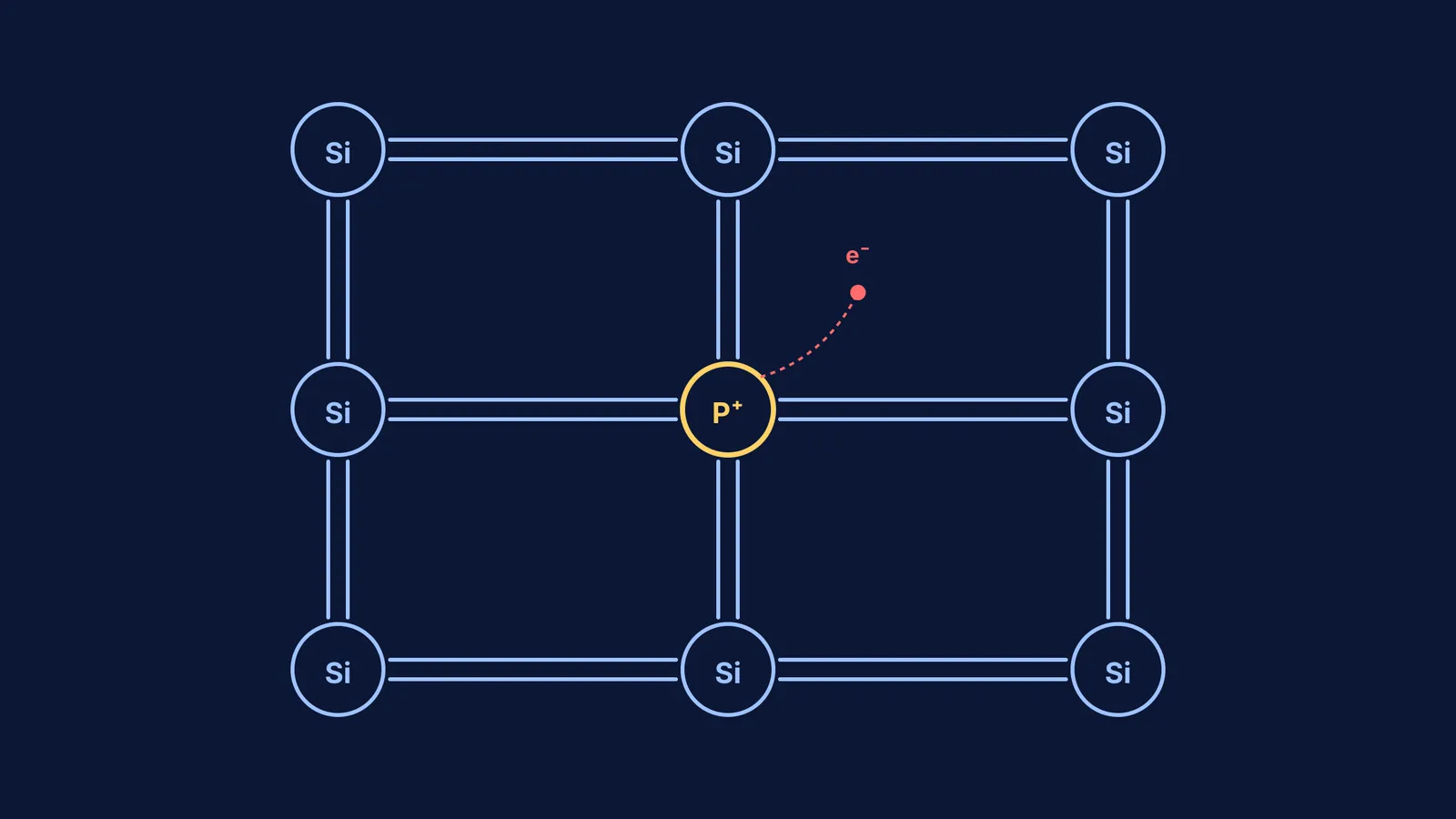
When a phosphorus atom replaces a silicon atom in the lattice, four of its valence electrons form normal covalent bonds with the surrounding silicon atoms. The fifth electron is left over. It is only weakly bound to the parent atom, and the thermal energy present at room temperature is enough to break it free. It wanders through the crystal as a mobile charge carrier.
Because the vast majority of the mobile charge carriers in this material are these negative free electrons, it is called an n-type semiconductor.
Is an n-type semiconductor negatively charged?
No, an n-type semiconductor is not negatively charged. The material as a whole remains electrically neutral.
To see why, we have to look at the atoms before and after they bond. Before doping, the pure silicon crystal is neutral. The phosphorus atoms we add are also entirely neutral—they each contain exactly 15 protons in the nucleus and 15 electrons in orbit.
When a phosphorus atom donates its fifth electron to the conduction band, the total number of electrons and protons in the crystal does not change. We have not added extra electrons to the material from the outside; we have only freed up electrons that were already there.
According to OpenStax *University Physics*, when the neutral donor atom loses its electron to the lattice, it becomes a positively charged ion fixed in place. The negative charge of the roaming free electron is perfectly cancelled by the stationary positive charge of the donor ion left behind.
A numerical example of neutrality
We can picture this balance with numbers. Silicon has about 5 × 10²² atoms in every cubic centimetre, according to PV Education.
Suppose we dope the silicon with phosphorus at a ratio of 1 part per million. This means we replace one in every million silicon atoms with a phosphorus atom.
We add 5 × 10¹⁶ phosphorus atoms per cubic centimetre.
Each of these atoms donates one free electron.
This creates 5 × 10¹⁶ free electrons per cubic centimetre.
At the same time, because each phosphorus atom lost an electron, it becomes a positive ion (P⁺). We now have exactly 5 × 10¹⁶ positive donor ions per cubic centimetre permanently embedded in the crystal.
The negative charge density of the free electrons perfectly matches the positive charge density of the donor ions.
Why is an n-type semiconductor electrically neutral?
In any semiconductor, the sum of all negative charges must equal the sum of all positive charges. We can write this charge neutrality condition as a simple mathematical equation:
n + N_A = p + N_D
Here, n is the number of free electrons and N_A is the number of fixed negative acceptor ions. On the positive side, p is the number of holes and N_D is the number of fixed positive donor ions.
In an n-type material with no acceptors, N_A is zero. The number of electrons is equal to the number of holes plus the number of donor ions. The free electrons massively outnumber the holes, but the overall crystal has a net charge of exactly zero.
If you are learning the physics of energy bands in semiconductors or solving carrier concentration problems, keeping this neutrality principle in mind prevents basic mistakes. If you have concept gaps around crystal lattices or doping, you can explore the Fermi Concept Library, where every concept in physics has its own lesson and its place in the map.


