

On this page
If a JEE or board question asks you to show that RC and L/R have the dimensions of time, the proof takes two lines once you write each unit in volts, amperes and seconds. The same trick shows that √(LC) is a time too. Better still, it lets you check a circuit answer in under a minute.
Why does RC have the dimensions of time?
Start from the SI definitions. In the NIST Guide to the SI, Table 3, the ohm is a volt per ampere (V/A), the farad is a coulomb per volt (C/V), and the coulomb is an ampere-second (s·A).
Multiply them:
Ω × F = (V/A) × (C/V) = C/A
C/A = (A·s)/A = s
Volts cancel, then amperes, and a second is left.
If your teacher wants it in M, L, T, A form, use the base-unit column of the same NIST table: [R] = M L² T⁻³ A⁻² and [C] = M⁻¹ L⁻² T⁴ A². Add the powers and you get M⁰ L⁰ T¹ A⁰, which is just [T].
How do you prove L/R has the dimensions of time?
The same NIST table gives the henry as a weber per ampere (Wb/A) and the weber as a volt-second (V·s). So a henry is V·s/A.
H ÷ Ω = (V·s/A) ÷ (V/A)
The V/A cancels, leaving s
In base units, [L] = M L² T⁻² A⁻². Divide by [R] = M L² T⁻³ A⁻² and only T¹ survives.
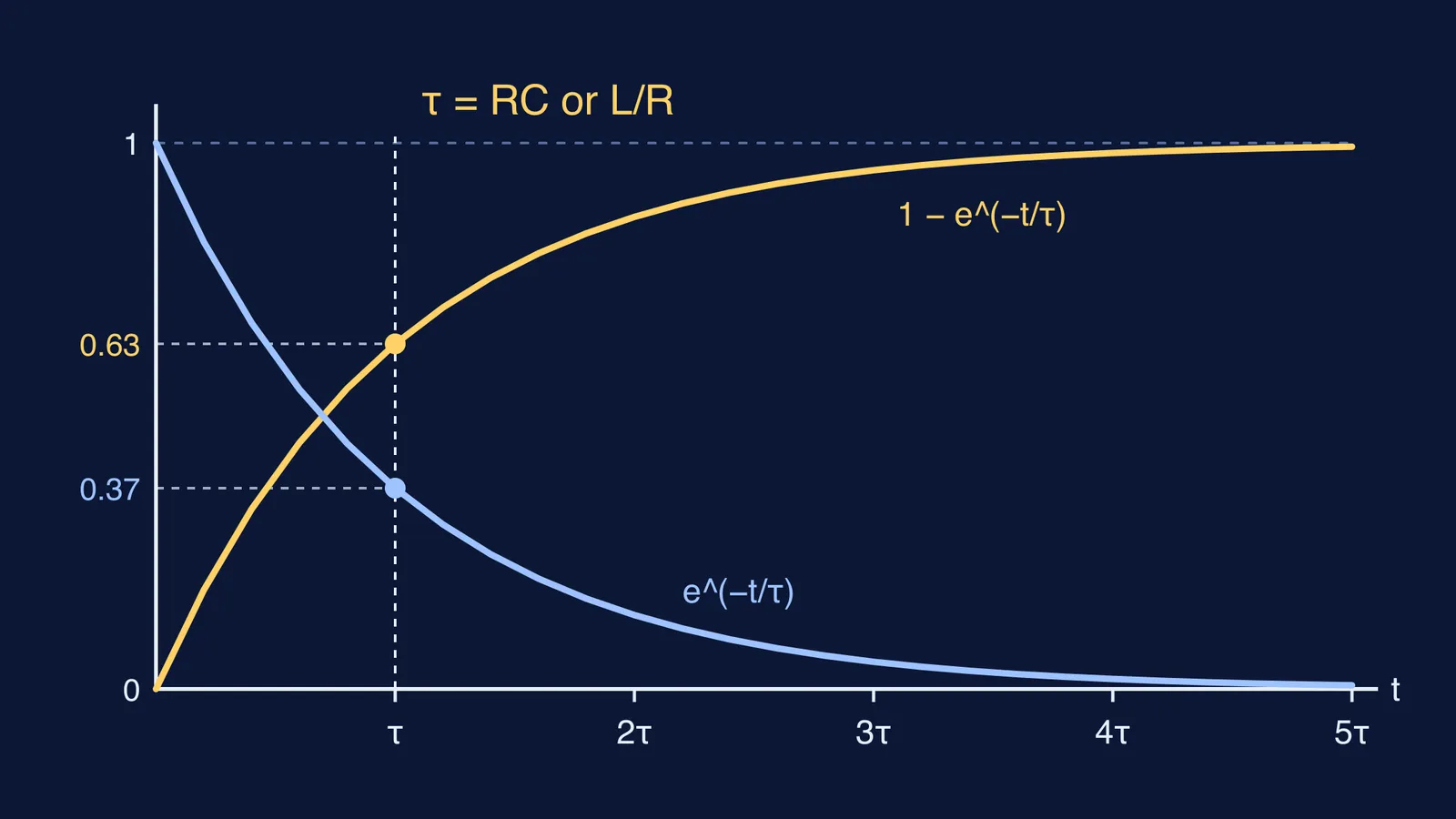
This is why both are called time constants. OpenStax University Physics Volume 2 defines τ = RC for a charging capacitor and states that the units of RC are seconds. Its section on RL circuits defines τ = L/R, and after one time constant the current has reached about 63% of its final value.
Why is √(LC) also a time?
Multiply the henry by the farad: (V·s/A) × (A·s/V) = s². The square root is a second.
That matches the LC oscillator. OpenStax gives the angular frequency of an LC circuit as ω = 1/√(LC), so the period is T = 2π√(LC). Because ω is measured in radians per second, 1/√(LC) has to be per second, and √(LC) has to be seconds.
How do you use this to check a circuit answer?
OpenStax's chapter on dimensional analysis gives the two rules that do the work: every term in an expression must have the same dimensions, and the argument of an exponential, logarithm, sine or cosine must be dimensionless. It also warns that the method will not help with dimensionless factors. With the three time combinations in your head, the check is four questions.
Exponent test. Anything inside e^( ) must be a time divided by a time. e^(−t/RC) and e^(−Rt/L) pass; e^(−tL/R) fails, because tL/R is a time squared.
Rate test. Anything added to or subtracted from ω² must be 1/time². Both 1/LC and (R/L)² qualify.
Answer test. If the question asks how long something takes, your answer must be RC, L/R or √(LC) times a dimensionless factor. RC ln 2 is a time; ln 2/(RC) is a rate.
Size test. Put in typical values. 1 kΩ × 1 μF = 1 ms, and 10 mH ÷ 100 Ω = 0.1 ms. An answer of several hours for a lab circuit is a warning sign.
Worked example: is this damped LCR answer right?
Suppose you derive the frequency of a lightly damped series LCR circuit and get ω′ = √(1/LC − R²/4L). Run the rate test.
1/LC has dimensions of 1/T², since √(LC) is a time.
R/L has dimensions of 1/T, since L/R is a time.
So R²/4L = R × (R/L)/4 has dimensions of ohms per second, not 1/T².
You cannot subtract ohms per second from 1/T², so the answer is wrong before you open the key. The OpenStax section on RLC circuits gives the correct form, ω′ = √(1/LC − (R/2L)²), and (R/2L)² is 1/T² as required. The slip was a missing L in the denominator.
If an answer passes the check but still disagrees with the key, look for one of those factors or a sign. The Fermi Problem Library has worked problems with a step-by-step solver that explains the reasoning, so you can see which line went wrong. If the henry and the weber still feel like names rather than quantities, the Fermi Concept Library gives each concept its own lesson.
Where else does this habit help?
Rewriting units until they cancel works across the syllabus. See our guide to using units and dimensions to catch errors, the post on the dimensions of μ0 and ε0, and, to watch a time constant on a graph, how current grows in an RL circuit.
Next time you finish a circuit problem, spend thirty seconds on the four tests before you check the answer.


