

On this page
What is the dimensional formula of 1/√(μ₀ε₀)?
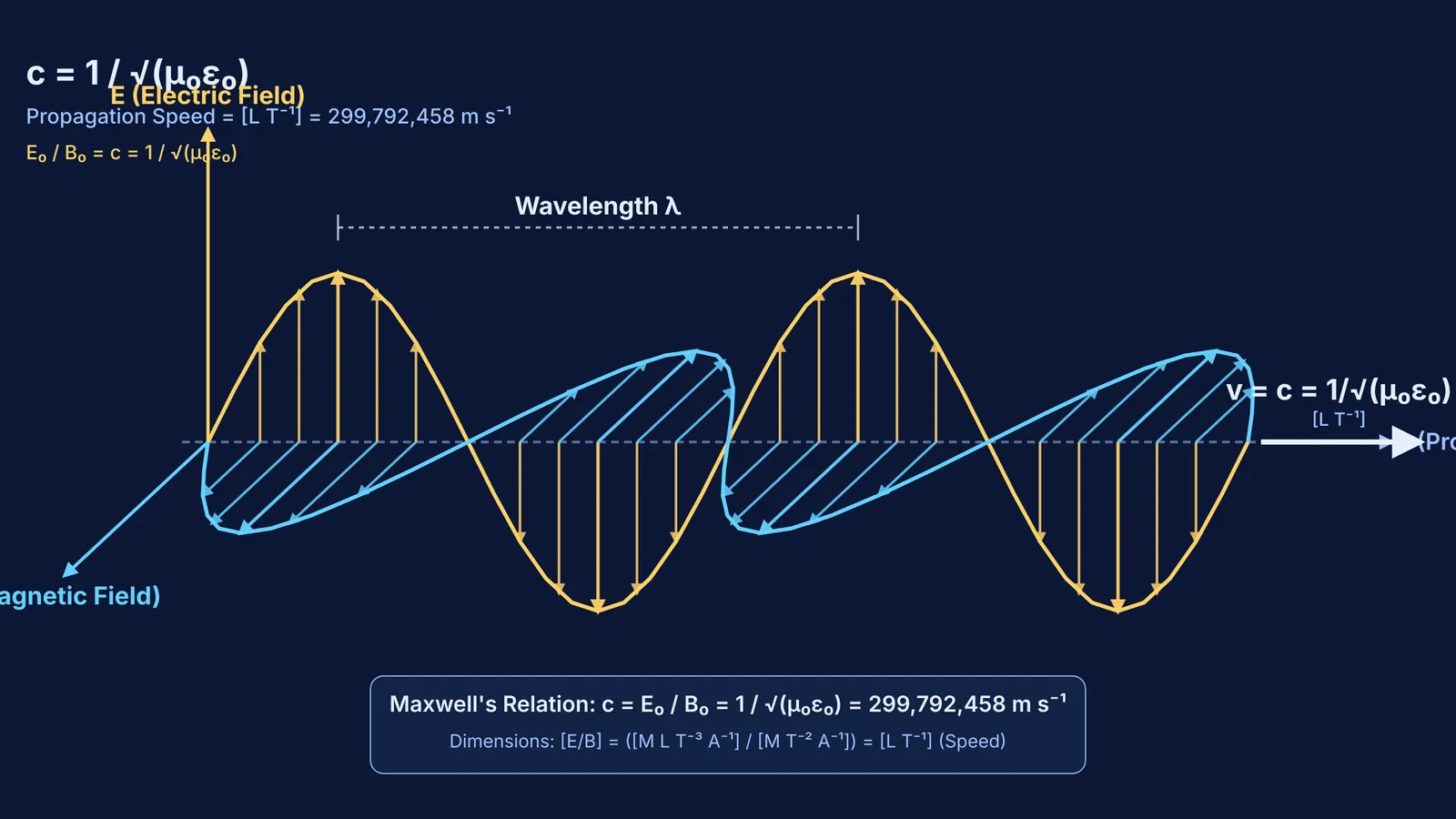
When James Clerk Maxwell unified electricity and magnetism in his 1865 paper, A Dynamical Theory of the Electromagnetic Field, he derived that electromagnetic waves propagate through empty space at a speed c determined by two vacuum constants: c = 1/√(μ₀ε₀).
Under the international system of units defined by the BIPM SI Brochure (9th Edition), the speed of light in vacuum c is defined as exactly 299,792,458 m s⁻¹ (documented by NIST CODATA). Because velocity is distance divided by time, its dimensional formula is [M⁰ L¹ T⁻¹ A⁰] (or [L T⁻¹]). By dimensional homogeneity, 1/√(μ₀ε₀) must share identical dimensions.
In competitive exams like JEE Main and NEET-UG, examiners test this relation in various algebraic forms. While knowing the wave speed identity gives the answer immediately, deriving the individual dimensions of μ₀ and ε₀ is essential for converting a quantity between unit systems using dimensions.
How do you find the dimensions of ε₀ from Coulomb's law?
The electric permittivity of free space ε₀ governs electrostatic force. From Coulomb's law:
F = (1 / (4π ε₀)) × ((q₁ × q₂) / r²)
Rearranging for ε₀:
ε₀ = (q₁ × q₂) / (4π × F × r²)
Because 4π is a dimensionless constant:
Charge q = I × t, so [q] = [A T].
Force F = m × a, so [F] = [M L T⁻²].
Separation distance r has dimension [r] = [L], giving [r²] = [L²].
Substituting these into the formula:
[ε₀] = [A T]² / ([M L T⁻²] × [L²]) = [M⁻¹ L⁻³ T⁴ A²]
In SI base units, this equals A² s⁴ kg⁻¹ m⁻³, or farads per metre (F m⁻¹). The NIST CODATA recommended value lists ε₀ as 8.854 187 8188 × 10⁻¹² F m⁻¹. This dimensional form is fundamental when calculating energy storage in energy density in an electric field: u = ε₀E²/2 worked.
How do you find the dimensions of μ₀ from magnetic force?
The magnetic permeability of free space μ₀ quantifies magnetic induction. A fast derivation uses Ampère's force law between two parallel current-carrying conductors separated by distance d:
F / L = (μ₀ × I₁ × I₂) / (2π × d)
Rearranging for μ₀:
μ₀ = (2π × d / L) × (F / (I₁ × I₂))
Here, 2π is dimensionless, and d / L is a ratio of lengths ([L] / [L] = [1]). Therefore:
[μ₀] = [F] / [I]² = [M L T⁻²] / [A²] = [M L T⁻² A⁻²]
In SI units, permeability is expressed in newtons per ampere squared (N A⁻²) or henries per metre (H m⁻¹), catalogued as 1.256 637 061 27 × 10⁻⁶ N A⁻² by NIST CODATA.
How do you find the dimensions of 1/√(μ₀ε₀) without multiplying?
Multiplying the base dimensions of μ₀ and ε₀ directly yields:
[μ₀ ε₀] = [M L T⁻² A⁻²] × [M⁻¹ L⁻³ T⁴ A²] = [L⁻² T²]
Taking the reciprocal square root gives:
[1 / √(μ₀ε₀)] = ([L⁻² T²])^(-1/2) = [L T⁻¹]
However, multiplying four base powers under timed pressure risks sign errors. You can bypass base dimensions completely using field energy density. In an electromagnetic wave, electric and magnetic energy densities are equal:
u_E = (1/2) × ε₀ × E²
u_B = B² / (2 × μ₀)
Equating them gives [ε₀ × E²] = [B² / μ₀], or:
[1 / (μ₀ ε₀)] = [E / B]²
Taking the square root yields [1 / √(μ₀ ε₀)] = [E / B]. From the Lorentz force relation F = q E = q v B, the ratio E / B has the dimensions of velocity v:
[E / B] = [v] = [L T⁻¹]
This confirms the speed dimension in two lines without expanding mass, charge, or time. For numerical wave calculations, see energy density and intensity of an EM wave, with worked numbers.
What common dimensional traps appear in competitive exams?
Entrance exams frequently alter exponents in questions on electromagnetic constants:
μ₀ × ε₀ has dimensions [L⁻² T²] (inverse square of speed).
√(μ₀ × ε₀) has dimensions [L⁻¹ T] (slowness, or inverse speed).
1 / (μ₀ × ε₀) has dimensions [L² T⁻²] (speed squared).
√(μ₀ / ε₀) has dimensions [M L² T⁻³ A⁻²] (electrical resistance).
To solve dimensional problems quickly and accurately:
Identify whether a constant combination represents a wave property or conservation law.
Use force or energy density ratios instead of expanding to base units.
Check the final exponents against physical units before marking your answer.
If you struggle with dimensional deductions under timed pressure, the Fermi Problem Library has worked problems with a step-by-step solver that explains the reasoning rather than printing an answer. To review how wave constants connect across fields, the Fermi Concept Library maps every concept in physics, chemistry, biology, mathematics and computing, each with its own lesson and its place in the map. When you are revising electromagnetic theory, Fermi's AI tutor can work out what you already know and build a plan for the session, so you sit down to a clear next step.


