On this page
Cyclopropylmethyl is a primary carbocation, yet it turns up in JEE Advanced-style ranking questions because it behaves far better than its label suggests. The reason sits in the three-membered ring next to the positive carbon.
Why is the cyclopropylmethyl carbocation so stable?
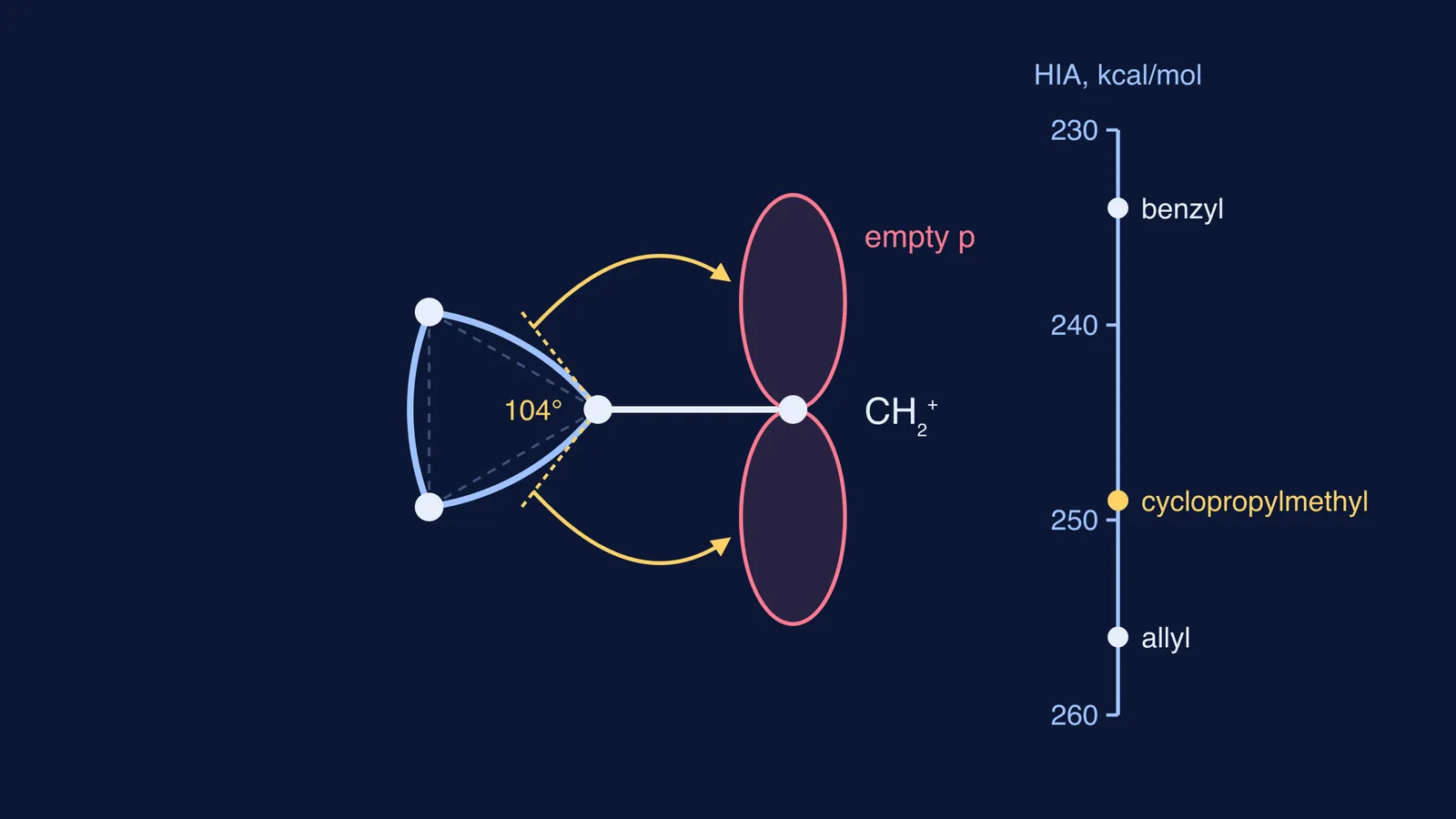
Start with the ring. The three carbons of cyclopropane form a triangle with 60° angles, but carbon's orbitals cannot point that sharply at each other. The angle between the orbitals that make each ring bond is about 104°, so the bonds bow outward (Bent bond, Wikipedia). These curved bonds are the banana bonds of your textbook.
A. D. Walsh gave the other classic picture, in which the ring is held together by orbitals with partly π character (Walsh, Transactions of the Faraday Society, 1949). In a 1971 paper on cyclobutane, Roald Hoffmann and Robert Davidson reviewed both models and noted that cyclopropane's highest occupied orbitals sit higher in energy than the C–C σ orbitals of unstrained hydrocarbons, but lower than the π orbitals of ethylene (Hoffmann and Davidson, JACS 1971). That middle position helps explain the effect: the ring can push electron density into a neighbouring empty orbital, somewhat as a double bond does.
How do the banana bonds overlap with the empty p orbital?
Geometry decides it. In the bisected conformation, the plane of the CH₂⁺ group cuts the ring into mirror halves, and the empty p orbital lies parallel to the ring, beside its two nearest bent bonds. Hoffmann and Davidson's analysis shows the p orbital overlapping effectively with one of the ring's highest occupied orbitals in this shape, and only weakly when twisted 90° away (Hoffmann and Davidson, JACS 1971).
Experiment agrees. Charles Pittman Jr. and George Olah observed the bisected form directly in the dimethylcyclopropylcarbinyl cation (Pittman and Olah, JACS 1965), and Hoffmann and Davidson cite a 13.7 kcal/mol barrier, measured by D. S. Kabakoff and E. Namanworth, for twisting that cation out of position. That resistance to twisting reflects real stabilisation from the overlap.
Is cyclopropylmethyl more stable than benzyl and allyl?
One clean comparison is hydride ion affinity (HIA): the energy released when a cation in the gas phase picks up a hydride ion, H⁻. A lower HIA means a more stable cation. The carbenium ion article on Wikipedia lists these values (Carbenium ion, Wikipedia):
Benzyl, C₆H₅CH₂⁺: 234 kcal/mol
Isopropyl, (CH₃)₂CH⁺: 246 kcal/mol
Cyclopropylmethyl, c-C₃H₅CH₂⁺: 249 kcal/mol
Allyl, CH₂=CH–CH₂⁺: 256 kcal/mol
Ethyl, CH₃CH₂⁺: 273 kcal/mol
By this measure, benzyl > cyclopropylmethyl > allyl. The cyclopropylmethyl cation is primary, yet it sits 24 kcal/mol below the ethyl cation and only 3 kcal/mol above the secondary isopropyl cation.
These are gas-phase numbers with no solvent, so treat them as a guide rather than a verdict on every reaction. If an answer key puts cyclopropylmethyl above benzyl, ask what measure it relies on; these values do not support that order.
A JEE Advanced-style question, worked step by step
Arrange in decreasing order of stability: (P) C₆H₅CH₂⁺, (Q) CH₂=CH–CH₂⁺, (R) cyclopropyl–CH₂⁺, (S) CH₃CH₂⁺.
Find what sits next to the empty p orbital: a benzene ring (P), one C=C bond (Q), two bent C–C bonds (R), only single bonds (S).
Check that overlap is possible. P and Q are flat and conjugated; R overlaps best in its preferred bisected shape.
Place S last. Ethyl gets help only from hyperconjugation with three α C–H bonds; here is how to count α-hydrogens for hyperconjugation.
Settle the middle with evidence. In benzyl the charge spreads over the CH₂ carbon and three ring carbons, which explains why P comes first. Reasoning alone cannot cleanly separate R and Q, so use the HIA values from the carbenium ion table: P (234) < R (249) < Q (256) < S (273).
Answer: P > R > Q > S.
Stable does not mean it stays put: check for ring-expanded and ring-opened products. The classic study is John D. Roberts and Robert Mazur's 1951 paper on interconversions of cyclobutyl, cyclopropylcarbinyl and allylcarbinyl derivatives (Roberts and Mazur, JACS 1951); our explainer on carbocation ring expansion shows how to draw those shifts.
How should you revise this before the exam?
Draw the ring with bent bonds and the bisected p orbital from memory.
Say in one sentence why bent bonds donate.
Learn benzyl > cyclopropylmethyl > allyl > ethyl with one reason per step.
Reread why angle strain makes cyclopropane reactive, because the same strain bends the bonds.
If the orbital picture is the gap, the Fermi Concept Library gives every concept in chemistry its own lesson and its place in the map. For ranking practice, the Fermi Problem Library has worked problems with a step-by-step solver that explains the reasoning rather than printing an answer, so you can see whether your step 4 matches.
Next time you see a three-membered ring beside a positive carbon, draw the p orbital flat beside it first.