

On this page
You meet a carbocation sitting right next to a four-membered ring, and the answer key shows a five-membered ring in the product. It is not a trick. The cation reaches into the ring, pulls one ring bond across, and the ring grows by one carbon. Once you see why, you can predict these products instead of memorising them.
What is carbocation ring expansion?
Ring expansion is a 1,2-alkyl shift in which the migrating group is a bond of the ring itself, so the cationic carbon outside the ring becomes a ring member. LibreTexts files these moves under Wagner-Meerwein rearrangements_UNDER_CONSTRUCTION/30%3A_Cationic_Rearrangements/30.1%3A_Wagner-Meerwein_Rearrangements), a family of rearrangements named after the chemists H. Meerwein and G. Wagner.
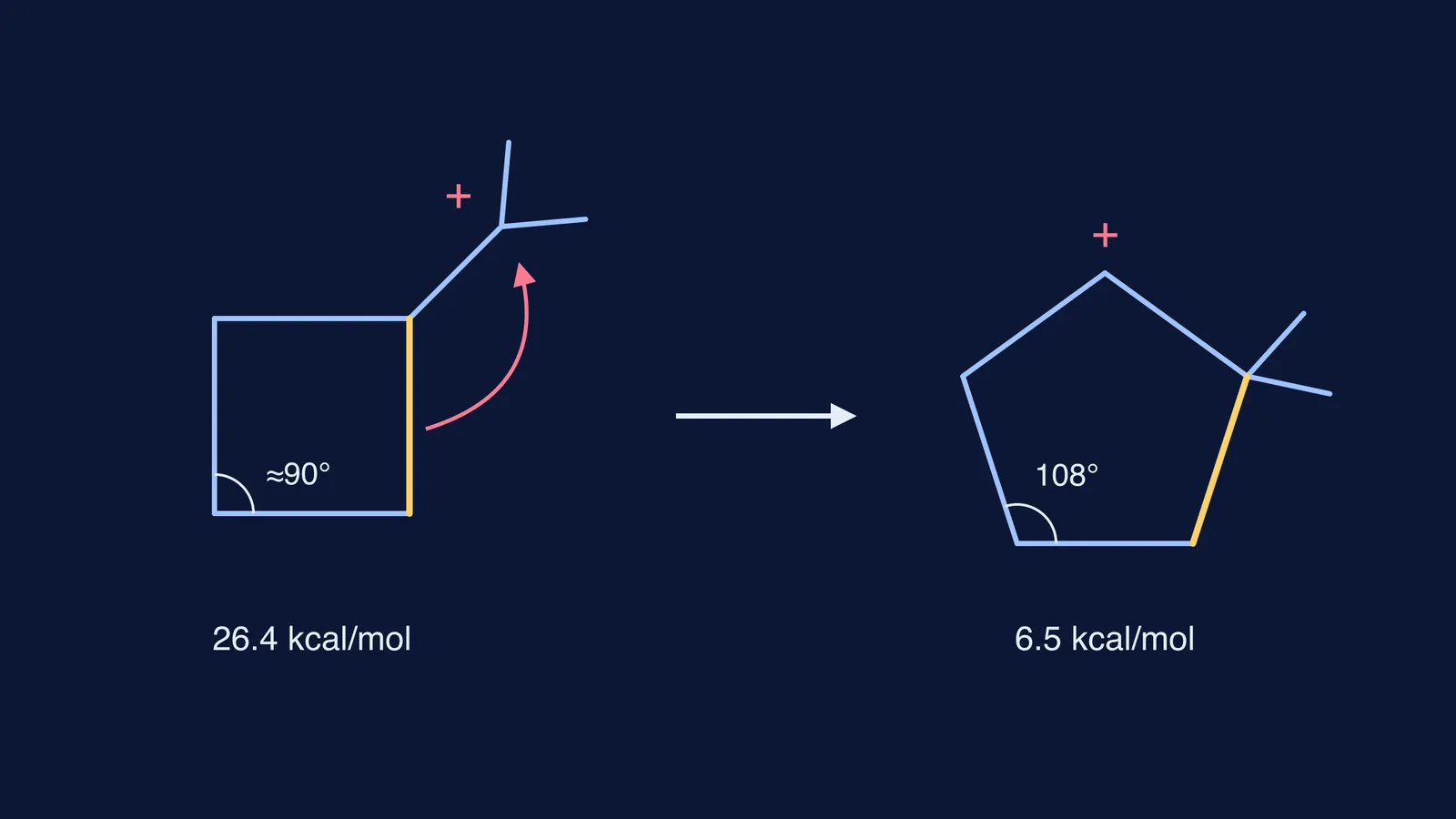
Label it like this. Call the cationic carbon outside the ring Cα, the ring carbon attached to it C1, and C1's ring neighbours C2 and C4. The two electrons of the C1–C2 bond move onto Cα, carrying C2 with them. Count the new ring: Cα, C2, C3, C4, C1. Five carbons. The positive charge is left on C1, the carbon that lost a bond.
If the curly arrow confuses you, our guide to what each arrow in chemistry means helps: the arrow starts at the electrons (the C1–C2 bond) and ends at the electron-poor carbon (Cα).
Why does a cyclobutyl carbocation expand to cyclopentyl?
Because the four-membered ring is badly strained and the five-membered ring is not. A square ring forces the C–C–C angle far below the tetrahedral 109.5°, and real cyclobutane folds slightly, to an angle of about 88°, easing clashes between hydrogens at the cost of a slightly worse angle. A flat pentagon has 108° angles, almost tetrahedral.
Heats of combustion put numbers on this. Yale's chemistry study notes give a total strain energy of 26.4 kcal/mol for cyclobutane and 6.5 kcal/mol for cyclopentane, measured against an unstrained CH₂ group. Going from a four-membered to a five-membered ring therefore releases roughly 20 kcal/mol (about 83 kJ/mol) of strain.
That is a large reward. It is why the LibreTexts example_UNDER_CONSTRUCTION/30%3A_Cationic_Rearrangements/30.1%3A_Wagner-Meerwein_Rearrangements) shows a tertiary cation next to a cyclobutane expanding into a secondary cation: relief of angle and torsional strain outweighs the loss of cation stability. When the expansion also improves the cation, both driving forces point the same way, as Chemistry Steps notes.
Worked example: what does 2-cyclobutylpropan-2-ol give with acid?
Take 2-cyclobutylpropan-2-ol, a cyclobutane ring carrying a C(CH₃)₂OH group, and warm it with concentrated H₂SO₄.
Loss of water. The OH is protonated and leaves, giving a tertiary cation on Cα, the carbon bearing the two methyls.
Ring expansion. The C1–C2 ring bond shifts to Cα. The ring now has five carbons, Cα carries two methyls inside the ring, and the positive charge sits on C1, which is secondary.
Methyl shift. A 1,2-methyl shift from Cα to C1 moves the charge back onto Cα, which is tertiary again, and leaves C1 with one methyl.
Loss of a proton. Removing the H on C1 gives a double bond between C1 and Cα, each carrying a methyl.
The product to expect is 1,2-dimethylcyclopentene, a tetrasubstituted alkene and the Zaitsev choice. Many students stop at step 1 and write 2-cyclobutylpropene; in questions like this the expected answer is usually the rearranged five-membered ring.
How do you spot a ring expansion in an exam question?
Run this checklist whenever a reaction makes a carbocation (dehydration of an alcohol, SN1 or E1 of a halide, addition of HX to an alkene):
Find the cation carbon first and draw its + before anything else.
Look one carbon away. A small ring attached directly to the cation carbon is the trigger.
Shift a C1–C2 bond, where C1 is the ring carbon bonded to the cation.
Renumber the ring and move the + to C1.
Look again. A second shift (hydride or methyl) may still improve the cation.
Finish: lose H⁺ toward the most substituted alkene, or let the nucleophile attack.
Ring expansion needs a free carbocation, so it appears under SN1 and E1 conditions, not in a clean SN2. Our guide to polar protic and aprotic solvents in SN1 and SN2 explains how to tell which path a question sets up.
Where can you practise ring expansion problems?
Rearrangement questions punish one wrong arrow, so work several rather than reading one. The Fermi Problem Library has worked problems with a step-by-step solver that explains the reasoning rather than printing an answer, so you can see exactly where a shift goes. If carbocation stability itself feels shaky, the Fermi Concept Library gives each chemistry concept its own lesson. Then try the pinacol-pinacolone rearrangement, where the same 1,2-shift logic makes a ketone.


