

On this page
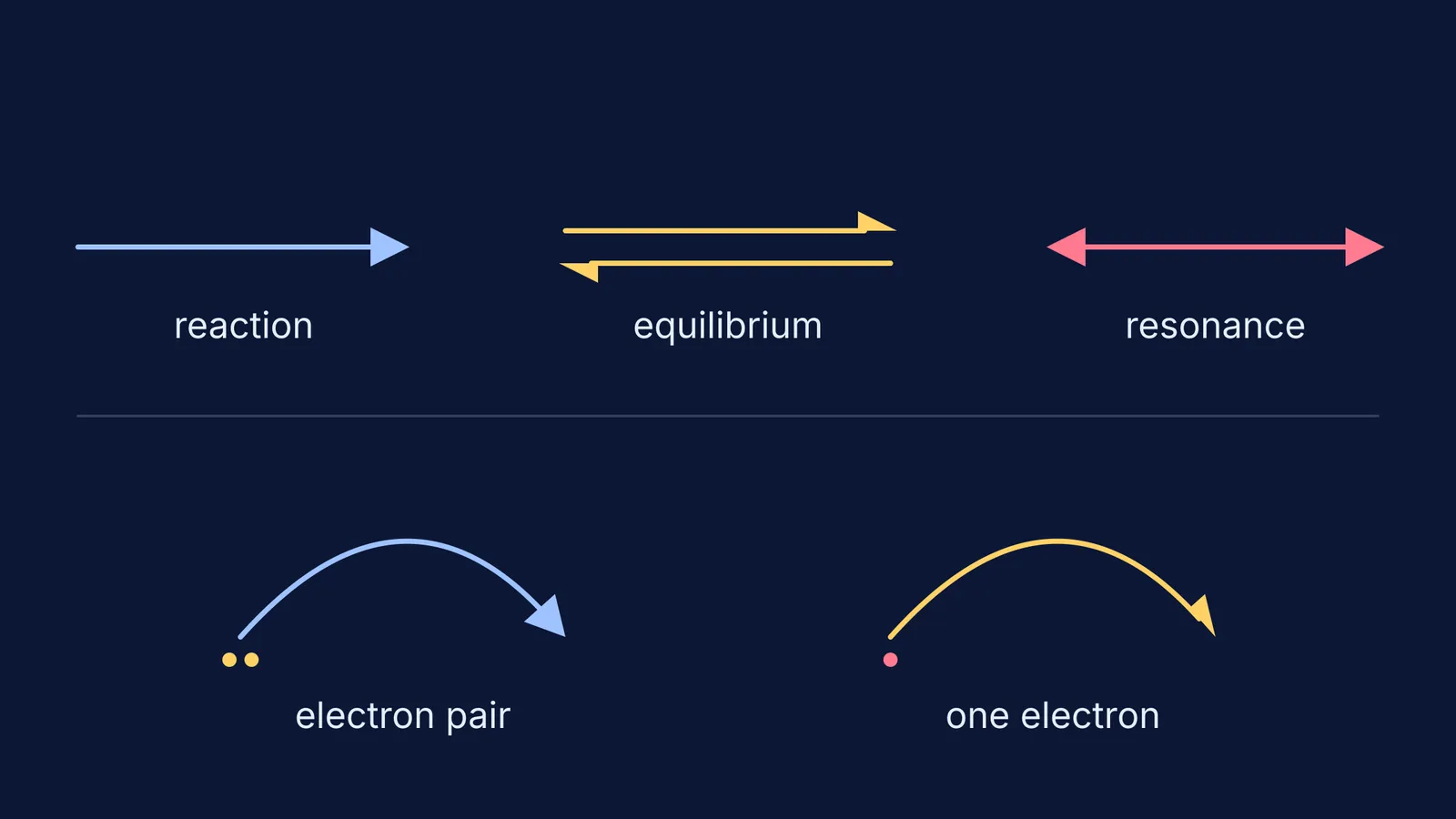
A chemistry page can carry six different arrows, and each makes a different claim. One says a reaction happened, two say it runs both ways, one says two drawings describe a single molecule, and two track electrons. Swap them in a board answer or a JEE mechanism and you have written different chemistry.
What does each arrow in chemistry mean?
IUPAC sets the conventions in its Green Book, Quantities, Units and Symbols in Physical Chemistry (page 52), and NCERT teaches the electron arrows in Unit 8 of the Class 11 chemistry textbook. The full set:
→ Single reaction arrow. IUPAC lists → as a “net forward reaction”; at the molecular level, a single arrow links the reactants and products of one elementary step.
⇄ Two full arrows. IUPAC reads this as a reaction going in both directions.
⇌ Equilibrium half-arrows. Two harpoons, each with half an arrowhead, mean the system is at equilibrium. LibreTexts notes/V:__Reactivity_in_Organic_Biological_and_Inorganic_Chemistry_3/03:_Understanding_Mechanism/3.03:_Arrow_Conventions) that one half-arrow is sometimes drawn longer to show the favoured direction.
↔ Resonance arrow. One line with a head at each end. It joins two drawings of the same molecule and is not a reaction.
Curved arrows. In NCERT, a full-headed curved arrow moves a pair of electrons and a single-barbed “fish hook” moves one electron.
Is a resonance arrow the same as an equilibrium arrow?
No. The IUPAC Green Book says the two-sided arrow ↔ “should not be used for reactions to avoid confusion with resonance structures” and “does not signify a reaction equation” (IUPAC Green Book, page 52).
An equilibrium has two real substances that turn into each other, both present in the flask. Resonance structures are not real: NCERT calls them “hypothetical” and says they “individually do not represent any real molecule”.
Benzene is the evidence. NCERT gives every C–C bond in benzene as 139 pm, between a C–C single bond (154 pm) and a C=C double bond (134 pm) (NCERT Class 11, Unit 8). A single Kekulé structure would have two bond lengths; benzene has one. For how much this stabilises the ring, see the resonance energy of benzene.
The reverse mistake matters too: ⇌ between resonance structures claims two separate substances. When you do have a real equilibrium, here is what the size of the equilibrium constant tells you.
How do you read a curved arrow in a mechanism?
NCERT's rule is that a curved arrow “starts from the point from where an electron pair is shifted and it ends at a location to which the pair of electron may move” (NCERT Class 11, Unit 8). In practice:
The tail sits on electrons: a lone pair or a bond, never a positive charge.
The head points at an atom (a new lone pair) or between two atoms (a new bond).
Radical steps use fish hooks. NCERT splits the C–Cl bond of chloromethane with two fish hooks, one electron going to each atom.
The notation is about a century old. William Kermack and Robert Robinson used curly arrows in a 1922 paper in the Journal of the Chemical Society, and Chemistry World's history of the curly arrow explains their idea: the way electrons move between neighbouring atoms decides which bonds can form.
Worked example: every arrow in the acetate ion
NCERT Problem 8.16 asks you to write resonance structures of CH3COO⁻ and show the electron movement with curved arrows (NCERT Class 11, Unit 8). Do it in five steps:
Draw structure I, CH3–C(=O)–O⁻, with every lone pair shown. The negative charge sits on the single-bonded oxygen.
Draw curved arrow 1 from a lone pair on O⁻ to the space between that oxygen and carbon. This makes a new C=O.
Draw curved arrow 2 from the old C=O π bond onto the other oxygen. That oxygen now holds the lone pair and the negative charge.
Draw structure II and join I and II with ↔. Not ⇌, and no reaction arrow.
Check: atoms in the same places, total charge still −1, electrons moved but none created.
Now protonate it. CH3COO⁻ + H3O⁺ ⇌ CH3COOH + H2O uses half-arrows, because acetate and acetic acid are two real substances in the same solution. Same ion, two different arrows, two different claims.
A 30-second arrow check before you submit
Did one substance turn into another? Use →.
Is it reversible, with K or Le Chatelier in play? Use ⇌.
Are you comparing drawings of one species? Use ↔ and keep the atoms fixed.
Does every curved arrow start on electrons?
Two electrons moving: full head. One electron: fish hook.
Do charges balance on both sides?
If an arrow keeps tripping you up because the idea behind it is shaky, the Fermi Concept Library has a lesson for every chemistry concept, each with its place in the map. For mechanism practice, the Fermi Problem Library has worked problems with a step-by-step solver that explains the reasoning rather than printing an answer.
Using an AI tool too? First read how to check an AI's organic mechanism arrows.


