

On this page
When resistors sit side by side in parallel, the incoming current has to split. School physics and JEE questions keep asking the same thing: how much goes each way? The larger current goes through the smaller resistor.
What is the current divider rule for two resistors in parallel?
For two resistors R₁ and R₂ in parallel carrying a total current I, the current through R₁ is I₁ = IR₂/(R₁ + R₂), and the current through R₂ is I₂ = IR₁/(R₁ + R₂).
Notice the "wrong" resistor on top. The current through one resistor equals the total current times the other resistor divided by the sum of the two, as the DC circuit analysis lab manual on LibreTexts/06%3A_Parallel_DC_Circuits/6.1%3A_Theory_Overview) sets it out. The same source states that the currents in a parallel circuit are inversely proportional to the associated resistances.
Why does the smaller resistor carry more current?
Two facts do all the work. First, in parallel the potential drop across each resistor is the same, and the current in each follows from Ohm's law, I = V/R (OpenStax University Physics, Volume 2). Second, by the junction rule, the current flowing into a junction equals the current flowing out.
Now write it out:
Same voltage: I₁R₁ = I₂R₂.
Junction rule: I₁ + I₂ = I.
From step 1, I₂ = I₁R₁/R₂. Put that into step 2: I₁(1 + R₁/R₂) = I.
Multiply through by R₂: I₁(R₂ + R₁) = IR₂, so I₁ = IR₂/(R₁ + R₂).
Both branches get the same push, so the branch that resists less lets more charge through each second. Quick check: if R₁ = R₂, each branch gets I/2, which is what symmetry says.
A worked example: 9 A enters 6 Ω and 3 Ω in parallel. The current through 6 Ω is 9 × 3/(6 + 3) = 3 A. The current through 3 Ω is 9 × 6/9 = 6 A. Check the voltages: 3 × 6 = 18 V and 6 × 3 = 18 V. They match, so the split is right.
How do you split current across three resistors in parallel?
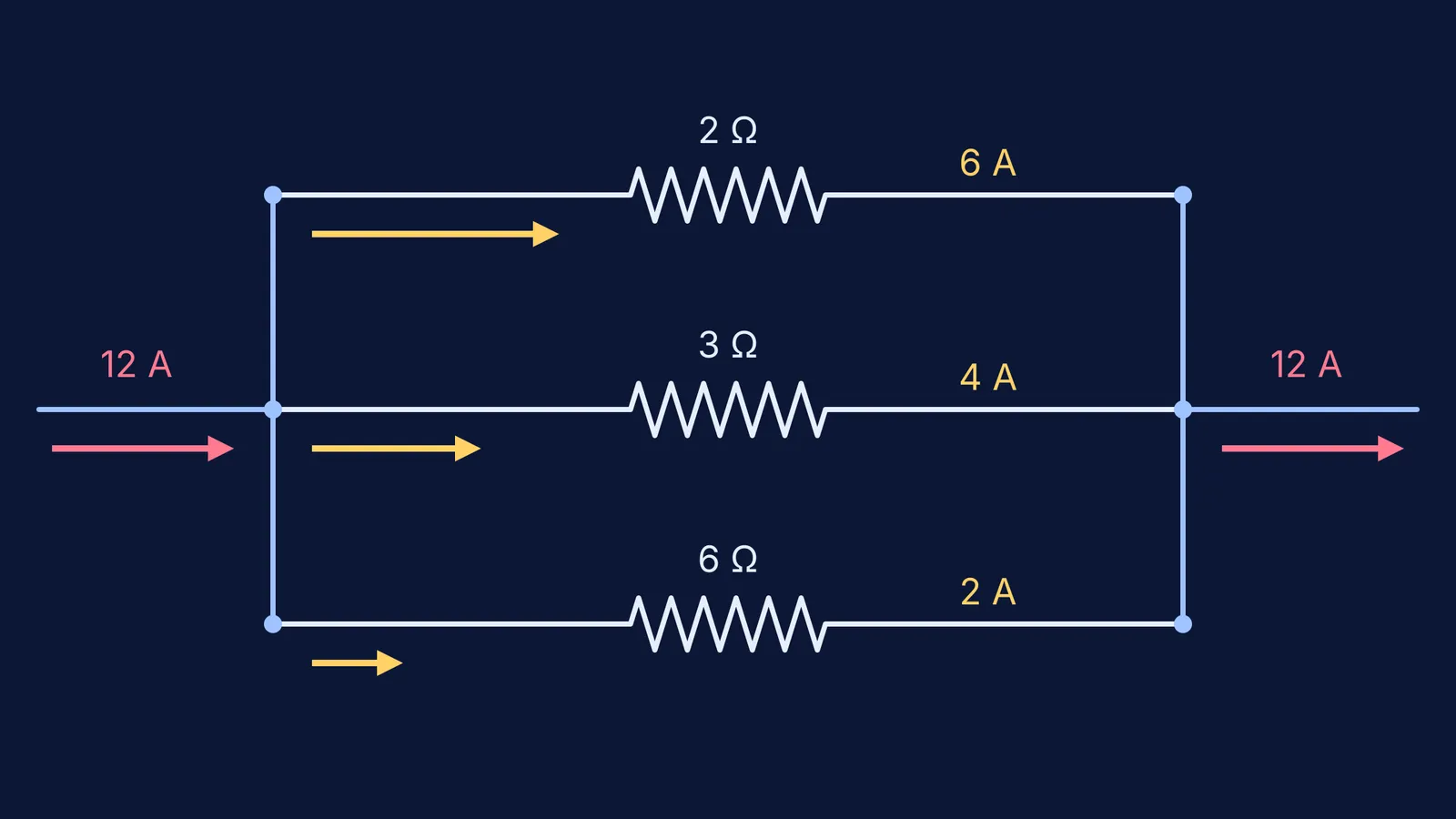
Here is the trap. The two-resistor formula does not stretch to three branches by piling extra resistors on the top and bottom. Take 12 A entering 2 Ω, 3 Ω and 6 Ω in parallel. The tempting guess for the 2 Ω branch, 12 × (3 + 6)/(2 + 3 + 6), gives about 9.8 A, which is wrong. Two methods work.
Method 1: find the common voltage.
Equivalent resistance: 1/R_p = 1/2 + 1/3 + 1/6 = 1, so R_p = 1 Ω. OpenStax notes that R_p is always less than the smallest individual resistance, and 1 Ω is less than 2 Ω.
Voltage across every branch: V = IR_p = 12 × 1 = 12 V.
Branch currents from I = V/R: 12/2 = 6 A, 12/3 = 4 A, 12/6 = 2 A.
Junction check: 6 + 4 + 2 = 12 A.
The general current divider formula, Iₙ = I × R_p/Rₙ, given in Kuphaldt's Lessons in Electric Circuits on LibreTexts/06%3A_Divider_Circuits_and_Kirchhoff's_Laws/6.03%3A_Current_Divider_Circuits_and_the_Current_Divider_Formula), packs those steps into one line. For the 3 Ω branch: 12 × 1/3 = 4 A.
Method 2: collapse two branches, then use the two-resistor rule.
Combine 3 Ω and 6 Ω: (3 × 6)/(3 + 6) = 2 Ω.
Now 2 Ω faces 2 Ω, so the 12 A splits into 6 A and 6 A.
Split the second 6 A between 3 Ω and 6 Ω: 6 × 6/9 = 4 A through 3 Ω, and 6 × 3/9 = 2 A through 6 Ω.
Both methods agree: 6 A, 4 A and 2 A, in the ratio 1/2 : 1/3 : 1/6, or 3 : 2 : 1. Halve the resistance and you double the current. If collapsing resistors still feels slow, practise with how to combine three resistors for a required resistance.
Which mistakes cost marks on current divider questions?
Putting R₁ on top when finding I₁. Use the sanity check above.
Using the two-resistor formula on three or more branches without collapsing first.
Missing a short. A branch with zero resistance takes everything: put R₂ = 0 into I₁ = IR₂/(R₁ + R₂) and I₁ becomes zero.
Mixing it up with the potential divider with an LDR or thermistor, where voltage, not current, is shared, and the bigger share goes to the bigger resistor.
Not checking that the branch currents add back to the total.
If your answers keep going wrong at the same step, the Fermi Problem Library has worked problems with a step-by-step solver that explains the reasoning rather than printing an answer, so you can see where your split went off. If "same voltage, different current" still feels slippery, the Fermi Concept Library gives each concept its own lesson and its place in the map.
To see the rule with real meters, our guide to the series and parallel resistors practical takes you from readings to a result.


