

On this page
If a question tells you 175616 is a perfect cube, you do not need prime factorisation. You can read its cube root, 56, straight from the digits. Here are the two steps, three worked examples, and why the trick always works for perfect cubes up to six digits.
How do you find a cube root by the unit digit?
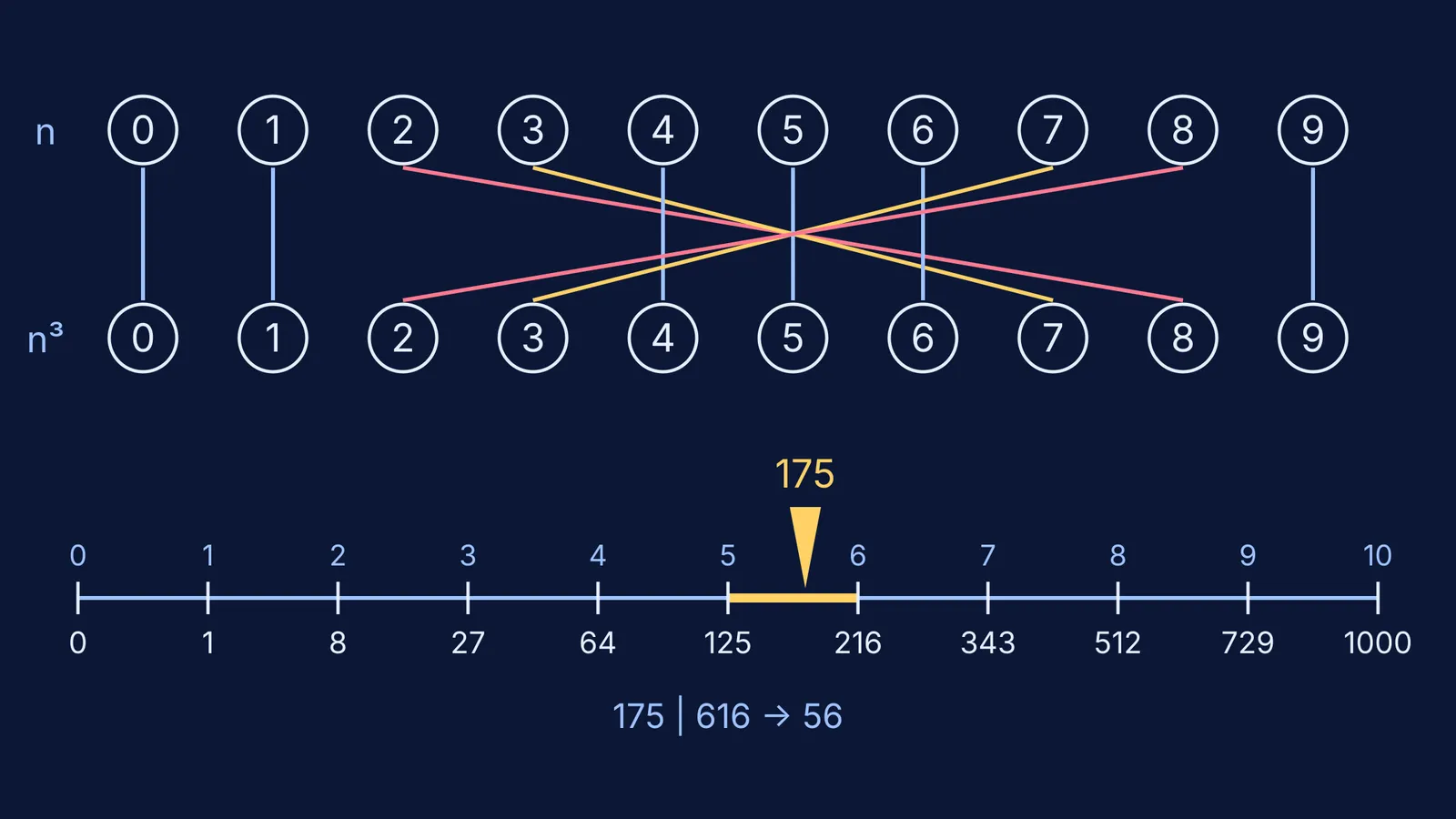
The NCERT Class 8 chapter Cubes and Cube Roots asks students to work out the last digit of the cubes of numbers ending in 1, 2, 3 and so on. That pattern is the whole trick. Here are the cubes of 0 to 9:
0, 1, 8, 27, 64, 125, 216, 343, 512, 729
Look at their last digits: 0, 1, 8, 7, 4, 5, 6, 3, 2, 9. Each digit from 0 to 9 appears exactly once. So 0, 1, 4, 5, 6 and 9 end in themselves, 2 and 8 swap, and 3 and 7 swap.
For a perfect cube with up to six digits, first mark off the last three digits. What is left is the leading group. Then:
Read the cube's last digit. Its partner from the list above is the root's units digit.
Find the largest number whose cube is less than or equal to the leading group. That is the root's tens digit.
Worked examples: 175616, 110592 and 46656
All three are in Exercise 6.2 of the NCERT chapter, set there for prime factorisation.
175616: split it as 175 | 616. It ends in 6, so the root ends in 6. 5³ = 125 and 6³ = 216, and 175 lies between them, so the tens digit is 5. Root: 56. Check: 56² = 3136, and 3136 × 56 = 175616.
110592: split it as 110 | 592. It ends in 2, and 2 is paired with 8, so the root ends in 8. 4³ = 64 is at most 110, but 5³ = 125 is bigger, so the tens digit is 4. Root: 48.
46656: split it as 46 | 656. It ends in 6, so the units digit is 6. 3³ = 27 and 4³ = 64 give a tens digit of 3. Root: 36.
For the slower method that works on any number, see our post on finding cube roots by prime factorisation.
Why does the last digit decide the root's last digit?
Write a two-digit root as n = 10a + b, where a is the tens digit and b is the units digit. Expanding it gives n³ = 1000a³ + 300a²b + 30ab² + b³. Every term except b³ is a multiple of 10, so the last digit of n³ is the last digit of b³.
Since the ten cubes above end in ten different digits, each last digit points back to exactly one b.
Why does the leading group give the tens digit?
The root n is at least 10a and less than 10a + 10. Cubing keeps that order, so n³ is at least 1000a³ and less than 1000(a + 1)³. Drop the last three digits and the leading group is at least a³ and less than (a + 1)³. The smaller of the two neighbouring cubes tells you a.
That is also why the trick stops at six digits. The largest two-digit number is 99, and 99³ = 970299. A seven-digit cube has a three-digit root, and the middle digit needs more work.
When does the unit digit trick give a wrong answer?
The number is not a perfect cube. The steps still produce an answer: 175617 gives 53, but 53³ = 148877. Use the trick only when you know the number is a perfect cube.
The leading group is itself a cube. For 125000, the group 125 is exactly 5³, so the root is 50. The rule is "less than or equal to".
Mixing up the swaps. The easy slip is forgetting that 2 and 8 swap, and 3 and 7 swap. Say the pairs aloud while you practise.
For more ways to calculate without a calculator, see our calculation shortcuts for JEE. Comparing a square root with a cube root uses the same skill of placing a number between two cubes.
A five-minute practice plan
Day 1: write the cubes of 1 to 10 from memory, then the last-digit pairs.
Day 2: find the roots of 91125, 15625 and 10648 from the NCERT exercise with the shortcut.
Day 3: a parent or friend cubes two-digit numbers on a calculator, and you find the roots.
If you get one wrong, find the step that failed instead of just reading the answer. The Fermi Problem Library has worked problems with a step-by-step solver that explains the reasoning rather than printing an answer. If the expansion of (10a + b)³ is the part that feels shaky, the Fermi Concept Library has a lesson for each idea in mathematics, so you can go back to the algebra first.


