

On this page
When comparing two surds like the square root of 3 and the cube root of 5, it is hard to guess the answer just by looking. The numbers under the root sign (the radicands) are different, and the roots themselves (the indices) are different. While you could type them into a calculator, examiners in tests like JEE or olympiads want to see if you can compare them algebraically.
How to compare surds with different roots?
The trick to comparing surds with different indices is to rewrite them so they share the same root. We do this using the laws of exponents. According to the laws of rational exponents, a root can be written as a fractional power: x^(1/n) represents the nth root of x.
Using this rule, we can rewrite our two competing numbers:
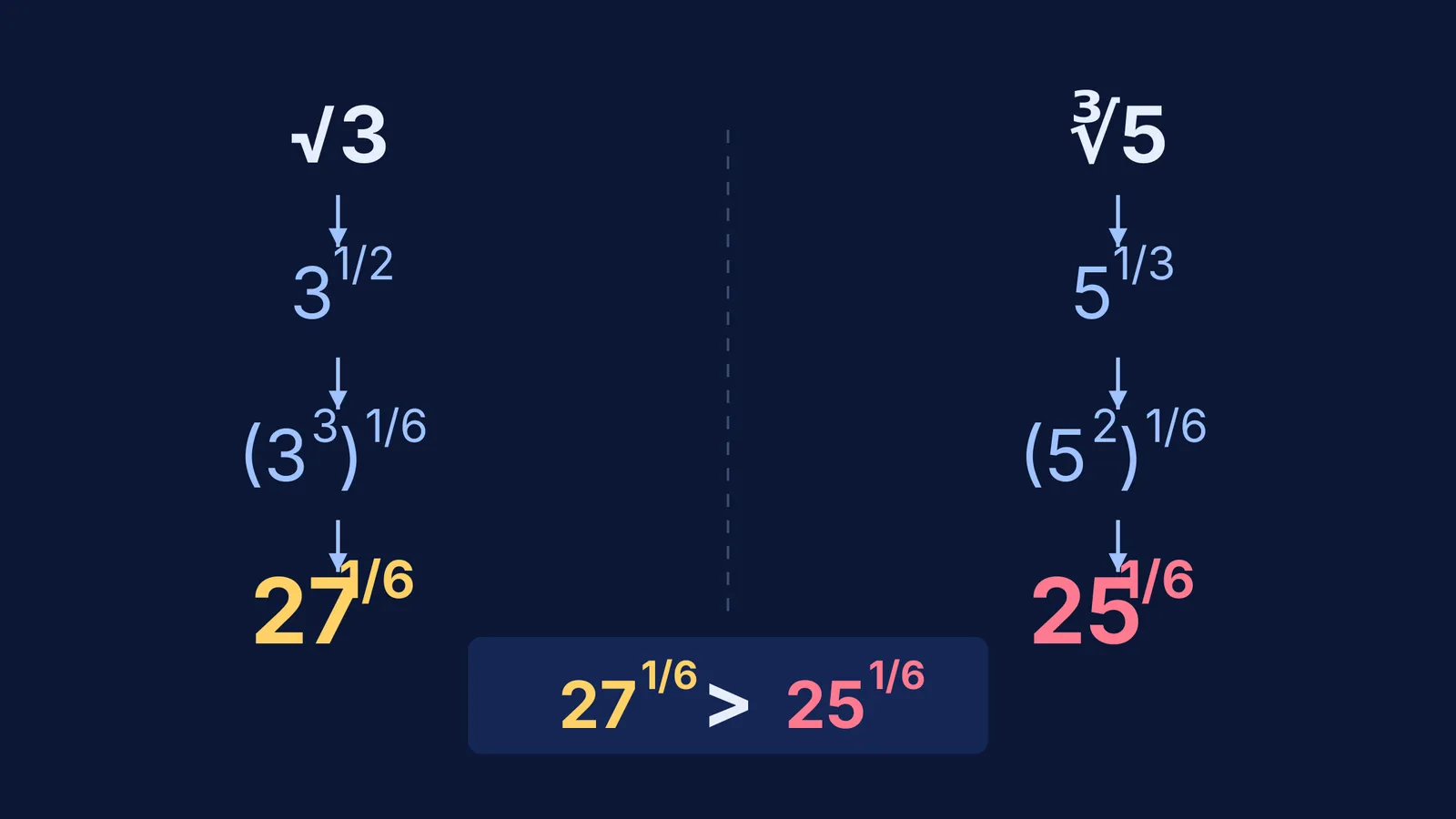
The square root of 3 is 3^(1/2).
The cube root of 5 is 5^(1/3).
Right now, comparing 3^(1/2) and 5^(1/3) is still difficult because the denominators of the fractions (2 and 3) are different. To fix this, we need to find a common denominator. The least common multiple (LCM) of 2 and 3 is 6.
Which is greater square root 3 or cube root 5?
Now we raise both numbers to the power of their LCM, which is 6. Because raising two positive numbers to the same positive integer power does not change which one is larger, this will give us a fair comparison. Why does this work? The function f(x) = x⁶ is strictly increasing for positive values of x. This means that if A > B > 0, then A⁶ > B⁶. By raising our surds to the 6th power, we map them to integers without changing their order on the number line.
Let us evaluate the square root of 3 raised to the sixth power: (√3)⁶ = (3^(1/2))⁶
By the power of a power rule—which states that (x^a)^b = x^(ab)—we multiply the exponents: 3^(1/2 × 6) = 3³ = 27
Next, we evaluate the cube root of 5 raised to the sixth power: (∛5)⁶ = (5^(1/3))⁶
Again, we multiply the exponents: 5^(1/3 × 6) = 5² = 25
Now the comparison is simple. Since 27 is greater than 25, the original number that produced 27 must be greater than the original number that produced 25. Therefore, the square root of 3 is greater than the cube root of 5.
A framework for any surd comparison
You can use this exact method to compare any set of surds with different roots. Just follow this four-step checklist:
Write as fractional powers: Convert every surd into the form x^(1/n).
Find the LCM: Look at the denominators of all the fractional exponents and find their least common multiple.
Raise to the LCM power: Raise every surd to the power of that LCM. Use the rule (x^(1/n))^m = x^(m/n) to simplify.
Compare the integers: You will be left with whole numbers. The largest integer corresponds to the largest original surd.
If you get stuck on algebraic tricks like this during your exam prep, Fermi's AI tutor can help. Instead of just handing you the final answer, the tutor works out what you already know and builds a plan for the session, teaching you the reasoning step by step. You can also explore the underlying math rules across subjects in the Fermi Concept Library, which maps out every concept in physics, chemistry, biology and mathematics.
Worked example: comparing three roots
Let us test the framework by arranging three surds in ascending order: √2, ∛3 and ∜4.
Write as powers: We have 2^(1/2), 3^(1/3) and 4^(1/4).
Find the LCM: The denominators are 2, 3 and 4. Their lowest common multiple is 12.
Raise to the 12th power:
(2^(1/2))¹² = 2⁶ = 64
(3^(1/3))¹² = 3⁴ = 81
(4^(1/4))¹² = 4³ = 64
Compare: The results are 64, 81 and 64.
This tells us that √2 and ∜4 are exactly equal (which makes sense, since ∜4 = (2²)^(1/4) = 2^(2/4) = 2^(1/2)), and ∛3 is the largest of the three.
Next time you face an ugly cluster of roots in a test, do not panic. Find the LCM, raise everything to that power, and let the integer math guide your way. For more practice with indices, you can read how Squares and square roots in Class 8 build the foundation for these problems, or jump into the Fermi Problem Library, where a step-by-step solver explains the reasoning for similar exam questions.
Read more:


