

On this page
Ctenophora gets one short paragraph in the Class 11 Animal Kingdom chapter, but nearly every line in it is a possible exam statement. Here is what the textbook says, what research adds, and how to tell comb jellies from Cnidaria.
What does NCERT say about Ctenophora?
The NCERT Class 11 Biology chapter on the Animal Kingdom (section 4.2.3) covers the whole phylum in one paragraph. Read it as a list of separate claims, because questions test them one at a time:
Common names: sea walnuts or comb jellies.
Habitat: exclusively marine.
Body plan: radially symmetrical, diploblastic, tissue level of organisation.
Locomotion: eight external rows of ciliated comb plates.
Digestion: both extracellular and intracellular.
Bioluminescence, the property of a living organism to emit light: well marked.
Reproduction: sexes not separate, only sexual reproduction, external fertilisation, indirect development.
Examples: *Pleurobrachia* and *Ctenoplana*.
If radial and bilateral symmetry still blur together, our guide to radial, bilateral and asymmetrical animal symmetry sorts them out. The phylum just before this one in the chapter is covered in how the Porifera canal system works.
How do comb plates move a comb jelly?
The name means "comb bearer", and the combs are the animal's engine. A chapter in the New Zealand Inventory of Biodiversity by Mianzan, Dawson and Mills (2009) describes eight symmetrical comb rows made of fused ciliary plates, called ctenes. Metachronal beating of the ctenes, a wave that runs along each row, produces swimming in all but the adult creeping forms, and an apical sense organ called the statocyst coordinates it.
Ctenophores are the largest animals that use cilia for locomotion, according to the same chapter by Mianzan, Dawson and Mills. They also describe the phylum as small, with about 150 species worldwide at the time, all of them marine.
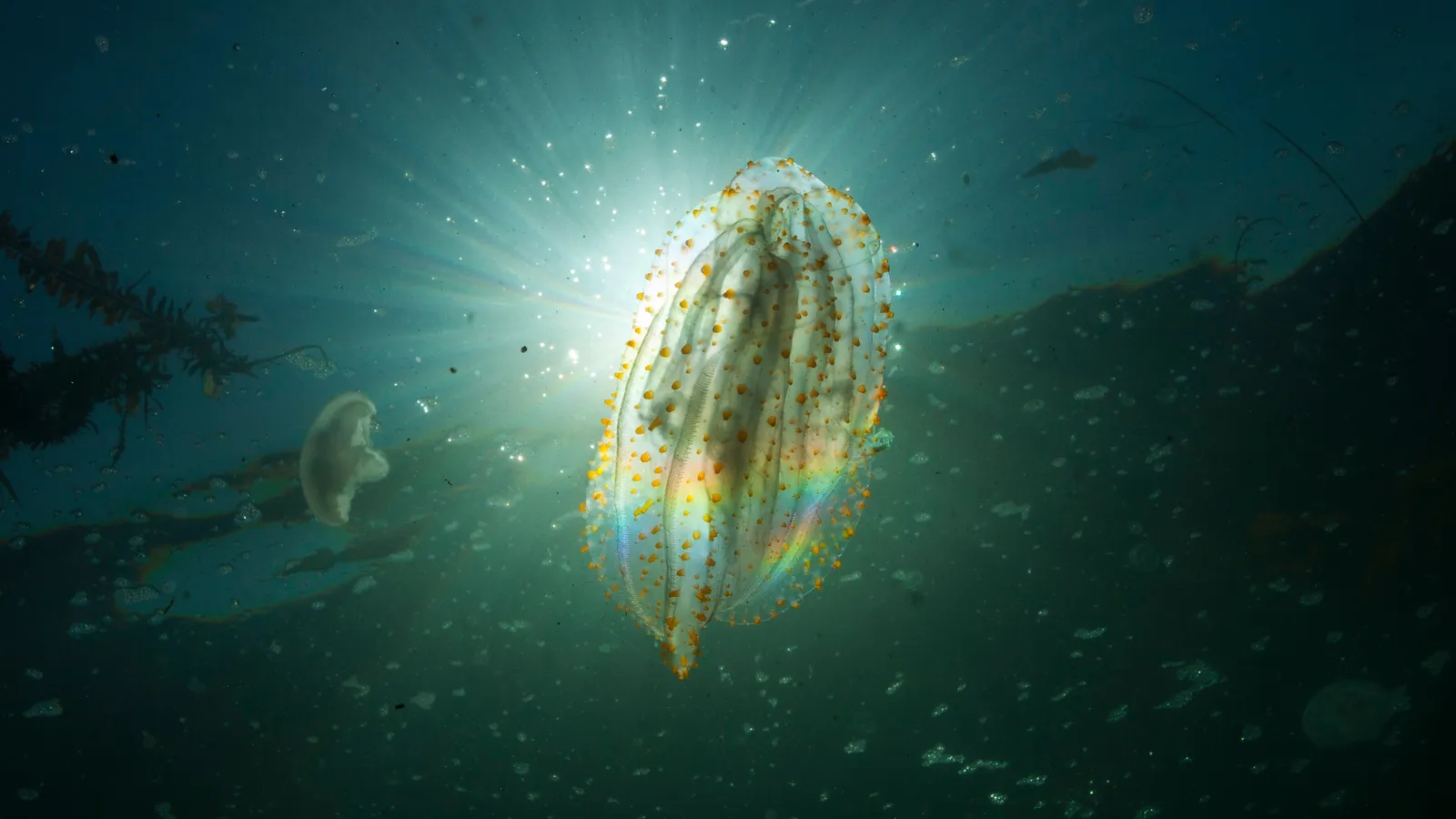
The rainbow shimmer in photos like the one above is not the animal glowing. The same authors describe ctenophores "flashing iridescence as their comb-like cilia plates catch the light", and they treat bioluminescence as a separate feature.
Do all ctenophores show bioluminescence?
Most do, but not all. In the comb jelly *Mnemiopsis*, light comes from photocytes "associated with the eight meridional canals underlying the longitudinal comb rows", according to Schnitzler and colleagues in BMC Biology (2012). The light-making proteins in those cells are calcium-activated photoproteins.
Haddock and Case (1995) ran physical and chemical tests on several species from the family Pleurobrachiidae and found no evidence that they could produce light, although every other ctenophore species they tested gave positive results. A 2023 review in Biophysical Reviews says most ctenophore species are bioluminescent and names the crawling, sea-floor *Coeloplana* and *Ctenoplana* as exceptions. The same review also cites a 2018 study reporting light from Black Sea *Pleurobrachia pileus*, so the question is not fully closed.
So the two textbook examples are poor ones to picture glowing. For the exam this changes nothing: "bioluminescence is well marked" describes the phylum, and the NCERT line is what gets marked.
How do comb jellies reproduce?
NCERT's three facts are that the sexes are not separate, fertilisation is external and development is indirect. Mianzan, Dawson and Mills write that most ctenophores are simultaneous hermaphrodites capable of self-fertilisation, and only the genus *Ocyropsis* has been reported with separate sexes. They also note that asexual reproduction has been recorded in the creeping platyctenids, but for the exam, stick to NCERT's "only by sexual means".
That combination helps explain a famous invasion. The same chapter reports that *Mnemiopsis*, carried to the Black Sea apparently in ships' ballast water, can release more than 10,000 eggs over its lifetime, and its arrival there was linked to the collapse of local pelagic fisheries.
How do you tell Ctenophora from Cnidaria in NEET-UG?
Both phyla are radially symmetrical, diploblastic and at the tissue level, so questions lean on the differences. Use this checklist, built from the NCERT chapter:
Swims with eight rows of ciliated comb plates: Ctenophora.
Has cnidoblasts with stinging capsules: Cnidaria.
"Exclusively marine": Ctenophora. "Aquatic, mostly marine": Cnidaria.
Polyp and medusa forms, or metagenesis: Cnidaria only.
"Reproduction takes place only by sexual means": Ctenophora.
Worked example. Which statement about ctenophores is wrong? (a) They are exclusively marine. (b) Fertilisation is internal. (c) They are diploblastic. (d) Digestion is both extracellular and intracellular.
Options (a), (c) and (d) match the NCERT text. Option (b) flips "external" to "internal", so (b) is the answer. Examiners often build the wrong option by swapping one word.
If you build a phylum comparison table with an AI chatbot, check every example it gives. The *Pleurobrachia* story shows how easily a confident example can be shaky.
To see where Ctenophora sits next to Porifera and Cnidaria, the Fermi Concept Library gives every biology concept its own lesson and its place in the map. That lets you check a neighbouring phylum without losing your place.
Next step: read section 4.2.3 aloud once, then try writing the five checklist points from memory.


