

On this page
Animal Kingdom is a chapter of tables in disguise. Every phylum has a level of organisation, a symmetry, a body cavity and a short list of example organisms, and exam questions mix them up on purpose. An AI chatbot will build that table for you in seconds. The useful part is what you do next: check every cell, and every example, against your NCERT book.
Why check an AI phylum table against NCERT?
Large language models such as ChatGPT and Gemini often "hallucinate" false outputs and unsubstantiated answers, according to a 2024 study in Nature by Farquhar and colleagues. A wrong example in a biology table can look just as convincing as a right one.
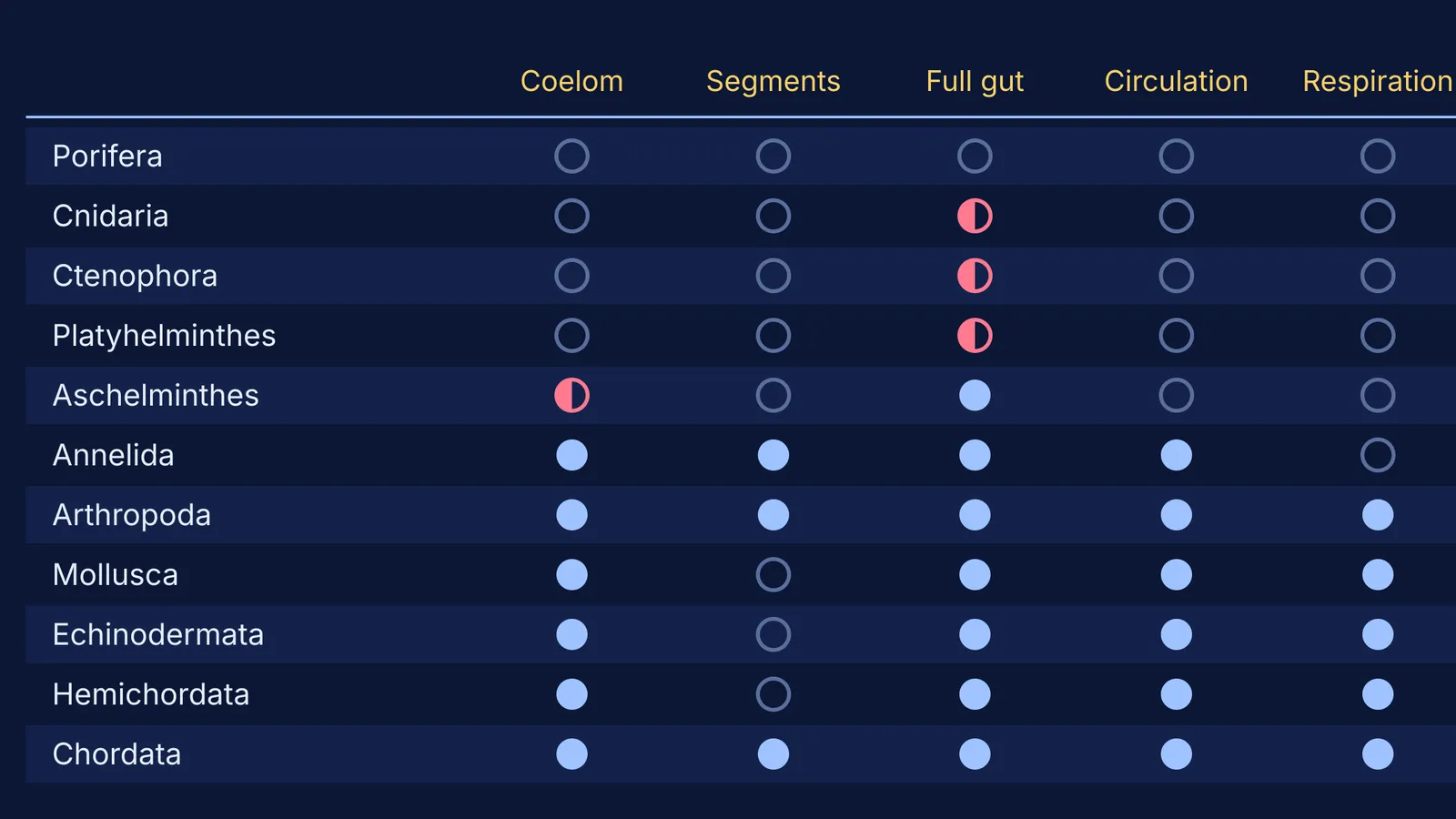
The NCERT Class 11 Biology chapter Animal Kingdom is the reference to check against. Its Table 4.2 compares 11 phyla across eight columns: level of organisation, symmetry, coelom, segmentation, digestive, circulatory and respiratory systems, and distinctive features. Each phylum and class section also has an "Examples" line naming specific genera.
An AI draws on many textbooks and websites at once, so its answer can be correct biology and still not match your book. Three mismatches are worth watching for:
Names. NCERT says Aschelminthes and Coelenterata (Cnidaria); an AI may say Nematoda or use only Cnidaria.
Placement. NCERT says Hemichordata was earlier treated as a subphylum of Chordata but is now a separate phylum under non-chordates. An AI may still nest it inside Chordata.
Examples. An AI may pick familiar animals that NCERT mentions in the text but leaves out of the Examples line, or animals it never mentions at all.
How do you prompt an AI to build a phylum comparison table?
Ask for a table that is easy to check, not one that looks impressive. Copy this script and adjust it:
"Make a comparison table of the 11 animal phyla in NCERT Class 11 Biology, Chapter 4, in this order: Porifera to Chordata."
"Use these columns only: level of organisation, symmetry, coelom, segmentation, digestive system, circulatory system, respiratory system, distinctive feature, two examples."
"Give each example as genus name plus common name, the way NCERT writes it."
"Mark any cell you are unsure of with a question mark instead of guessing."
"Then make a second table for the classes of Vertebrata: Cyclostomata, Chondrichthyes, Osteichthyes, Amphibia, Reptilia, Aves and Mammalia."
The column order matches Table 4.2, so you can lay your book beside the screen and check row by row. If you keep a blank-table habit already, our guide to the blank-table method for plant and animal examples pairs well with this.
Worked example: what does checking a row look like?
Suppose the AI's Cnidaria row gives "tissue level, radial, coelom absent" and examples "Hydra, jellyfish". The features match Table 4.2. For the examples, open section 4.2.2. The Examples line lists *Physalia*, *Adamsia*, *Pennatula*, *Gorgonia* and *Meandrina*. Hydra appears only in the text, as an example of the polyp form, and jellyfish are mentioned only in the text, beside *Aurelia*, as the medusa form. Mark both "in text, not in Examples line" and add one listed genus.
Now suppose the Mollusca row lists "*Pila*, *Sepia* (squid)". *Pila* is right. But NCERT gives *Sepia* as cuttlefish and *Loligo* as squid, so the common name is wrong. This is the kind of swap that becomes a wrong option in a multiple-choice question.
Use four marks for every example:
E: in NCERT's Examples line
T: in the text or a figure, not the Examples line
W: in NCERT, but under a different phylum or class
X: not in the chapter at all; replace it
Which class examples are easiest to mix up?
The vertebrate classes are full of animals whose common names point the wrong way. In the same NCERT chapter, *Hippocampus* (sea horse) and *Exocoetus* (flying fish) are bony fishes, *Ichthyophis* is a limbless amphibian, *Pteropus* (flying fox) is a mammal, and *Ornithorhynchus* (platypus) is given as an egg-laying mammal. *Trygon* (sting ray) and *Scoliodon* (dog fish) are cartilaginous fishes.
Non-chordates have the same trap. NCERT puts the scorpion in Arthropoda in Figure 4.12; our explainer on whether a scorpion is an arachnid or an insect goes one level deeper.
How do you turn the checked table into revision?
Once every cell is checked, hide one column and fill it from memory. Do the examples column last. If the AI also offers a mnemonic for the phyla order, test it the same way, letter by letter; our post on checking AI mnemonics for NEET biology shows how.
If a column keeps tripping you up because the idea behind it is unclear, such as why a pseudocoelom differs from a true coelom, look the concept up in the Fermi Concept Library before memorising more rows. And if you are not sure where to start in the chapter, Fermi's AI tutor works out what you already know and builds a plan for the session, so the table becomes one step in it rather than the whole evening.


