

On this page
If you wear −6.00 D glasses and switch to contact lenses, the number on the lens box will probably be smaller. Nothing has gone wrong. The lens has moved about a centimetre closer to your eye, and that changes the power you need. It is Class 12 ray optics, and one formula handles it.
What is vertex distance?
Vertex distance is the gap between the back surface of a spectacle lens and the front of the cornea, and most eye tests measure a prescription with the lens 12–14 mm from the eye (Wikipedia: Vertex distance). A contact lens rests on the cornea, so its vertex distance is effectively zero.
You also need lens power: P = 1/f, with f in metres and P in dioptres (D). If that feels shaky, our post on why a convex lens's focal length changes in water works through it.
Why is contact lens power different from spectacle power?
A short-sighted eye sees sharply only out to its far point. A minus lens makes light from a distant object spread out as if it came from that far point, and that distance is measured from the lens, not the eye.
On the cornea, the lens is 12 mm further from the same far point, so a weaker minus lens puts the image in the same place. For long sight it flips: a plus lens moved closer to the eye needs more power.
The conversion formula is Fc = F ÷ (1 − d × F), where F is the spectacle power in dioptres, d is the vertex distance in metres and Fc is the power at the cornea (Wikipedia: Vertex distance, which derives it from fc = f − d).
How do you convert spectacle power to contact lens power?
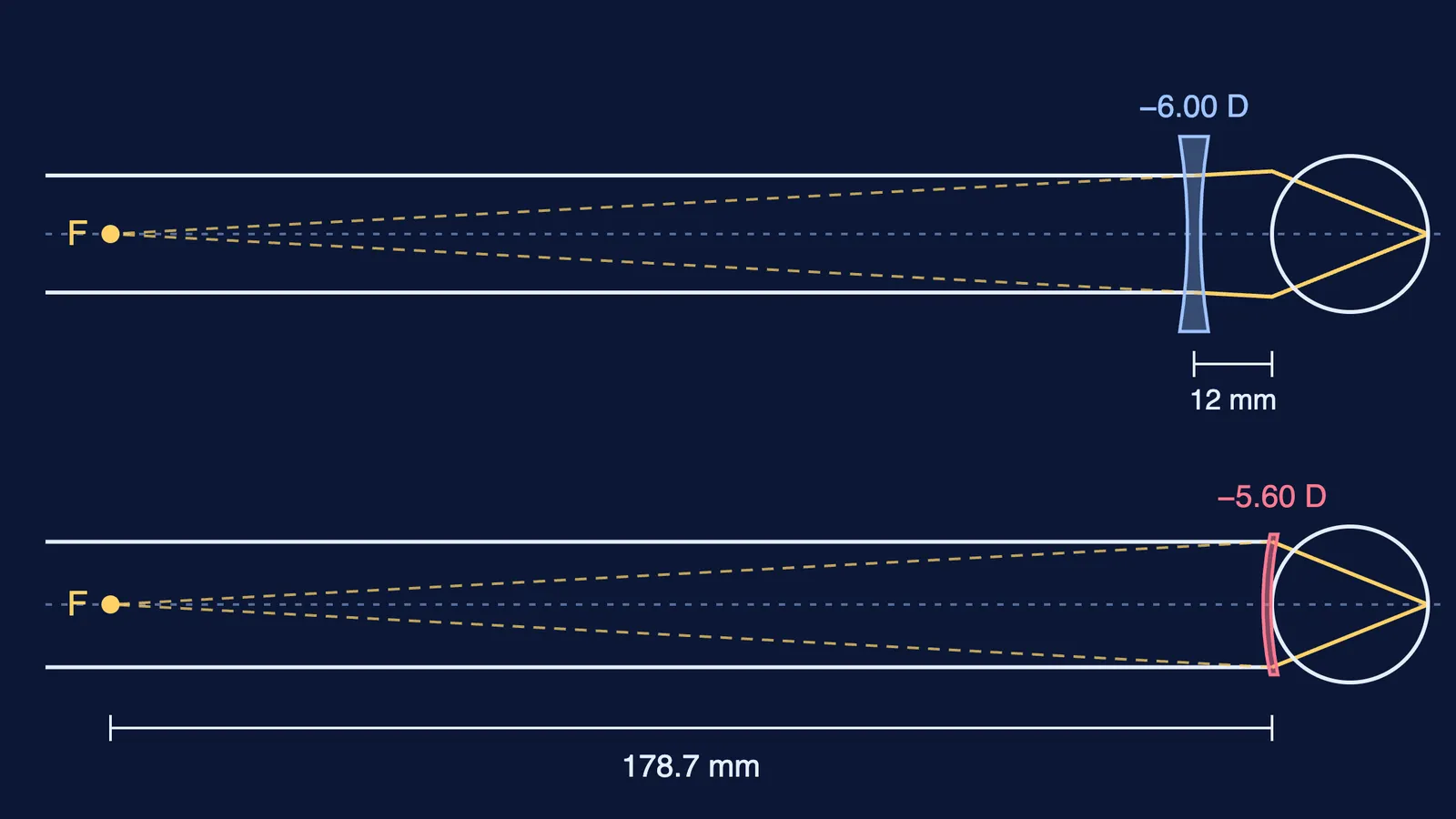
Take −6.00 D glasses worn 12 mm from the eye.
Find where the lens sends the image: f = 1 ÷ (−6.00) = −0.1667 m, so light appears to come from a point 166.7 mm in front of the lens.
Add the vertex distance: 166.7 + 12 = 178.7 mm in front of the cornea. That is the eye's far point.
The contact lens must put the image at the same point, measured from the cornea: Fc = 1 ÷ (−0.1787) = −5.60 D.
Check with the formula: −6.00 ÷ (1 − 0.012 × −6.00) = −6.00 ÷ 1.072 = −5.60 D.
That is a difference of 0.40 D. Going backwards uses F = Fc ÷ (1 + d × Fc); the same Wikipedia article works out that a −8.00 D contact lens corresponds to about −8.84 D in glasses at 12 mm.
We ran the formula at 12 mm for a few spectacle powers:
−3.00 D glasses → −2.90 D at the cornea (0.10 D apart)
−6.00 D glasses → −5.60 D (0.40 D apart)
−10.00 D glasses → −8.93 D (1.07 D apart)
+6.00 D glasses → +6.47 D (0.47 D apart)
The gap grows roughly as d × F²: double the power and it roughly quadruples.
When does the difference matter?
The difference becomes significant once a spectacle prescription goes beyond about ±4.00 D: above roughly that power, the gap grows past 0.25 D, which counts as clinically significant (Wikipedia: Vertex distance). At exactly 4 D the formula gives about 0.2 D, so treat it as a rule of thumb. A clinical cheat sheet for eye-care professionals agrees: generally, the spherical power does not need converting if the spectacle power is 4.00 D or less, and astigmatism is handled separately (Eyes On Eyecare vertex distance cheat sheet).
What does this mean for your own prescription?
A few points for you and your parents:
Your spectacle numbers are not a contact lens prescription. That comes from an optometrist or ophthalmologist after a fitting.
If your glasses are stronger than about ±4.00 D, expect the two prescriptions to differ. That is optics, not a mistake.
The axis of an astigmatism correction does not change with vertex distance, but the cylinder power can (Wikipedia: Vertex distance).
How does this show up in JEE Main and NEET-UG physics?
Short-sight questions use the same steps: the far point is the image position, then P = 1/f. Try it: a far point of 50 cm with glasses 2 cm from the eye gives P = −1 ÷ 0.48 = −2.08 D; as a contact lens, P = −1 ÷ 0.50 = −2.00 D. Our worked myopia problem with a far point of 2 m uses the same method. For more practice on where images form, read our guide to telling a mirror from a lens without touching it.
If ray diagrams for the eye still feel abstract, Fermi's AI tutor can draw the figure and work through a problem like this with you, checking understanding as it goes. The Fermi Simulation Lab has interactive simulations for ideas that are easier to see than read.
Next time your glasses and your lens box show different numbers, run the formula yourself and see how close you get.


