

On this page
In a Class 10 practical you may be handed three mirrors or two lenses and told not to touch them. You don't need to. Each one gives itself away by its image, and by how that image changes as you move closer.
How do you identify a plane, concave or convex mirror without touching it?
Hold the mirror at arm's length, look at your face, then bring the mirror slowly towards you. NCERT's Class 10 science chapter, Light – Reflection and Refraction, sets out what each mirror does:
Plane mirror: the image is always virtual, erect and the same size as you.
Convex mirror: the image is always virtual, erect and diminished.
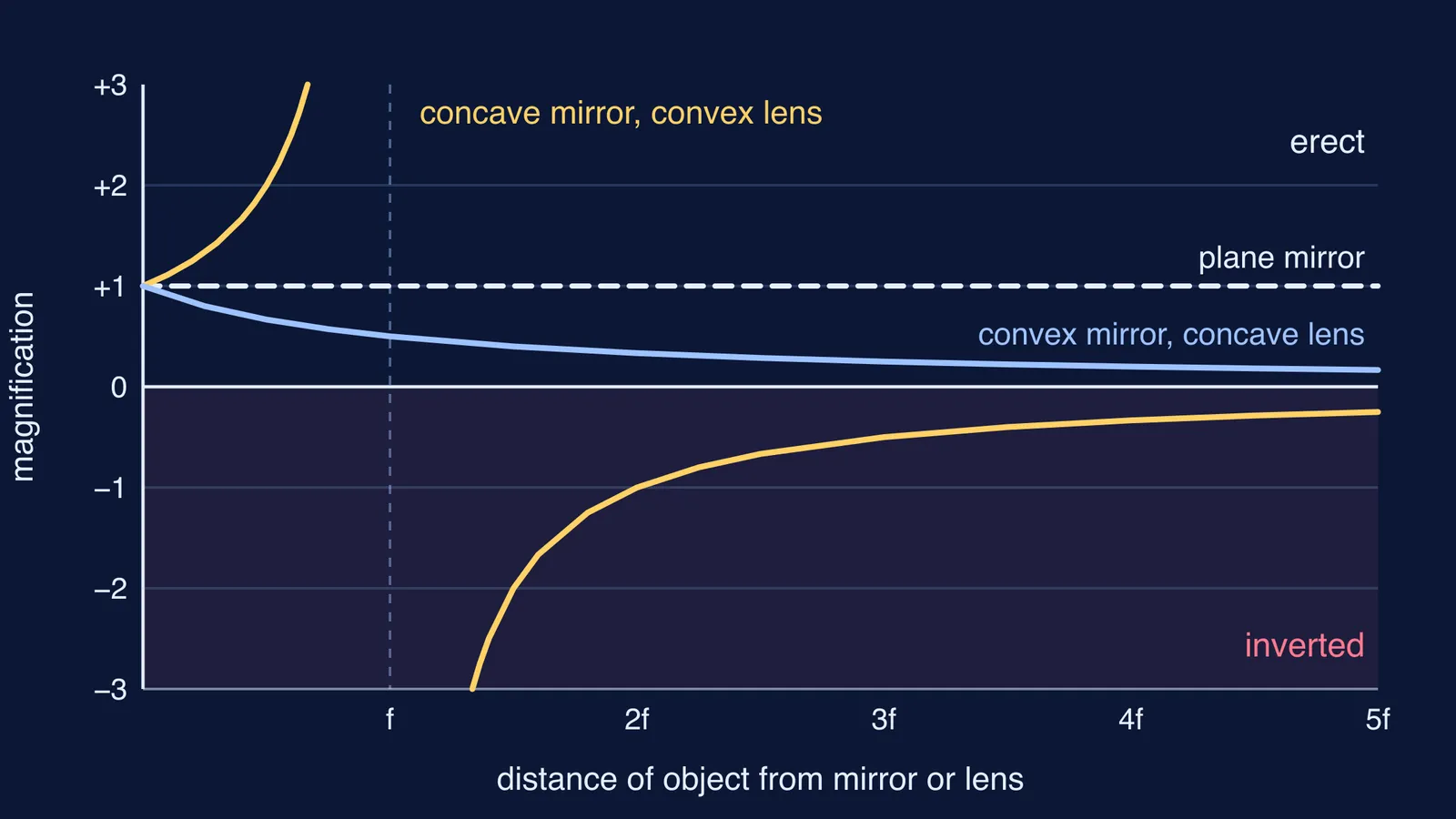
Concave mirror: the image depends on distance. Between the mirror and its focus it is virtual, erect and enlarged. Beyond the focus it becomes real and inverted, and beyond the centre of curvature it is inverted and diminished.
So the rule is short. If your face ever turns upside down, the mirror is concave. If it never flips, look at the size: same size means plane, smaller means convex. For every stage of a concave mirror's image, see all six object positions for a concave mirror.
How do you tell a convex lens from a concave lens?
First, look at the edge. NCERT describes a convex lens as thicker at the middle than at the edges, and a concave lens as thicker at the edges (NCERT Class 10, Chapter 9). Hold the lens side-on against a plain wall and the profile shows.
Second, read through it. Place the lens just above printed text, then lift it slowly towards your eye:
Convex lens: close to the page, the letters look enlarged and erect. Keep lifting and the print blurs, then reappears upside down.
Concave lens: the letters look smaller and erect at every height. NCERT's summary is that a concave lens "will always give a virtual, erect and diminished image, irrespective of the position of the object."
A convex lens behaves like a concave mirror, and a concave lens like a convex mirror, so you only need to remember three behaviours, not five. Our guide to convex lens image positions for Class 10 covers each case with ray diagrams.
What is the step-by-step check in a practical exam?
Can you see through it? Yes means a lens. No means a mirror.
Hold it very close to your face or the page. Enlarged and erect: concave mirror or convex lens. Same size: plane mirror. Smaller: convex mirror or concave lens.
Move it slowly to arm's length. Blurs, then inverted: concave mirror or convex lens. Erect and shrinking: convex mirror or concave lens. Erect and always the same size as the object: plane mirror.
For a lens, check the edge profile to confirm.
A viva answer can be this short: "The image was erect and diminished at every distance, so this is a convex mirror. A plane mirror would have given an image the same size as the object."
Why does only a concave mirror or convex lens flip the image?
A concave mirror and a convex lens bring parallel rays together at a real focus. With the object beyond the focus, the rays really meet: real, inverted image. Inside the focus, your eye traces spreading rays back to an erect, enlarged, virtual image. A convex mirror and a concave lens only spread light out, so their images are always virtual, erect and smaller (NCERT Tables 9.1, 9.2, 9.4 and 9.5).
Magnification puts a number on this. NCERT defines it as m = h′/h, image height over object height; a negative m means a real image and a positive m a virtual one. In NCERT's Example 9.1, a convex rear-view mirror with a radius of curvature of 3.00 m shows a bus 5.00 m away as an image 1.15 m behind the mirror, with m = +0.23: erect, and less than a quarter of the bus's size. We explain the geometry in why a convex mirror always forms a virtual, diminished image.
The switch from erect to inverted as the object crosses the focus is easier to see than to read. The Fermi Simulation Lab has interactive simulations for ideas like this one.
What mistakes cost marks?
Calling a convex mirror plane because the image is erect. Always compare the size.
Deciding there is no image when the view blurs at one distance. The object is at or near the focus; NCERT's tables note that with the object at the focus the image would not be formed.
Looking at the Sun through a lens, or into a mirror reflecting sunlight. NCERT warns this may damage your eyes.
If one of these ideas is still shaky, the Fermi Concept Library gives each physics concept its own lesson. Then try the flip test on a steel spoon tonight: NCERT notes the inside approximates a concave mirror and the back a convex one.


