

On this page
You know the type: "The sum of three consecutive integers is 72. Find them." It reads like a riddle, but it becomes a one-line linear equation as soon as you write every number in terms of one unknown. NCERT's Class 8 chapter on linear equations notes that problems on numbers, ages, perimeters and currency notes can all be solved with linear equations (NCERT Class 8 Mathematics, Chapter 2). Consecutive-number problems are the cleanest place to practise that translation step.
How do you write consecutive integers in algebra?
Consecutive integers are integers in which each one is 1 more than the one before, so you write them as x, x + 1, x + 2 (OpenStax Elementary Algebra 2e, section 3.1).
Consecutive even integers go up by 2 each time, so they are written x, x + 2, x + 4 (same OpenStax section).
Consecutive odd integers are also written x, x + 2, x + 4, because adding 2 to an odd number gives the next odd number (same OpenStax section).
Integers include zero and negatives, so -4, -3, -2 count too. If the number sets blur together, see our explainer on natural numbers, whole numbers and integers.
How do you solve a consecutive integer sum problem?
OpenStax teaches a seven-step strategy for word problems: read, identify, name, translate, solve, check, answer (OpenStax Elementary Algebra 2e, section 3.1). For consecutive numbers it shrinks to five moves:
Name the first (smallest) number x.
Write the others: steps of + 1 for plain integers, steps of + 2 for odd or even integers.
Add them and set the total equal to the given sum.
Solve the linear equation for x.
Write out every number, then check the sum and the type.
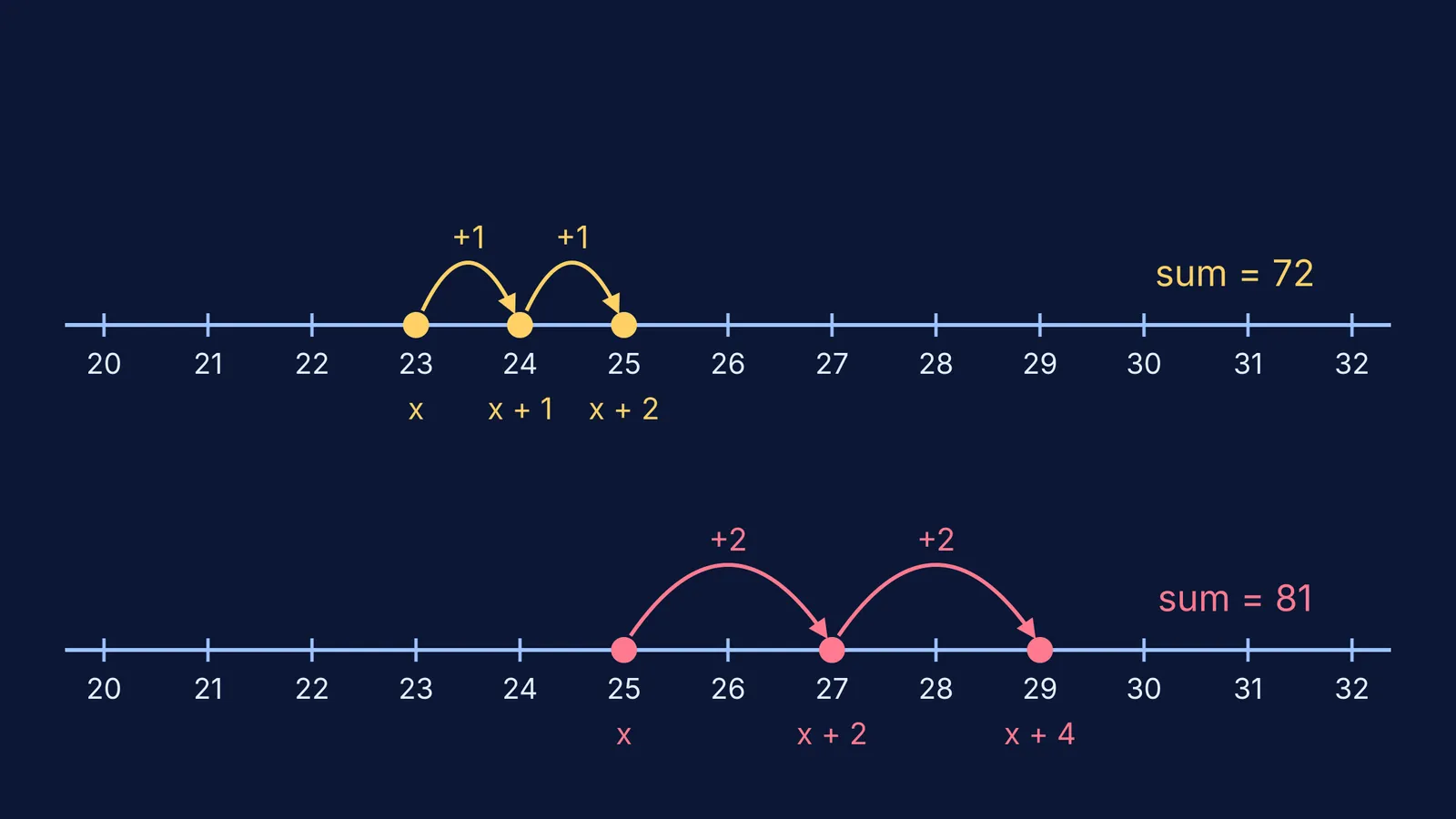
Example 1: three consecutive integers that add to 72.
x + (x + 1) + (x + 2) = 72
3x + 3 = 72
3x = 69, so x = 23
The numbers are 23, 24 and 25. Check: 23 + 24 + 25 = 72.
Example 2: three consecutive odd integers that add to 81.
x + (x + 2) + (x + 4) = 81
3x + 6 = 81
3x = 75, so x = 25
The numbers are 25, 27 and 29. Check: they add to 81 and all three are odd.
Example 3: four consecutive even integers that add to 108.
x + (x + 2) + (x + 4) + (x + 6) = 108
4x + 12 = 108
4x = 96, so x = 24
The numbers are 24, 26, 28 and 30. Check: they add to 108.
Is there a faster way to find consecutive numbers from their sum?
With an odd count of numbers, call the middle one x. Three consecutive integers become x - 1, x, x + 1, which add to 3x. A sum of 72 gives a middle of 72 ÷ 3 = 24, so 23, 24, 25. With an even count, keep x as the smallest. Either way, sum ÷ count is the average, and your answers should sit evenly around it: a ten-second exam check.
What mistakes cost marks in these problems?
Writing the next odd number as x + 1. Odd to odd is always a step of 2.
Skipping the type check. For "two consecutive odd integers add to 50", x + (x + 2) = 50 gives x = 24, which is even. No such odd integers exist, and saying so is the correct answer: two consecutive odd numbers, (2k + 1) + (2k + 3) = 4k + 4, always add to a multiple of 4.
Stopping at x. The question asks for all the numbers, so finish with a sentence that names them.
Rejecting negatives. If three consecutive integers add to -9, then x = -4, and -4, -3, -2 is valid unless the question says positive.
Practice set with answers
Cover the answers and use the five moves.
Two consecutive integers add to 61. Answer: 30 and 31.
Three consecutive even integers add to 126. Answer: 40, 42 and 44.
Three consecutive odd integers add to 57. Answer: 17, 19 and 21.
Five consecutive integers add to 0. Answer: -2, -1, 0, 1 and 2.
Two consecutive odd integers add to 70. Answer: none, because 70 is not a multiple of 4.
If you got one wrong and cannot see why, the Fermi Problem Library has worked problems with a step-by-step solver that explains the reasoning rather than printing an answer, so you can find the exact line where your setup went off.
Consecutive numbers are the warm-up. Next, try forming equations from Class 10 word problems and two-digit number problems where the digits are reversed, which use the same name-translate-solve-check habit.


