

On this page
When you face a two-digit number digits reversed problem in a maths exam, you do not need to guess and check every combination. The key is to stop seeing the number as a single block and start looking at its place value.
By writing the tens and units digits as separate variables, you can turn a word puzzle into two simple linear equations.
How do you write a two-digit number algebraically?
If you have a two-digit number, let the tens digit be a and the units digit be b. Because a is in the tens place, its actual value is 10 × a.
Therefore, you must write the original two-digit number as 10a + b. If the problem states the digits are reversed, the new tens digit is b and the new units digit is a. You write the reversed number as 10b + a.
This standard general form is introduced in the NCERT Class 8 Mathematics textbook chapter "Playing with Numbers" (NCERT).
Why is the difference always a multiple of 9?
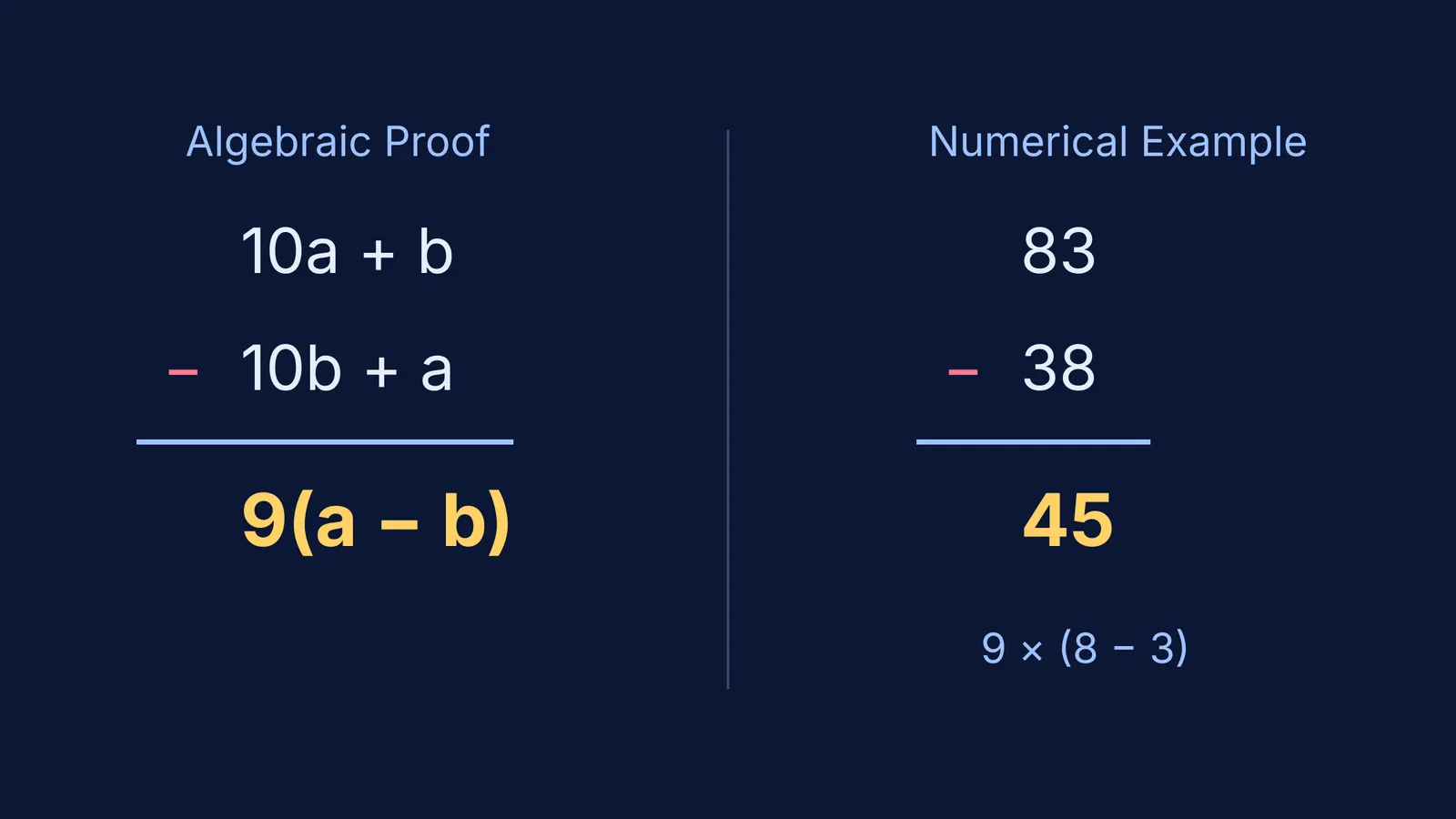
A common trick in these problems is that the difference between the original number and the reversed number is always perfectly divisible by 9.
Here is the algebraic proof:
Original number: 10a + b
Reversed number: 10b + a
Difference: (10a + b) - (10b + a)
Group the terms: 10a - a + b - 10b = 9a - 9b
Factorise: 9(a - b)
Because a and b are integers, a - b is an integer. Any integer multiplied by 9 is a multiple of 9. Furthermore, the quotient you get when you divide the difference by 9 is simply a - b (the difference between the two digits themselves).
What happens when you add the reversed number?
While the difference gives you a multiple of 9, the sum of a two-digit number and its reversed form gives you a multiple of 11.
Original number: 10a + b
Reversed number: 10b + a
Sum: (10a + b) + (10b + a)
Group the terms: 11a + 11b
Factorise: 11(a + b)
Just like the difference rule, the quotient when you divide the sum by 11 is exactly the sum of the digits, a + b. Exam setters love to use both rules in the same question to test whether you know your algebra.
How do you solve a digit reversal exam problem?
Here is how to use these rules to solve a typical exam question quickly.
Problem: The sum of the digits of a two-digit number is 11. When the digits are reversed, the new number is 45 less than the original number. Find the original number.
Step 1: Write what you know Let the tens digit be a and the units digit be b. Equation 1 (from the sum of digits): a + b = 11.
Step 2: Use the difference rule The problem states that the reversed number is 45 less than the original. We know from our rule that the difference is always 9(a - b). So, 9(a - b) = 45. Divide both sides by 9: Equation 2: a - b = 5.
Step 3: Solve the simultaneous equations Add Equation 1 and Equation 2 together: (a + b) + (a - b) = 11 + 5 2a = 16, so a = 8.
If a = 8 and a + b = 11, then b = 3.
The original number is 83. (Check: 83 - 38 = 45).
If you find setting up these equations tricky, the Fermi Problem Library has a step-by-step solver that explains the reasoning rather than printing an answer.
What is the four-step plan for digit reversal problems?
The next time you see a question about reversed digits, follow this framework:
Define your variables: let a be the tens digit and b be the units digit.
Write the original number as 10a + b and the reversed number as 10b + a.
Translate the English sentences into two algebraic equations.
Solve for a and b, and remember to put them back together into the final number.
Instead of guessing, you now have a reliable algebraic method to solve any digit puzzle. For a quick way to double-check your arithmetic when you finish, see our guide on How to Check Multiplication Using Casting Out Nines. If you enjoy seeing how algebra explains number tricks, you can also read about the algebra behind the square of a number ending in 5 trick.


