

On this page
Some equations look hard only because they are written the long way round. Componendo and dividendo is the ratio rule that turns them into two-line problems, especially when square roots sit in both the top and the bottom of a fraction.
What is the componendo and dividendo rule?
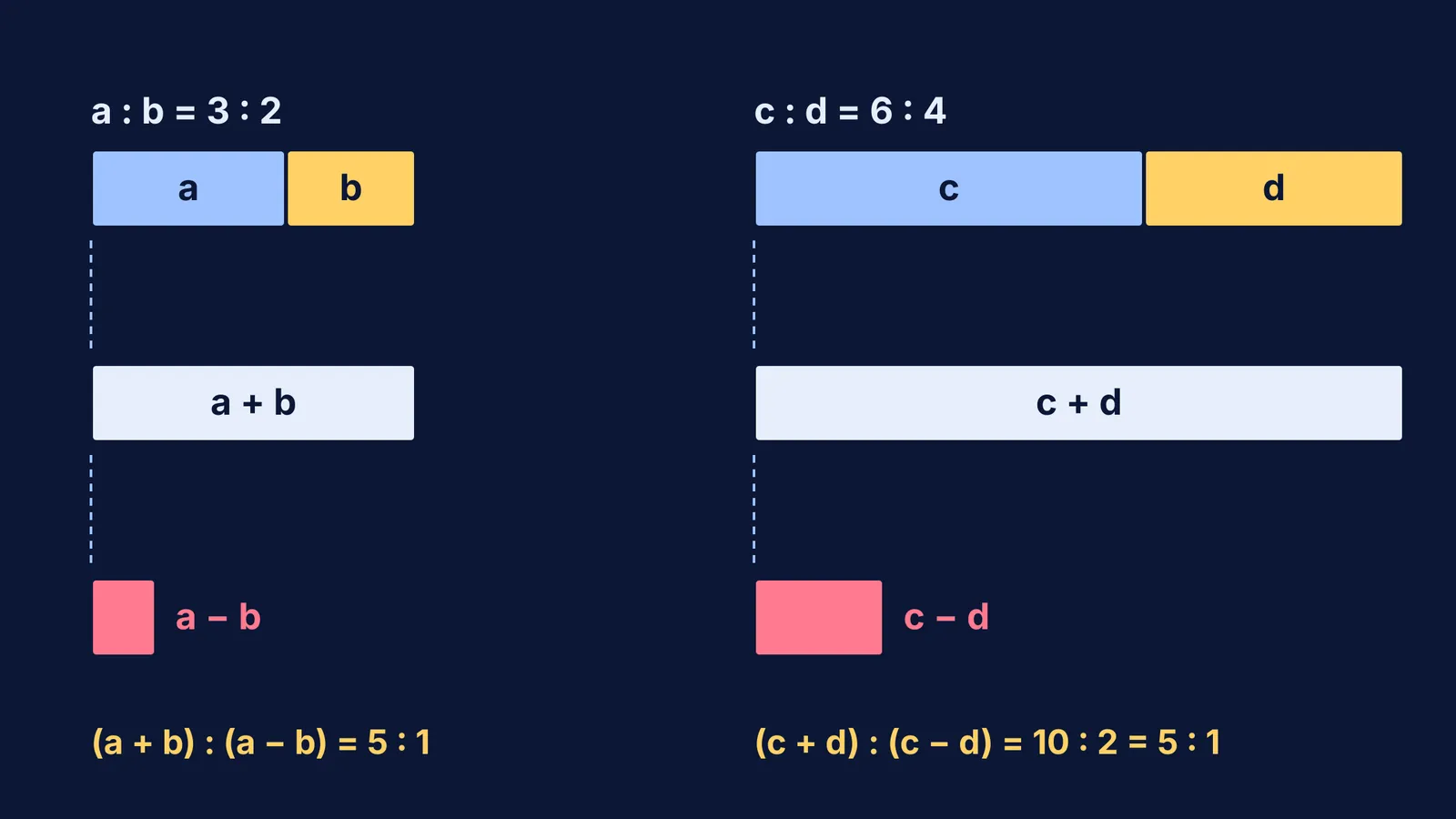
The rule: if a/b = c/d, then (a + b)/(a − b) = (c + d)/(c − d), provided b and d are not zero and a ≠ b.
It is two older steps glued together. Componendo adds the denominator to the numerator: (a + b)/b = (c + d)/d. Dividendo subtracts it: (a − b)/b = (c − d)/d. Divide the first result by the second and the b and d cancel, leaving the combined rule.
Both steps go back to Euclid. In Book V of the Elements, a ratio "taken jointly" means the antecedent together with the consequent, compared with the consequent by itself, according to Definition 14 in David Joyce's online edition of Euclid at Clark University. Joyce notes that Heath translates "taken jointly" with the Latin componendo. Proposition 18 of Book V proves that if magnitudes are proportional taken separately, they are also proportional taken jointly. Proposition 17 of Book V proves the reverse.
Why does componendo and dividendo work?
Call the common value k, so a = kb and c = kd. Then (a + b)/(a − b) = (kb + b)/(kb − b) = (k + 1)/(k − 1). The same steps give (c + d)/(c − d) = (k + 1)/(k − 1). Both sides depend only on k, so they are equal.
The proof also shows the rule runs backwards. If (p + q)/(p − q) = m/n, then p/q = (m + n)/(m − n), as long as m ≠ n. You will use this backwards form most often.
How do you use componendo and dividendo to solve equations?
Example 1. Solve (x + 5)/(x − 5) = 7/3.
Apply the rule backwards: x/5 = (7 + 3)/(7 − 3) = 10/4.
So x = 50/4 = 12.5.
Check: 17.5/7.5 = 7/3. Correct.
Example 2. If (3a + 2b)/(3a − 2b) = 4, find a : b.
The two pieces are 3a and 2b, so 3a/2b = (4 + 1)/(4 − 1) = 5/3.
Then a/b = (5 × 2)/(3 × 3) = 10/9.
Check with a = 10 and b = 9: (30 + 18)/(30 − 18) = 48/12 = 4.
Example 3. Solve (√(x + 1) + √(x − 1))/(√(x + 1) − √(x − 1)) = 3.
Adding top and bottom gives 2√(x + 1); subtracting gives 2√(x − 1). So √(x + 1)/√(x − 1) = (3 + 1)/(3 − 1) = 2.
Square both sides: (x + 1)/(x − 1) = 4, so x + 1 = 4x − 4 and x = 5/3.
Check: x + 1 = 8/3 and x − 1 = 2/3, so the square roots are in the ratio 2 : 1, and (2 + 1)/(2 − 1) = 3.
Without the rule, Example 3 means rationalising and a long expansion. If surd fractions trip you up, our guide on finding a and b when a surd fraction equals a + b√3 builds the same habit of matching parts.
When does componendo and dividendo go wrong?
The ratio is 1. If a = b, then a − b is zero and the rule divides by zero. In the backwards form, the right-hand side cannot equal 1 either.
Squaring adds fake answers. Example 3 needed a squaring step, and squaring can create values that do not satisfy the original equation. Substitute back, and make sure nothing under a square root is negative.
Picking the wrong pieces. In Example 2 the pieces are 3a and 2b, not a and b. Strip the coefficients only at the end.
Losing a zero case. If a factor you cancel could be zero, test that case on its own.
How should you practise it this week?
Day 1: prove the rule from a = kb, without notes.
Day 2: solve a handful of equations like Example 1, naming the two pieces aloud.
Day 3: try a few square-root equations like Example 3, checking every answer.
Day 4: mix in duplicate and compounded ratios and mean proportional and continued proportion, so you learn to spot which rule a question wants.
Day 5: redo the ones you got wrong and write one line on what went wrong.
When a step goes wrong and you cannot see why, the Fermi Problem Library has worked problems with a step-by-step solver that explains the reasoning rather than printing an answer. If the gap is the idea of a ratio itself, the Fermi Concept Library gives each mathematics concept its own lesson and its place in the map.


