

On this page
Ratios measure how quantities compare. But in exam papers like the ICSE Class 10 mathematics board exam, you will encounter specific, traditional names for combining and transforming them. Understanding these names—like the duplicate ratio and the compounded ratio—tells you exactly what operation to perform on the terms.
What is a duplicate ratio?
The duplicate ratio is what you get when you square both terms of a ratio. According to the foundational definitions set out in Euclid's *Elements* and still used in modern mathematics, if you have a ratio of a : b, its duplicate ratio is a² : b² (Wikipedia).
For example, the duplicate ratio of 3 : 4 is 3² : 4², which simplifies to 9 : 16.
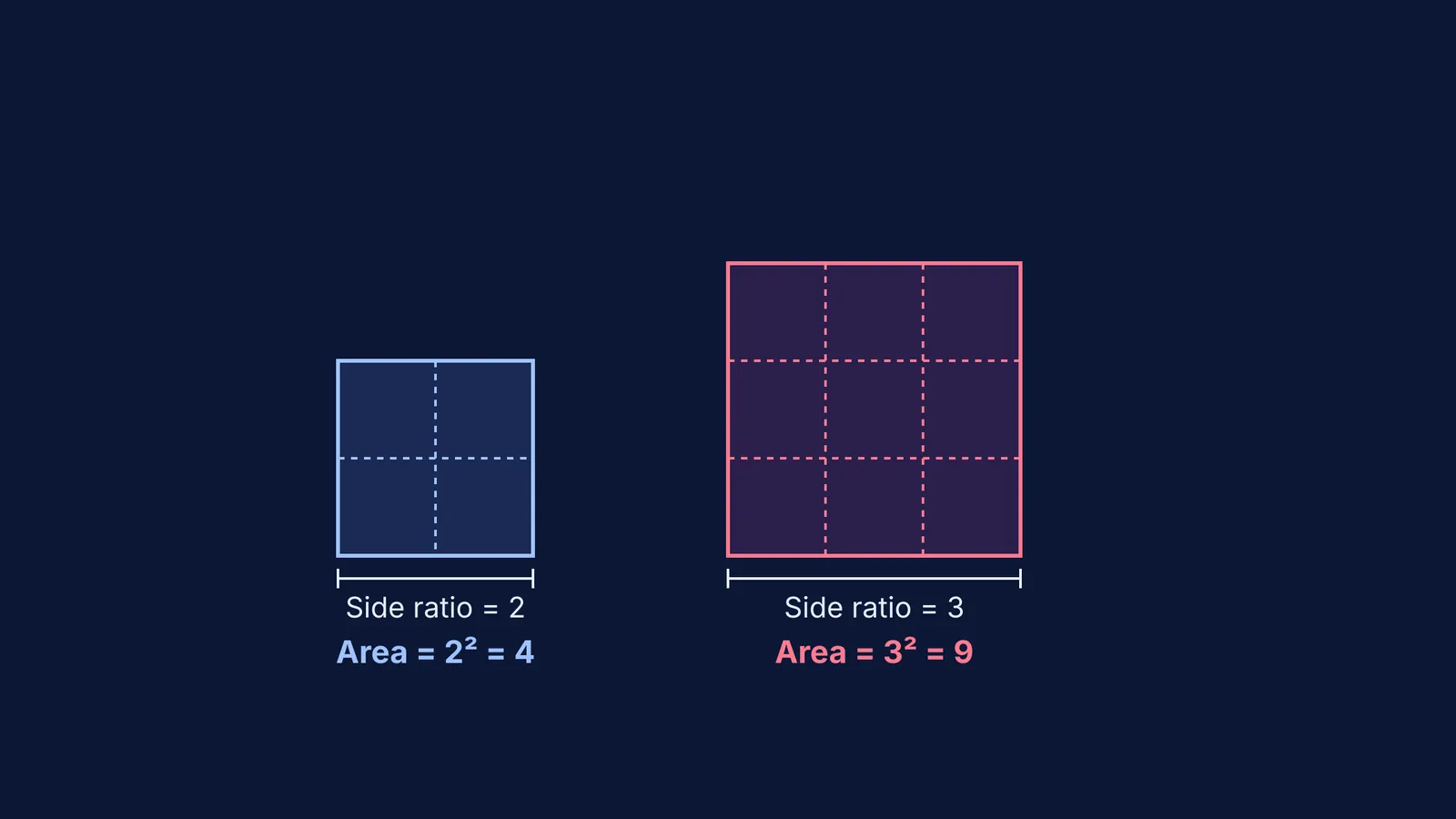
This is the geometric equivalent of comparing areas. If two squares have side lengths in the ratio of a : b, their areas are in the duplicate ratio a² : b². If a question asks for the duplicate ratio of algebraic terms, such as 3x : 4y, you square the coefficients and the variables to get 9x² : 16y².
You will also see the inverse operation, called the sub-duplicate ratio. This is the ratio of the square roots of the terms. The sub-duplicate ratio of a : b is √a : √b (BYJU'S). If a question asks for the sub-duplicate ratio of 25 : 36, the answer is 5 : 6.
A related concept is the triplicate ratio, which cubes the terms (a³ : b³), and the sub-triplicate ratio, which takes the cube root.
What is a compounded ratio?
A compounded ratio is formed by multiplying two or more ratios together. You multiply the first terms (the antecedents) to form the new first term, and multiply the second terms (the consequents) to form the new second term.
For two ratios a : b and c : d, their compounded ratio is ac : bd.
If you are asked to compound 2 : 3 and 5 : 7, you multiply the terms to get (2 × 5) : (3 × 7), giving 10 : 21.
A duplicate ratio is just a special case of a compounded ratio: it is a ratio compounded with itself. Compounding a : b with a : b yields a² : b².
Where do these appear in ICSE and applied maths questions?
These terms are a core part of the Ratio and Proportion chapter in Class 10. They rarely appear on their own; exams combine them with operations like componendo and dividendo (adding and subtracting the terms of a proportion).
A typical 3-mark board question might state that a given algebraic expression is the duplicate ratio of a simple number fraction, and then ask you to solve for the unknown variable. Setting up the equation correctly requires you to remember that "duplicate" means squaring the numbers, not multiplying them by two.
For example, if an exam question states that (x + 3) : (4x + 1) is the duplicate ratio of 3 : 5, you must first square the 3 and the 5 to get 9 : 25, and then solve the linear equation by cross-multiplying.
If you struggle to remember the difference between these definitions during a test, the Fermi Concept Library holds lessons on every algebraic concept. The AI tutor can walk you through the history of these terms and test your recall before you tackle full problems.
How do you combine these rules?
Let's look at a multi-step problem that tests several definitions at once.
Question: Find the compounded ratio of the duplicate ratio of 2 : 3, the reciprocal ratio of 16 : 21, and the sub-duplicate ratio of 49 : 64.
Find the duplicate ratio of 2 : 3.
Square the terms to get 2² : 3² = 4 : 9.
Find the reciprocal ratio of 16 : 21.
Swap the antecedent and consequent to get 21 : 16.
Find the sub-duplicate ratio of 49 : 64.
Take the square roots of both numbers to get √49 : √64 = 7 : 8.
Compound the three new ratios.
Multiply the first terms together and the second terms together: (4 × 21 × 7) : (9 × 16 × 8)
To simplify the calculation without a calculator, cancel common factors in the numerator and denominator. The 4 in the numerator cancels with the 16 in the denominator (leaving 4). The 21 and 9 share a factor of 3 (leaving 7 in the numerator and 3 in the denominator).
The remaining numerator is 1 × 7 × 7 = 49. The remaining denominator is 3 × 4 × 8 = 96.
Final Answer: 49 : 96.
Mistakes in these questions usually happen in the final simplification step, or by hurriedly misreading "sub-duplicate" as "duplicate". If you find your algebraic reasoning going off track, the Fermi Problem Library has a step-by-step solver that explains the logic behind each cancellation and equation setup, rather than just printing the final fraction.
For more practice with Class 10 algebra, see our guide on setting up quadratic word problems in Class 10, or review how to solve equations and inequalities with modulus.


