

On this page
Radicals and surds often look intimidating because they behave differently from whole numbers. A study in *Procedia - Social and Behavioral Sciences* found that 54.7% of high school students make errors when asked to simplify radicals into the standard a√b format. One of the most common exam questions tests your ability to manipulate these expressions by asking you to find unknown variables, typically labelled a and b.
When you are asked to find a and b from an equation where a fraction containing surds equals an expression like a + b√3, you are dealing with two distinct mathematical steps. First, you must clean up the fraction by rationalising the denominator. Second, you must use the principle of equality to match the rational and irrational pieces on both sides of the equation.
How do you find a and b when a surd fraction equals a + b√3?
To solve these problems, you need to transform the left side of the equation so that it has the exact same structure as the right side. The right side, a + b√3, has no fraction. Therefore, your first goal is to remove the surd from the denominator on the left side.
Let us look at a standard worked example. Suppose you need to find a and b if:
(5 + 2√3) / (7 + 4√3) = a + b√3
Here is the step-by-step plan:
Identify the conjugate: The denominator is 7 + 4√3. The rationalising factor of a binomial surd like x + √y is its conjugate, x - √y. In this case, the conjugate is 7 - 4√3.
Multiply top and bottom: Multiply both the numerator and the denominator by 7 - 4√3.
Left side = [(5 + 2√3) × (7 - 4√3)] / [(7 + 4√3) × (7 - 4√3)]
Simplify the denominator: Use the identity (x + y)(x - y) = x² - y².
Denominator = 7² - (4√3)² Denominator = 49 - (16 × 3) = 49 - 48 = 1.
Expand the numerator: Multiply out the brackets using the distributive property.
Numerator = 5(7) - 5(4√3) + 2√3(7) - 2√3(4√3) Numerator = 35 - 20√3 + 14√3 - 24
Combine the rational terms (35 - 24 = 11) and the irrational terms (-20√3 + 14√3 = -6√3).
Numerator = 11 - 6√3.
Read off the values: Now set your simplified left side equal to the right side.
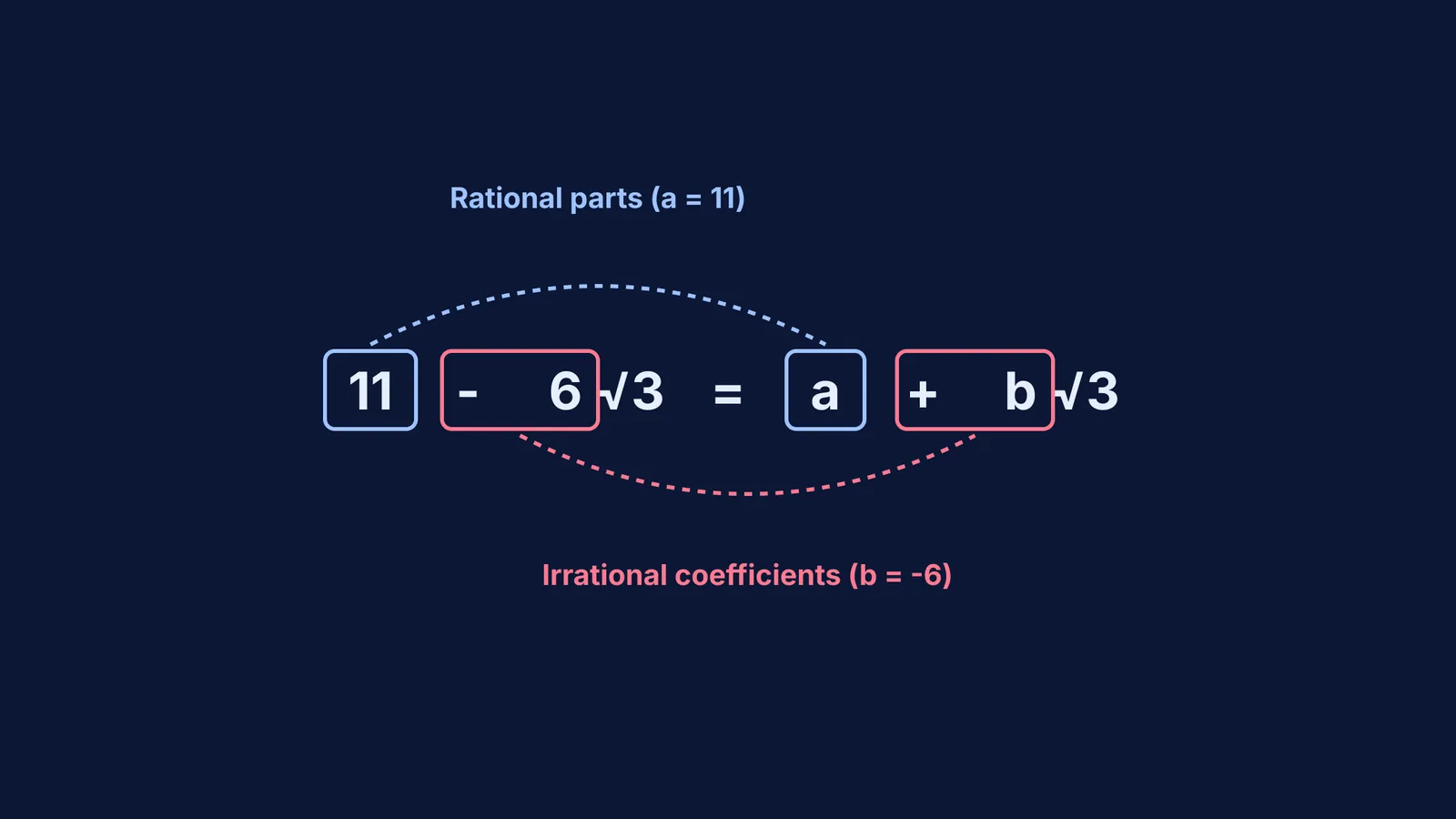
11 - 6√3 = a + b√3
Comparing the two sides, the rational part is a = 11, and the irrational coefficient is b = -6. You can practice more examples in the Fermi Problem Library, a step-by-step solver that explains the reasoning rather than just printing an answer.
Why do we compare rational and irrational parts?
You might wonder why we are allowed to simply declare that a = 11 and b = -6. This works because of a fundamental property of numbers: a rational number can never equal an irrational number.
If we have an equation p + q√x = r + s√x (where p, q, r and s are rational, and √x is irrational), the only way this statement can be true is if p = r and q = s. If the irrational parts were not equal (for example, if q and s were different), you could rearrange the algebra to solve for √x. That would mean writing √x as a fraction of integers, which contradicts the definition of an irrational number. This is a core rule you will also use when checking Is the Sum of Two Irrational Numbers Always Irrational?.
What are the common mistakes in surd comparison problems?
When preparing for exams, follow this checklist to avoid the procedural errors that trap most students:
Do not add dissimilar surds. You can only combine terms that share the exact same root, such as 3√3 and 5√3. If you have different roots, you must leave them separate, which you can read more about in Which is greater: square root 3 or cube root 5?.
Always bracket the numerator. When multiplying by the conjugate, put the entire original numerator in brackets before you expand, to ensure you do not miss any cross-multiplication terms.
Square both parts of a mixed surd. When squaring a term like 4√3 in the denominator, remember to square the 4 (giving 16) and the √3 (giving 3), then multiply them to get 48.
Include the sign in your final answer. If the question asks for a + b√3 and your calculation yields an answer with a minus sign, your value for b must be negative.
By breaking the problem down into rationalising first and comparing second, you turn a confusing algebraic fraction into a straightforward matching exercise.


