

On this page
When you solve ratio and proportion problems in maths, you often encounter situations where three quantities are linked together. If the ratio of the first to the second is the same as the ratio of the second to the third, they form a special sequence called a continued proportion.
Understanding how to navigate these terms—specifically finding the mean and third proportionals—is a core skill for algebra and competitive exams. Here is how they work and the formulas to find them quickly.
What is continued proportion?
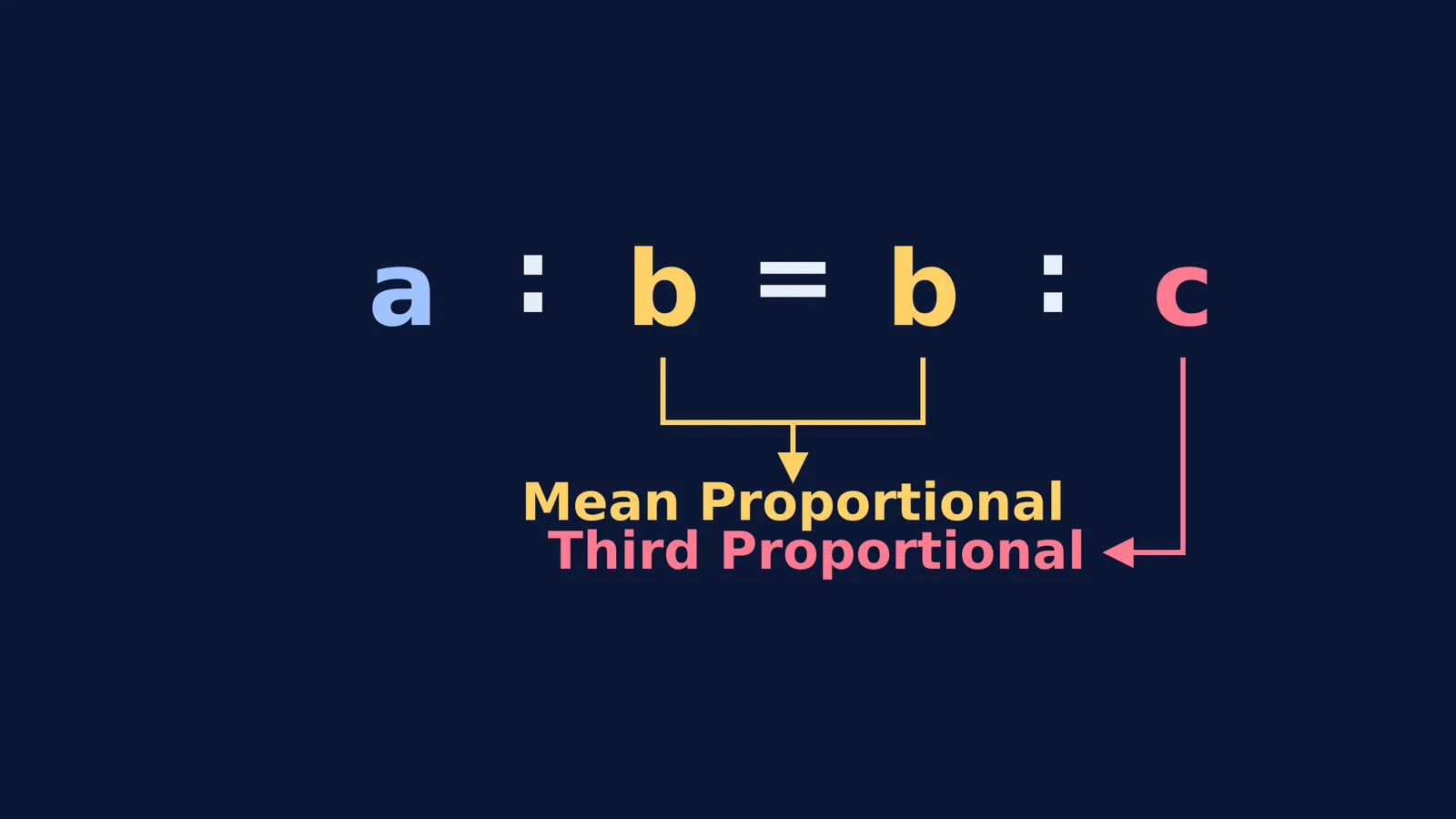
Three quantities (let's call them a, b and c) are in continued proportion if the ratio between the first and the second is equal to the ratio between the second and the third. Cuemath defines continued proportion as any three quantities where a : b = b : c.
In fraction form, this is written as: a / b = b / c
When you cross-multiply this equation, you get: b² = a × c
This relationship ties the three numbers together. If you know any two of the terms, you can use this formula to find the missing one.
What is the first proportional?
In the continued proportion a : b = b : c, the first term a is simply called the first proportional. While questions usually ask for the mean or third proportional, you can also find the first proportional if you know the other two. Using the same cross-multiplication, a = b² / c.
Example: Find the first proportional if the mean proportional is 6 and the third proportional is 12.
Here, b = 6 and c = 12.
Square the mean proportional: 6² = 36.
Divide by the third proportional: 36 / 12 = 3.
The first proportional is 3.
You can verify this by checking the ratios: 3/6 simplifies to 1/2, and 6/12 also simplifies to 1/2.
How to find the mean proportional?
In the continued proportion a : b = b : c, the middle term b is called the mean proportional between a and c. It is sometimes also called the geometric mean.
To find it, you multiply the two extreme terms and take the square root of the result. As Cuemath notes in its proportion guide, the formula for the mean proportional is b = √(a × c).
Example: Find the mean proportional between 4 and 9.
Multiply the two numbers: 4 × 9 = 36.
Take the square root: √36 = 6.
The mean proportional is 6.
You can check this by writing the ratios: 4/6 simplifies to 2/3, and 6/9 simplifies to 2/3.
How to find the third proportional?
In the same sequence a : b = b : c, the final term c is the third proportional to a and b.
You can find the third proportional by squaring the second term and dividing it by the first term. The formula is c = b² / a.
Example: Find the third proportional to 8 and 12.
Here, a = 8 and b = 12.
Square the second term: 12² = 144.
Divide by the first term: 144 / 8 = 18.
The third proportional is 18.
Checking answers with the Fermi Problem Library
Ratio questions can get complicated when fractions, decimals, or different units are introduced. If you are stuck on a textbook problem or want to check your method, the Fermi Problem Library has a step-by-step solver that explains the reasoning rather than printing an answer.
Fermi's AI tutor works out what you already know and builds a plan for the session, so you can sit down to a clear next step and see exactly where a calculation went wrong.
If you are working on ratio problems, you might also find these guides helpful:


