

On this page
A memorised list of reaction names stops helping the moment a question shows you an unfamiliar reaction. A more reliable route is to look only at bonds: which ones broke, which ones formed, and whether the formula of the molecule you are following changed.
What are the four types of organic reactions?
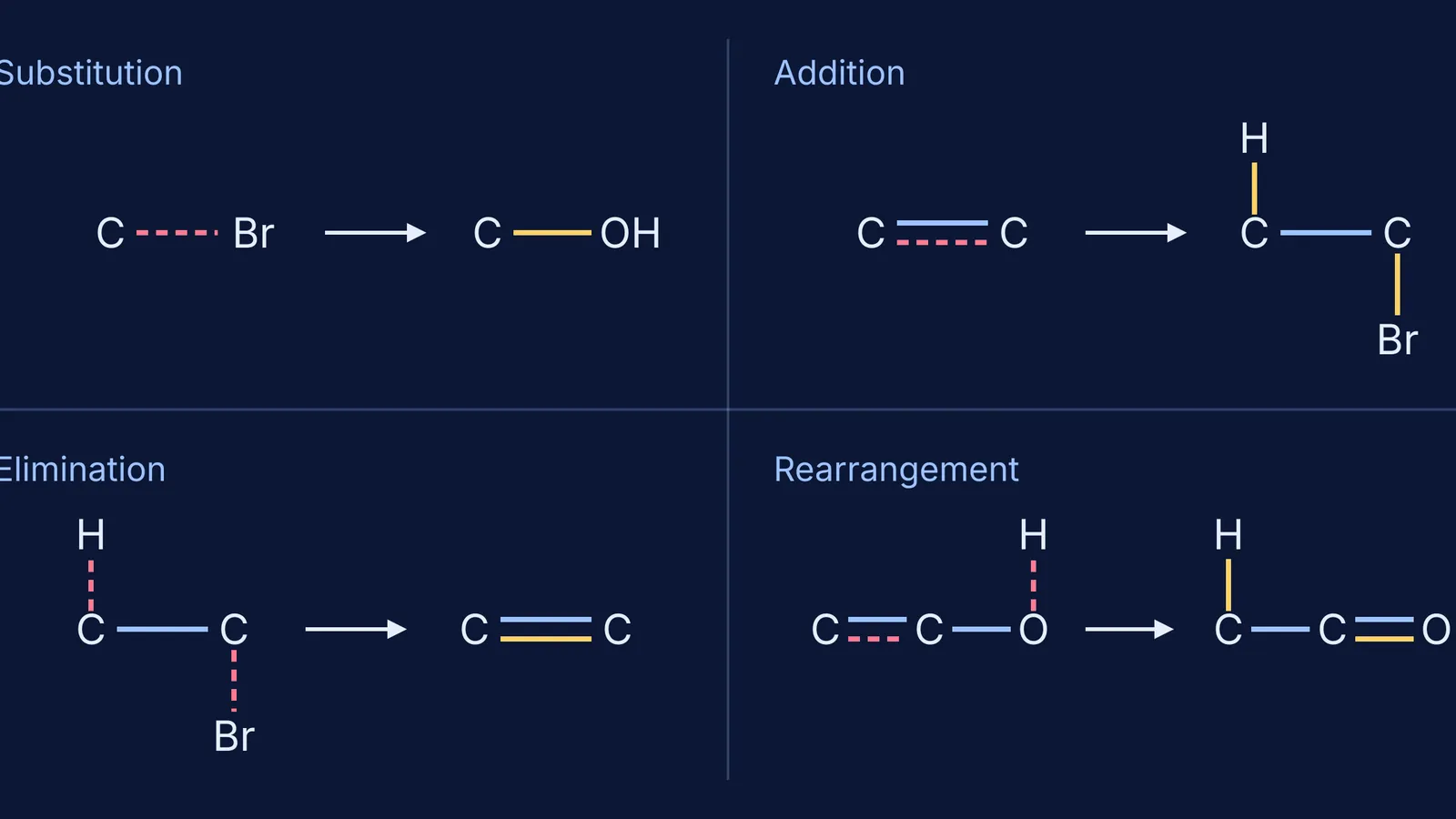
NCERT's Class 11 chemistry textbook (Unit 8, section 8.7.10) classifies organic reactions into four categories: substitution, addition, elimination and rearrangement reactions (NCERT Chemistry Part II, Unit 8). The open textbook on LibreTexts defines each one by what happens to the bonds (LibreTexts: Types of Organic Reactions_Complete_and_Semesters_I_and_II/Map%3A_Organic_Chemistry_(Wade)/05%3A_An_Introduction_to_Organic_Reactions_using_Free_Radical_Halogenation_of_Alkanes/5.01%3A_Types_of_Organic_Reactions)):
Addition: the number of σ bonds in the substrate increases, usually at the expense of one or more π bonds.
Elimination: the number of σ bonds in the substrate decreases, and new π bonds are often formed.
Substitution: one atom or group is replaced by another; apart from those groups, the number of bonds does not change.
Rearrangement: the product is an isomer of the starting material, and the number of bonds normally does not change.
The "substrate" is the organic molecule you are tracking, not the reagent attacking it.
How do you identify the reaction type from the bonds?
Write the substrate before and after, then ask in order:
Is the product an isomer of the starting material (same molecular formula, atoms moved)? Then it is a rearrangement.
Did the substrate lose a π bond and gain two new σ bonds to incoming atoms? Then it is an addition.
Did the substrate lose two atoms or groups, usually from neighbouring carbons, and gain a π bond between them? Then it is an elimination.
Did one group leave a carbon while another arrived at that carbon, with the π bonds untouched? Then it is a substitution.
What does each type look like in a real reaction?
Substitution, bromoethane to ethanol. Heating bromoethane with hydroxide ions gives ethanol: CH₃CH₂Br + OH⁻ → CH₃CH₂OH + Br⁻, by the SN2 mechanism (LibreTexts: substitution with hydroxide ions/Reactions/Substitution_Reactions/IV._Nucleophilic_Substitution_Reactions/C._Substitution_Reactions_Involving_Hydroxide_Ions)). One σ bond breaks (C–Br) and one forms (C–O) at the same carbon. No π bond changes, and the formula does (OH replaced Br), so this is substitution, not rearrangement. Our post on SN1 and SN2 stereochemistry shows what happens to the shape at that carbon.
Addition, ethene to bromoethane. Ethene reacts with hydrogen bromide to give bromoethane: CH₂=CH₂ + HBr → CH₃CH₂Br (LibreTexts: addition of HBr to ethylene/06%3A_An_Overview_of_Organic_Reactions/6.05%3A_An_Example_of_a_Polar_Reaction_-_Addition_of_HBr_to_Ethylene)). The C=C π bond breaks, and two new σ bonds form: C–H on one carbon and C–Br on the other. Count it: ethene has 5 σ bonds and 1 π bond; bromoethane has 7 σ bonds and none. Two σ in, one π out.
Elimination, 2-bromo-2-methylpropane to 2-methylpropene. With hydroxide as the base, 2-bromo-2-methylpropane gives 2-methylpropene, water and bromide ion in a single E2 step (LibreTexts: E2 reaction). A C–H bond on one carbon and the C–Br bond on its neighbour both break, and a new C=C π bond forms between them. The substrate goes from 13 σ bonds to 11, and from no π bonds to one.
Rearrangement, ethenol to ethanal. Vinyl alcohol (ethenol, H₂C=CHOH) converts to acetaldehyde (ethanal, CH₃CHO) soon after it is isolated near room temperature, and both have the formula C₂H₄O (Wikipedia: Vinyl alcohol). O–H breaks and C–H forms on the far carbon; the C=C π bond becomes a C=O π bond. Both have 6 σ bonds and 1 π bond: only the arrangement changed. This hydrogen shift is called tautomerism, and tautomers are constitutional isomers (LibreTexts: Keto-enol tautomerism/22:_Carbonyl_Alpha-Substitution_Reactions/22.01:_Keto-Enol_Tautomerism)).
Which reactions are hard to classify?
Some reactions combine types. The LibreTexts chapter notes that an ester reacting with ammonia to give an amide looks like a substitution, but it actually happens by addition followed by elimination (LibreTexts: Types of Organic Reactions_Complete_and_Semesters_I_and_II/Map%3A_Organic_Chemistry_(Wade)/05%3A_An_Introduction_to_Organic_Reactions_using_Free_Radical_Halogenation_of_Alkanes/5.01%3A_Types_of_Organic_Reactions)). So read the question: "type of reaction" usually means the overall change, while "mechanism" asks about each step. Our guide to what each arrow in chemistry means covers the notation for drawing those steps.
The other common slip is counting bonds in the reagent or a by-product, such as the new O–H bond in the water from the elimination above. Keep your eye on the substrate.
A ten-minute practice plan
Pick five reactions from your NCERT organic chapters. For each, fill in:
Bonds broken in the substrate:
Bonds formed in the substrate:
Change in π bonds (−1, 0 or +1):
Formula changed? (yes or no)
Type:
If you keep picking the wrong type for the same kind of reaction, the Fermi Problem Library has worked problems with a step-by-step solver that explains the reasoning rather than printing an answer. If the gap is earlier, in what a π bond or an isomer is, start with the lesson in the Fermi Concept Library. Next step: practising full organic mechanisms.


