

On this page
If you study for CBSE Class 11, JEE Main or NEET-UG, you will be asked to sort a structure into a class early in organic chemistry. The classes come from section 8.4 of the NCERT Class 11 Chemistry chapter "Organic Chemistry – Some Basic Principles and Techniques", and once you see the tree the sorting is quick. This guide follows NCERT's own tree and examples, then gives you a four-question test for any structure.
What are the main classes of organic compounds?
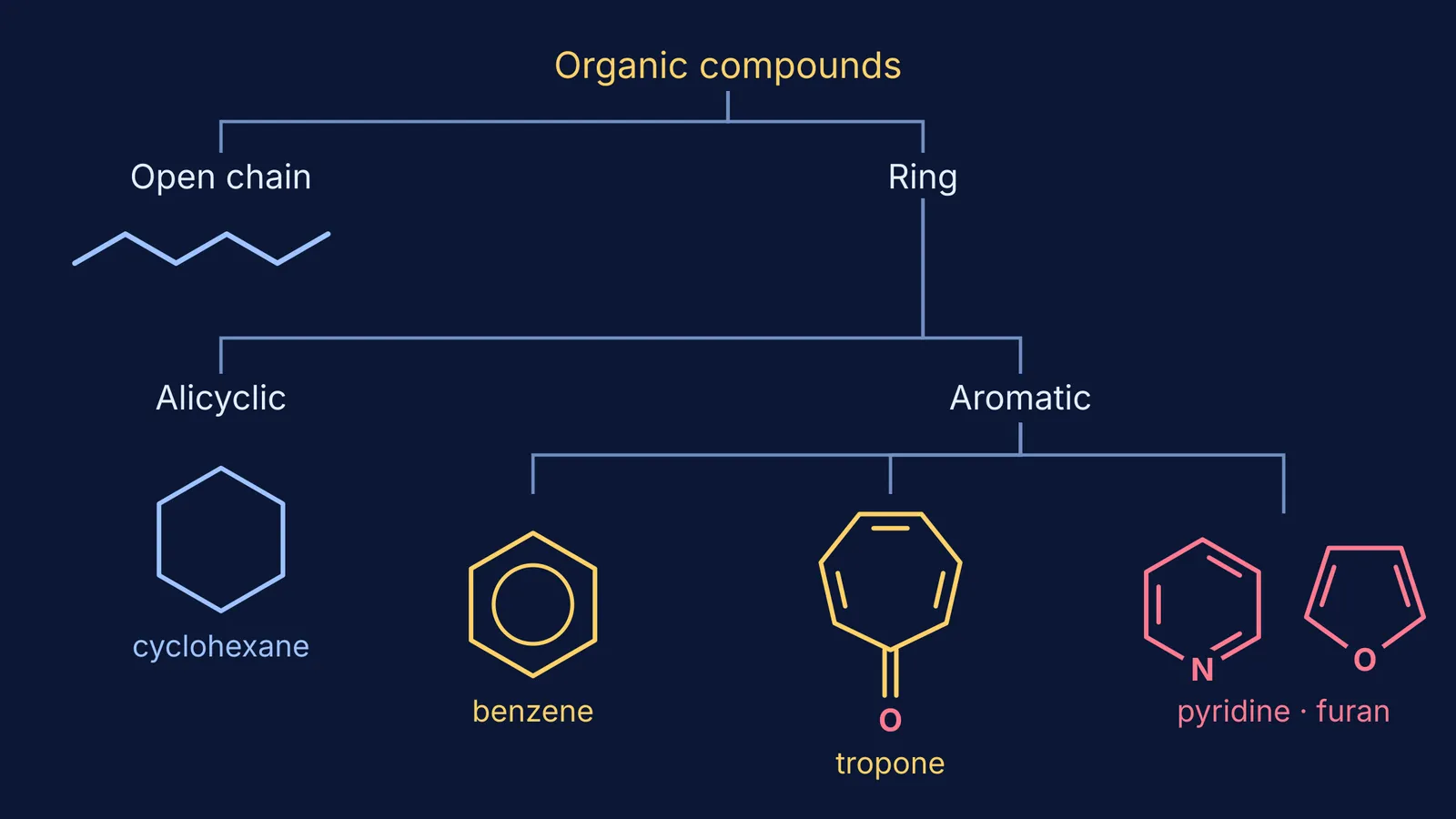
NCERT first splits organic compounds into acyclic (open chain) compounds and cyclic (closed chain, or ring) compounds (NCERT, section 8.4). Ring compounds then split into alicyclic and aromatic. Each of these splits once more:
Acyclic or open chain: straight or branched chains, also called aliphatic compounds. NCERT's examples are ethane, isobutane, acetaldehyde and acetic acid.
Alicyclic, homocyclic (carbocyclic): rings made only of carbon atoms, such as cyclopropane, cyclohexane and cyclohexene.
Alicyclic, heterocyclic (non-aromatic): rings that contain an atom other than carbon but are not aromatic. NCERT's example is tetrahydrofuran.
Aromatic, benzenoid: benzene and related ring compounds, such as aniline and naphthalene.
Aromatic, non-benzenoid: aromatic compounds without a benzene ring. NCERT's example is tropone.
Aromatic, heterocyclic: aromatic rings that contain a heteroatom. NCERT's examples are furan, thiophene and pyridine.
What is the difference between acyclic, alicyclic and aromatic compounds?
The first question is whether the molecule has a ring at all. If it doesn't, it is acyclic, however many branches it has: isobutane has a branch but no ring, so it is open chain.
If there is a ring, the next question is whether that ring is aromatic. NCERT describes alicyclic (aliphatic cyclic) compounds as carbon atoms joined in a ring that behave in some ways like aliphatic compounds (NCERT, section 8.4). Aromatic compounds are what NCERT calls "special types of compounds", covered in detail in the next unit.
To decide whether a ring is aromatic, a standard test is that the molecule is cyclic, planar, fully conjugated and has 4n+2 π electrons (LibreTexts, Aromaticity and the Hückel 4n + 2 rule/15%3A_Benzene_and_Aromaticity/15.03%3A_Aromaticity_and_the_Huckel_4n__2_Rule)). For practice counting π electrons ring by ring, see our guide to predicting aromatic rings with Hückel's rule.
Are furan and pyridine aromatic or heterocyclic?
They are both. This trips people up because "heterocyclic" and "aromatic" answer different questions. Heterocyclic tells you what atoms are in the ring. Aromatic tells you how the ring's electrons behave.
Pyridine (C5H5N, PubChem) has 6 π electrons, one from each ring atom. The nitrogen's lone pair is not part of the π system (LibreTexts/15%3A_Benzene_and_Aromaticity/15.03%3A_Aromaticity_and_the_Huckel_4n__2_Rule)). In furan, the four carbons give 4 π electrons and one oxygen lone pair adds 2, making 6, so furan is aromatic too (same source). That lone-pair difference is also why pyridine is more basic than pyrrole.
Now compare furan with tetrahydrofuran. Both have a five-membered ring with one oxygen. Furan is C4H4O (PubChem) and tetrahydrofuran is C4H8O (PubChem). The four extra hydrogens mean tetrahydrofuran has no ring double bonds, so it has no conjugation and is not aromatic. That is why NCERT lists it as alicyclic and heterocyclic, not aromatic (NCERT, section 8.4).
How do you classify any organic compound in four questions?
Ask these questions in order and stop at the first answer that settles it.
Is there a ring? No: acyclic (open chain). Yes: go on.
Is the ring aromatic (cyclic, planar, fully conjugated, 4n+2 π electrons)? No: alicyclic. Go to question 4 to choose homocyclic or heterocyclic.
If it is aromatic, does it contain a benzene ring? Yes: benzenoid. No: go on.
Is there a heteroatom (O, N, S) in the ring? For an aromatic ring: heterocyclic aromatic if yes, non-benzenoid if no. For an alicyclic ring: heterocyclic (non-aromatic) if yes, homocyclic if no.
Here is the test on five structures you will meet in NCERT:
Acetic acid, CH3COOH: no ring. Acyclic.
Chlorocyclohexane: ring of six carbons, all single bonds, so not aromatic. Alicyclic, homocyclic. The chlorine is a substituent, not a ring atom.
Aniline: benzene ring with an NH2 group. Benzenoid aromatic. The nitrogen sits outside the ring, so it is not heterocyclic.
Tropone: seven-membered ring, no benzene ring, listed by NCERT as aromatic. Non-benzenoid.
Pyridine: six-membered ring with nitrogen inside it, 6 π electrons. Heterocyclic aromatic.
If you can sort these but slip when the structure is unfamiliar, the gap is often aromaticity, not the tree. Work through mixed examples in the Fermi Problem Library, where the step-by-step solver explains the reasoning rather than printing an answer, so you can see which question in the test you got wrong. If a term like conjugation or homologous series is shaky, the Fermi Concept Library gives each concept in chemistry its own lesson.
Once you can classify rings, naming them comes next: start with the IUPAC rules for substituted cycloalkanes.


