

On this page
Class 7 circle sums use two formulas. Marks are lost around them: choosing 22/7 or 3.14, working back from a circumference, and turning wheel revolutions into distance. Here is the method, with worked examples and a self-test.
What are the formulas for circumference and area of a circle?
Pi (π) is defined as the ratio of a circle's circumference to its diameter, and its decimal value starts 3.14159265… (Wolfram MathWorld).
The circumference (the perimeter of a circle) is C = πd = 2πr, and the area is A = πr² (Wolfram MathWorld).
Around 225 BC, Archimedes used a 96-sided polygon to show that π lies between 3 10/71 and 3 1/7 (MathWorld). That upper bound, 3 1/7, is exactly 22/7. So 22/7 (3.142857…) is slightly bigger than π, and 3.14 is slightly smaller. Both are approximations. Neither is "the exact value".
Keep the units apart. Circumference is a length (cm, m). Area is in square units (cm², m²).
Should you use 22/7 or 3.14?
Use this order:
If the question tells you which value to take, use that value, every time.
If the radius or diameter is a multiple of 7 (7, 14, 21, 35, 70…), use 22/7. The 7 cancels and you get a whole number.
If the radius is a decimal or a multiple of 10, use 3.14.
With r = 7 cm, A = 22/7 × 7 × 7 = 154 cm², with no long division. With r = 10 cm, 3.14 gives C = 62.8 cm and A = 314 cm². 22/7 would give C = 62.86 cm: close, but not the key's answer.
How do you find the radius from the circumference?
Rearrange C = 2πr to get r = C ÷ 2π. Then find whatever else is asked.
Example 1. The circumference of a circle is 88 cm. Find its radius and area (π = 22/7).
r = 88 ÷ (2 × 22/7) = 88 × 7 ÷ 44 = 14 cm.
A = 22/7 × 14 × 14 = 22 × 2 × 14 = 616 cm².
Check: 2 × 22/7 × 14 = 88 cm. The circumference matches.
Example 2. A circular park has a circumference of 31.4 m. Find its radius (π = 3.14).
r = 31.4 ÷ (2 × 3.14) = 31.4 ÷ 6.28 = 5 m.
From an area, work backwards in the same way. If A = 154 cm², then r² = 154 × 7 ÷ 22 = 49, so r = 7 cm. A common slip is stopping at r² = 49 and writing 49 as the radius.
How do you solve wheel revolution problems?
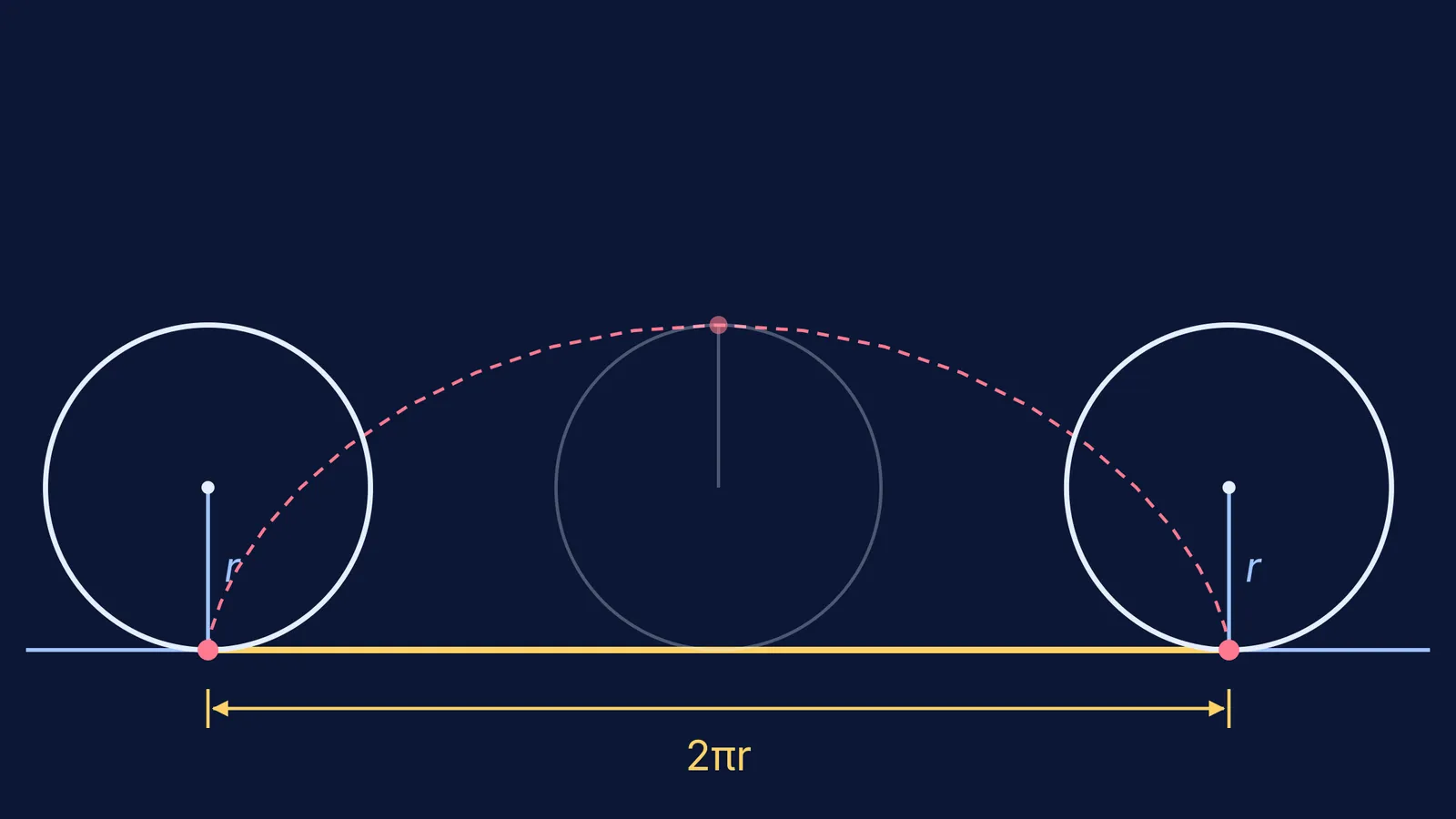
In one full turn, a wheel rolls forward exactly one circumference, as the diagram above shows. So:
distance covered = number of revolutions × 2πr
number of revolutions = distance ÷ circumference
Example 3. A bicycle wheel has a diameter of 70 cm. How many revolutions does it make to cover 1.1 km?
Circumference = πd = 22/7 × 70 = 220 cm.
Convert the distance to the same unit: 1.1 km = 1,100 m = 1,10,000 cm.
Revolutions = 1,10,000 ÷ 220 = 500.
Example 4. A cart wheel makes 250 revolutions and covers 157 m. Find its radius (π = 3.14).
Circumference = 157 ÷ 250 = 0.628 m = 62.8 cm.
r = 62.8 ÷ 6.28 = 10 cm.
If you keep getting stuck, the Fermi Problem Library has worked problems with a step-by-step solver that explains the reasoning, so you can see which line went wrong instead of only comparing final answers.
What mistakes cost marks in circle problems?
Run through this checklist before you write the final answer:
Did you halve the diameter to get the radius before using πr²?
Is the area in square units and the circumference in plain units?
For a semicircle's boundary, did you add the diameter? Its perimeter is πr + 2r, not just πr.
Did you keep fractions until the last line instead of rounding midway?
Does your answer pass a quick estimate? The circumference should be a little more than 3 times the diameter.
Self-test, answers in brackets:
r = 21 cm. Find C and A. (132 cm, 1,386 cm²)
C = 44 m. Find r and A. (7 m, 154 m²)
A wheel of radius 35 cm makes 1,000 revolutions. How far does it go? (2.2 km)
Next, try area of shaded regions with circles and squares and arc length and the area of a sector. For the history, read about Ahmes, the Rhind papyrus and early values of pi. If π still feels like a magic number, the Fermi Concept Library gives each mathematics concept its own lesson.


